
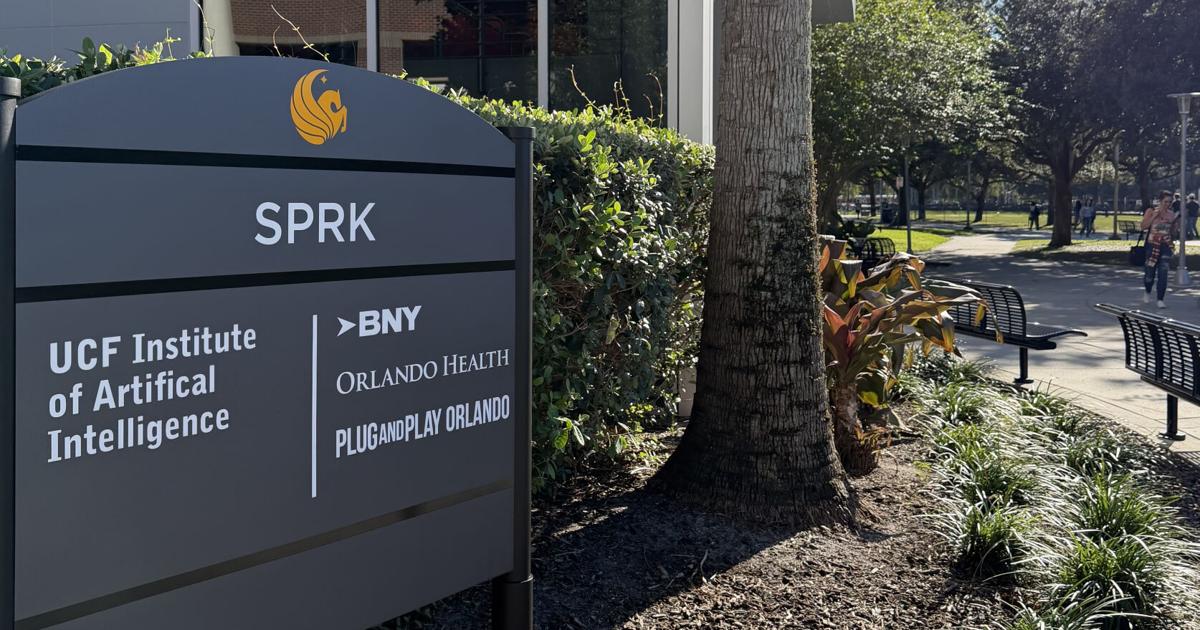

The UCF Global building changes its sign to display “UCF Institute of Artificial Intelligence” after UCF Global offices moved to the third floor of the College of Sciences Building in March.
Rachel Jones
Florida legislators passed a bill in July that effectively eliminates tax breaks on supercomputer equipment and technology for supercomputers if they do not have a 100-megawatt power capacity, making it less ideal to invest in data centers.
UCF is exploring funding sources for a local supercomputer in order to provide support for t…
But UCF’s AI growth and intentions to bring in major AI investors, like Google, Meta and Amazon to Central Florida, along with its interest in funding for a local supercomputer, imply a greater impact than expense for the university.
The Sunrise Movement is a national organization that seeks to combat climate change through legislation. UCF and the city of Orlando have Sunrise chapters with active young environmentalists advocating for a more sustainable future.
UCF Sunrise member Mason Rhody, a senior majoring in environmental science with a Geographic Information System Certification, rejects the need for Orlando to be the next Silicon Valley.
“AI majorly increases the energy being used by a given area and UCF should not be contributing to the use of energy consumption, especially when we should be transitioning away from energy dense fuels,” Rhody said. “We need to be transitioning away from fossil fuels.”
Rhody referred to the Climate Action Plan UCF proposed in 2010 that promises lowered fossil fuel consumption and climate neutrality by 2050. Rhody said that the increased dependency on AI data centers would violate his understanding of what UCF committed itself to in the plan.
“UCF does not need to be inviting in companies that are not climate-friendly and that do not line up with those goals in the Climate Action Plan,” Rhody said.
The Charge reached out to UCF’s Institute of AI to comment on how it plans to adhere to the university’s climate action plan, but nothing was provided for over a week before publication.
UCF Sunrise’s upcoming resolution proposal cites the university’s recent preeminent status achievement as giving UCF the opportunity to remove itself further from environmentally harmful companies, since research programs receive more state funding under preeminence, Rhody said.
Ramón Pereira Bonilla, the Orlando Sunrise Co-Facilitator of the Direct-Action Team, made his argument against data centers and the rise of AI technologies relatable to the average person.
“While I care about the way data centers are driving up our water consumption, the devastating impact it has on our wildlife and on our environment, I am also very interested in the effects it has on working families’ pocketbooks,” Pereira Bonilla said. “Not just working families, but anyone who relies on energy companies for their power.”
Pereira Bonilla said he is worried by watching communities across the country experiencing financial strain from the rise of data centers and hopes that Orlando can use that to motivate action and organization against abundant data center growth.
According to The Harvard Business Review, growing AI demand is set to drive data center energy consumption to about 6% of the nation’s total electricity usage in 2026, adding “further pressure on grid infrastructures.”
Dr. Richard Plate, UCF associate professor and program coordinator of sustainability and environmental science, denied sufficient knowledge of the UCF’s Institute of AI, but provided commentary on the concern around water and energy demands of AI technology.
“For those of us most concerned with these aspects of AI, I think the best response is not to resist AI entirely, which strikes me as quixotic, but rather to engage with it in a way that helps draw focus to these concerns,” Plate said.