
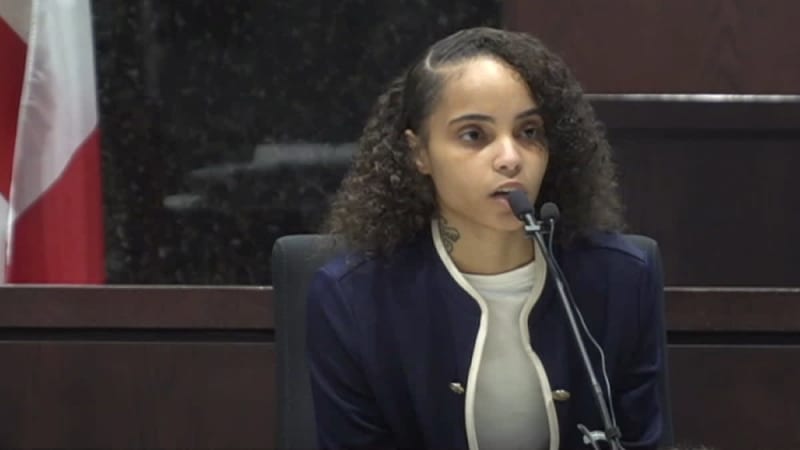
A Tampa jury on Friday found a woman guilty of manslaughter for her role in the brazen execution of a rapper whose death publicly exposed Jacksonville’s gang war.
Prosecutors sought to convict AliciaAndrews, 22, on charges of first-degree murder and conspiracy to commit first-degree murder in the shooting of Julio Foolio, which would have meant a life sentence. Instead, jurors found her guilty of the lesser charge of manslaughter, which carries a sentence of up to 15 years in prison.
The jury deliberated for just over three hours before delivering the verdict.
While Andrews did not pull the trigger in the shooting, she was charged as a “principal” in the crime, an element of Florida law that allows an accomplice to be charged as though they committed the act themselves. The state’s burden was to prove that Andrews aided and abetted in the rapper’s murder.
Foolio, whose real name was Charles Jones, was a key figure in Jacksonville’s “drill rap” scene, with popular music videos and a large social media following. Jones had come to Tampa for the weekendwith a group of friends to celebrate his 26th birthday and perform at a venue.
The coordinated shooting on June 23, 2024, brought the violence of Jacksonville’s longtime gang conflicts to the streets of Tampa.
Footage captured a trio of masked gunmen converging on Jones as he sat in the passenger seat of his Dodge Charger outside of the Home2 Suites hotel near the University of South Florida.
A barrage of rounds from two rifles and a modified fully automatic pistol struck the windshield of the car. Jones tried to dive into the back seat but was killed.
Two people in the car with Jones were wounded. The footage shows the driver take off straight ahead into more gunfire in an attempt to flee. The car turned the corner, hopped a curb and came to a halt in the parking lot of the Holiday Inn nearby.
The three shooters quickly made their way into a black Chevrolet Impala and took off.
Prosecutors argued that Andrews and her boyfriend, 22-year-old Isaiah Chance, stalked Jones throughout the night, relaying information in real time leading up to the killing.
Jones and his entourage first visited Teasers, a strip club on North Nebraska Avenue, where he had a planned performance that was advertised on social media. They then went to an after-party at Truth 18 night club on East Busch Boulevard.
Chance and Andrews could be seen on security footage pulling into the parking lots of both locations in a silver Chevrolet Cruze. The couple walked in the parking lots wearing COVID masks. Andrews could be seen unlocking her phone so Chance could use it to communicate with the shooters, prosecutors said.
This ultimately led to the Home2 Suites, where the Cruze was seen making two passes by Jones’ car. The shooters, staged in the Impala out of Jones’ line of sight, began their attack shortly after Chance and Andrews left the parking lot.
Andrews’trial saw testimony from a slew of detectives, firearms experts and digital forensics analysts. Detectives from the Jacksonville Sheriff’s Office’s gang unit outlined the particulars of the city’s gang problem.
Jones was considered the most prominent member of “6 Block,” a gang that has engaged in a yearslong conflict with two allied gangs known as “1200″ and “ATK,” the latter an acronym for “Ace’s Top Killers.” Jacksonville police have attributed dozens of murders in that city to the ongoing war.
Drill rap music videos by Jones and Jacksonville rival Yungeen Ace, whompolice described as the most well-known member of ATK, were played in court for the jury. References to the retaliatory shootings, including a previous attempt on Jones’ life, dominate the music.
Prosecutors alleged in closing arguments that Andrews played a role in the conspiracy to kill Jones. Assistant State Attorney Michelle Doherty argued that Andrews tangibly helped by trying to book an Airbnb for the defendants and providing her phone for Chance to communicate with the shooters.
The state also said Andrews provided Chance “cover” by walking with him as a companion outside of the venues that night, making their movements less suspicious.
“They hunted him, they stalked him, they found him, they targeted him and they gunned him down,” Doherty said.
Andrews’ attorneys said she was simply tagging along with her controlling boyfriend for a weekend trip to Tampa.
Andrews, who took the stand on Friday, described an abusive relationship with Chance. She told the jury that Chance was jealous and possessive, leading to domestic violence. Pictures from her phone showed bruises to her face thatshe said were the result of arguments with Chance.
“It’s kind of like he was manipulating me,” Andrews said. “It’s not that easy to leave.”
Defense attorney Jeremy McLymont argued that the state’s case lacked evidence that Andrews was aware of a plot to kill Jones or was affiliated with any Jacksonville gangs.
“She is not a gang member,” McLymont said. “She is not a gang associate.”
From the beginning, McLymont told the jury, law enforcement saw her as “cold and heartless.” He also emphasized that Andrews testified because she had nothing to hide.
“You need to throw this case away,” McLymont said.
Andrews’ sentencing is scheduled for Dec. 8.
Chance and the three men charged with shooting Jones — Rashad Murphy, 31; Davion Murphy, 28; and Sean Gathright, 20 — are set to face trial April 8.