
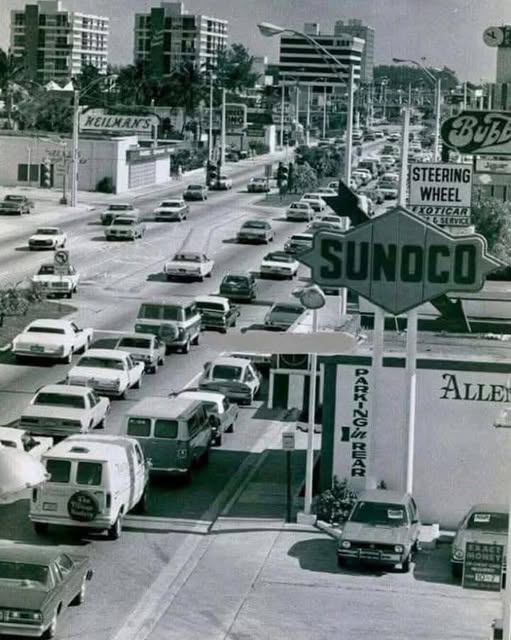
Fifty years ago this weekend, America celebrated its 200th birthday.
Our “long national nightmare” of Watergate was over, so we were told. The accidental president, Gerald Ford, was in the White House. The bicentennial was an obvious time to take stock of things — and to speculate what life might be like 50 years later.
Mike Stocker/Sun Sentinel
Steve Bousquet is Opinion Editor of the Sun Sentinel. He first moved to Broward County in 1981.
Well, here we are.
The July 4, 1976 edition of the Fort Lauderdale News/Sun Sentinel (as the combined weekend papers were known back then) was chock full of futuristic stuff.
The stories were sandwiched around page after page of bicentennial-themed ads by the leading retailers of the day: Burdines, Levitz Furniture, Lionel Play World, Luke Bolton Ford, Modernage, Pantry Pride, and Jeffersons, where the fad of the moment, a deluxe 23-channel CB radio, could be yours for $99.
Breaker, breaker 1-9: They’re all long gone.
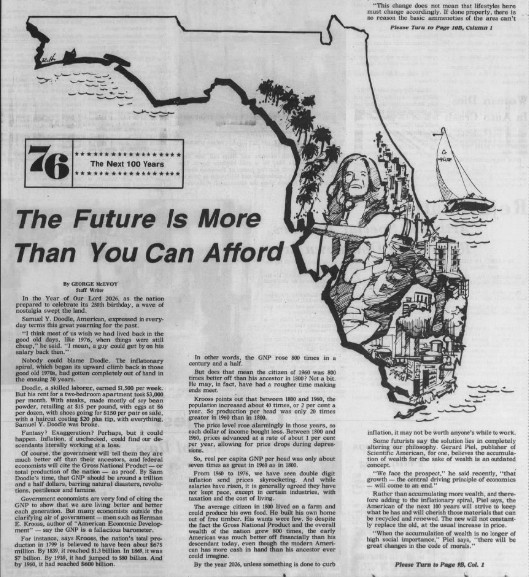 A futuristic 1976 article in the Fort Lauderdale News foresaw today’s housing affordability crisis (newspapers.com)
One particular headline in that crystal ball edition jumped off the page.
“The future is more than you can afford,” it said.
Staff writer George McEvoy predicted that by 2026, a two-bedroom apartment would rent for $3,000 a month in Broward.
No wonder that people in 2026 would be so nostalgic, craving a much simpler and less expensive time, he wrote. Gone were the days when “a guy could get by on his salary.”
“The inflationary spiral, which began its uphill climb back in those good old 1970s, had gotten completely out of hand in the ensuing 50 years,” McEvoy wrote.
Well, here we are.
In Broward, one of the least affordable metropolitan areas in the U.S., the average monthly rent is now $2,109 for an efficiency and $3,298 for a three-bedroom apartment. The place is increasingly unaffordable, and it’s getting worse, as is life in many places.
Nearly half of all Broward households spend more than 30% of their income on housing, making them “cost-burdened” — a term that did not yet exist in 1976. In 2026, the housing affordability crisis defies solutions, yet people saw it coming 50 years ago.
In that July 4 edition, a new one-bedroom condo sold for $19,900 at the brand-new Laurels of Margate. The same drab little unit, with dated-looking jalousie windows, can be had today for $115,000.
You can peruse all 178 pages of that futuristic Sunday edition and you won’t find a single mention of artifical intelligence, iPhones, iPads, drones, driverless cars or hyperscale data centers.
Not one word about Alexa, Android, chatbots, Kindle, satellite radio, Siri or Flock cameras.
(The just-approved new state budget had more than $150,000 for Fort Lauderdale and Plantation to buy the electronic spying gadgets also known as license plate readers, but Gov. Ron DeSantis vetoed the money).
Some fanciful pundits in those pie-in-the-sky stories of 1976 predicted that, by 2026, local property taxes in Florida would no longer exist.
It’s a mystery how they would have seen that coming, and it has not happened yet, but Florida is heading in that direction — subject to the approval of voters.
The mayor of Fort Lauderdale in 1976, E. Clay Shaw, made the outlandish prediction that in 50 years, nifty “two-way television” would allow people and the government to talk to each other.
Well, not exactly — not yet, anyway — but a Zoom call is what the mayor was describing. Not only that, but government meetings are just clicks away on your cell phone or laptop, an advance that was hastened by the COVID-19 pandemic.
Shaw also presciently predicted a future in which “voting will take place in the home by electronic means.”
If you take away the electronic part, which if course does not exist, that sounds like voting by mail, which President Donald Trump wants to greatly restrict, calling it “mail-in cheating” which it is not.
I looked and looked through those 1976 papers for a bold prediction that in the next 50 years, the American people would twice elect as their president a self-absorbed former reality TV show host who was woefully unqualified for the job.
I couldn’t find it anywhere.
Steve Bousquet is Opinion Editor of the Sun Sentinel and a columnist in Tallahassee and Fort Lauderdale. Contact him at sbousquet@sunsentinel.com or (850) 567-2240.