
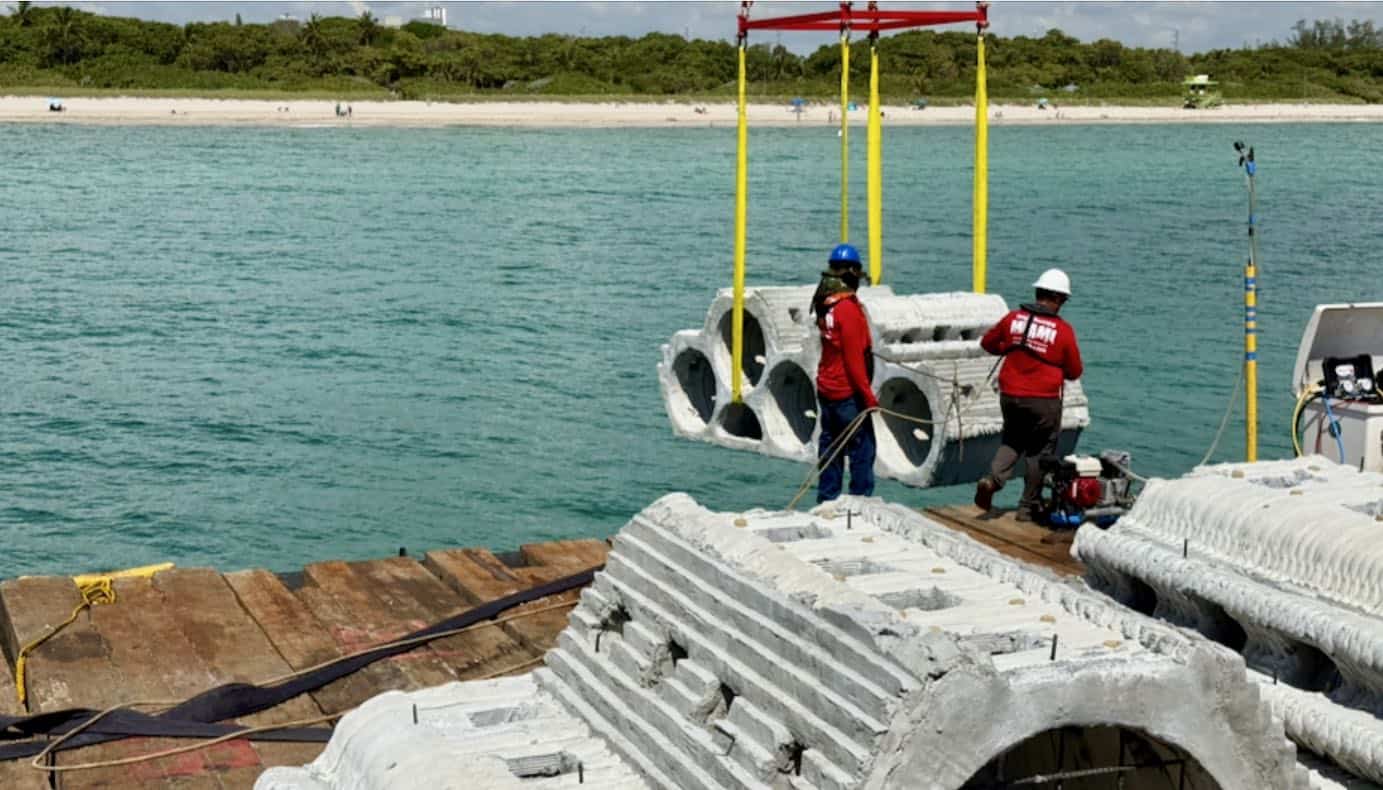
Researchers have expanded an offshore reef restoration and coastal resilience project off Miami Beach with the deployment of three 3D-printed SEAHIVE clustered structures.
Coinciding with National Ocean Month, the second phase of the Engineering Coastal Resilience Through Hybrid Reef Restoration (ECoREEF) project advances an offshore living laboratory designed to study how engineered reef structures can be combined with active restoration of stony corals to produce self-building and self-repairing hybrid reefs that dissipate wave energy, reduce coastal flooding, and create new marine habitat.
Initiated by a seed grant from the University of Miami Laboratory for Integrative Knowledge (U-LINK), ECoREEF represents nearly a decade of interdisciplinary collaboration among engineers, marine scientists and coral restoration practitioners. Unlike traditional artificial reefs, ECoREEFs are deployed in shallow water near vulnerable shorelines and include stony corals that have been specifically produced to thrive in these tough, wave-impacted environments.
Researchers from the University of Miami Rosenstiel School of Marine, Atmospheric and Earth Science and collaborators have used a variety of approaches to solve the challenge of producing stress-resistant corals, including using baby corals provided with special heat-tolerant symbionts, unusual corals that are hybrids of staghorn and elkhorn coral that do well in these difficult conditions, and resilient corals rescued from seawalls and other nearby construction projects.
Andrew Baker, professor in the Department of Marine Biology and Ecology and director of the Coral Reef Futures Lab at the Rosenstiel School said:
“The ECoREEF structures are a great opportunity to develop and test new approaches to producing the kinds of hardy corals we need to restore reefs in the 21st century. At the same time, they also give corals a head start building offshore structures to protect our coastlines – a real win-win for the marine environment and for our coastal defenses.”
Before the first offshore deployment in 2023, researchers conducted extensive experiments in the Rosenstiel School’s SUrge–STructure–Atmosphere INteraction (SUSTAIN) Laboratory to optimize performance under varying wind, wave, and water conditions. More recent testing, the findings of which have been published in the Coastal Engineering Journal, found that the SEAHIVE system’s porous, modular design improved wave attenuation compared with solid structures of similar size, with larger configurations further reducing wave transmission.
Landolf Rhode-Barbarigos, associate professor at the University of Miami College of Engineering and the associate director of the University of Miami Climate Resilience Institute said:
“Every aspect of the structure’s physics was informed by engineering analysis and physical testing. The goal is not only to create habitat for corals and marine life, but also to understand how hybrid reef systems can advance solutions to reduce wave energy and protect vulnerable coastlines.”
Testing at the SUSTAIN lab in 2021 found that adding staghorn corals to SEAHIVE structures enhanced wave dissipation compared with the structures alone. Under the shallowest conditions tested, the hybrid reef model dissipated up to 98 percent of incoming wave energy, with corals accounting for as much as 56 percent of the total reduction. The findings were published in the Journal of Marine Science and Engineering.
The second-phase deployment incorporates three concrete SEAHIVE structures produced by 1Print, a University of Miami licensee specializing in advanced 3D-printed infrastructure solutions. The company manufactured the structures using proprietary concrete-printing technology designed to support resilient coastal and marine infrastructure.
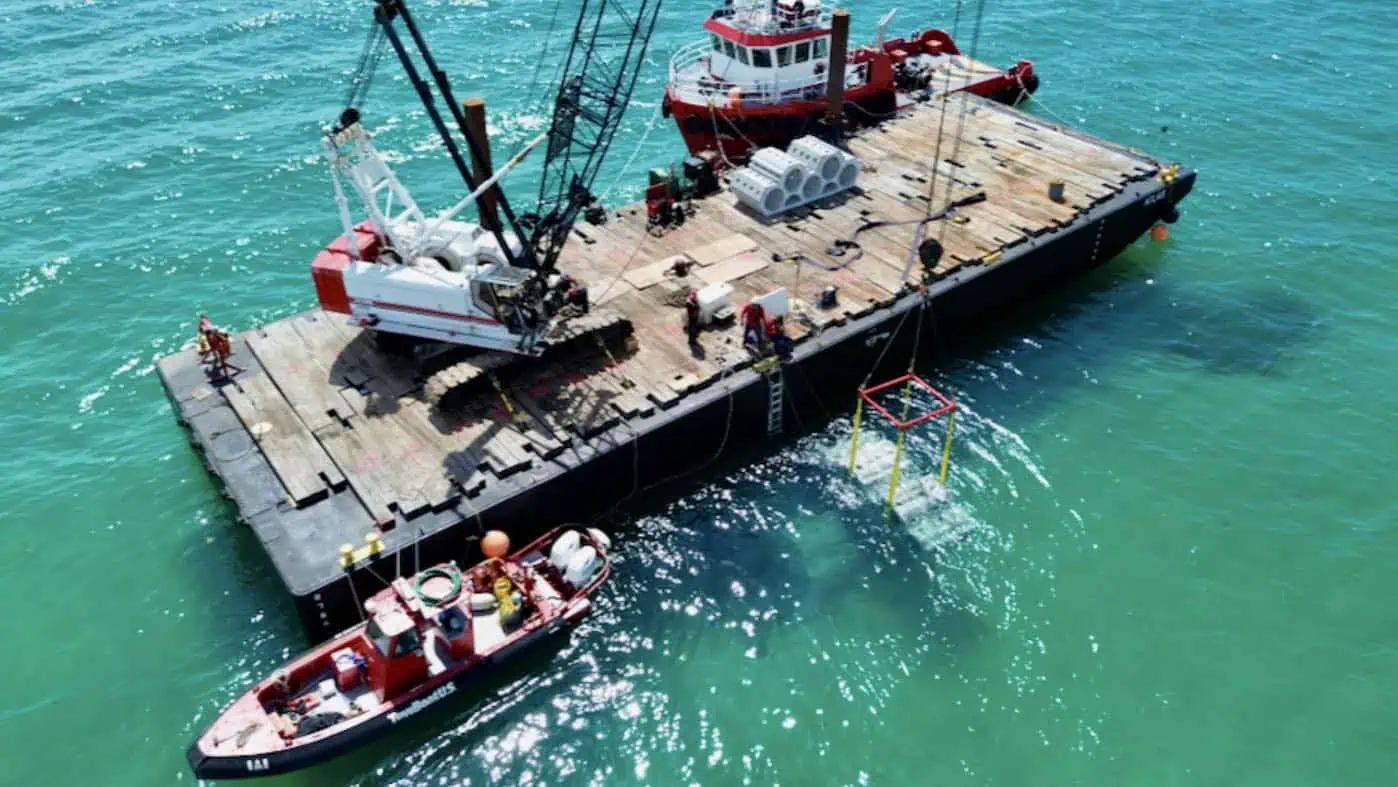 Barge deploys 3D printed SEAHIVE structures (Image credit: 1Print)