
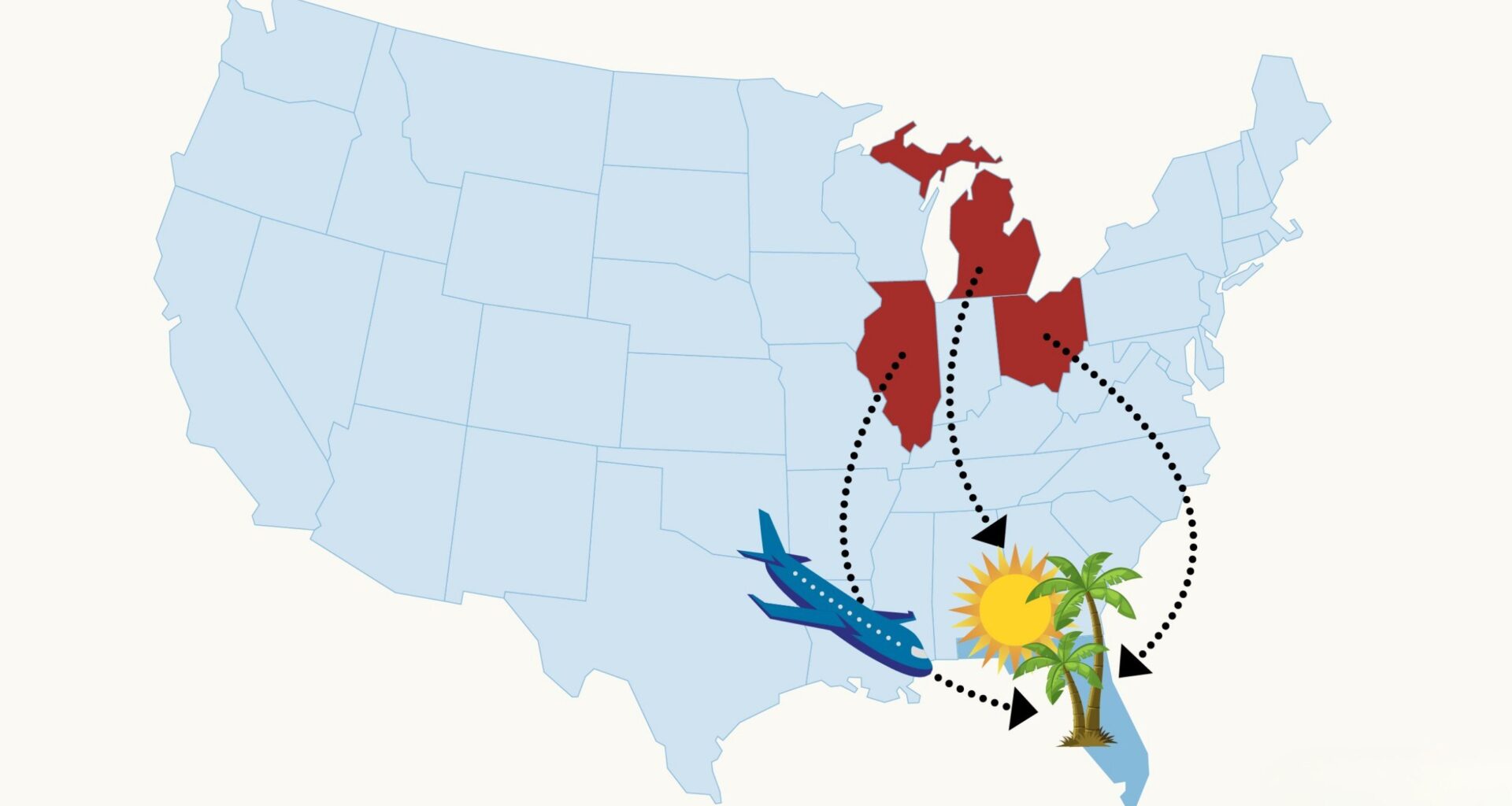
Midwesterners are streaming to Sarasota County, FL, for a permanent “toes in the sand” lifestyle after the area was recently named one of the nation’s 10 best beach towns.
Sarasota County’s population surged 12.4% in the five years through April 2025, according to Florida‘s Bureau of Economic and Business Research (BEBR). Migration from the Midwest was a key driver of that growth, local experts say.
“People from the Midwest favor this side of Florida because there’s a pattern of generational traveling for decades,” says Amanda Bray, an agent with Oasis Group. “A lot of people who move here, their parents had a home here, or their grandparents had a home here. So there’s that pattern that has passed down among the generations.”
Bray also points out that Sarasota offers extensive nonstop air service from major Midwestern cities, including Chicago, Indianapolis, and Minneapolis, to the Gulf Coast airports. This accessibility makes travel effortless, turning seasonal snowbirds into permanent residents later in life.
Michigan had an estimated 1,585 people relocating to Sarasota County from 2018 to 2022, according to the U.S. Census Bureau data. Illinois followed closely with 1,399 transplants, and Ohio came in third with 1,282.
As of April 1, 2025, the Bureau of Economic and Business Research reported that Sarasota County’s population reached 487,640.MJ Kerr / Adobe Stock
“The Gulf Coast is especially popular with Midwest residents and retirees who can drive straight down I-75 to get there,” Realtor.com® senior economist Hannah Jones notes.
The migration trend accelerated after the COVID-19 pandemic, as Florida was among the first states to lift restrictions.
“During COVID, there was an influx of people, because Florida also was one of those states that opened. So a lot of people wanted to get out of the North and come down here, and then they fell in love with it here,” Bray explains.
As a result, Sarasota’s business and real estate landscape transformed from a highly seasonal market into a balanced, full-time economy.
However, the sudden influx initially strained the area’s real estate market. Ultralow mortgage rates contributed to the frantic market conditions, characterized by waived inspections, escalation clauses, and multiple offers on a single day.
Fortunately, the market has since stabilized.
“We have improved inventory, more accurate pricing, that multiple-offer situation has gone, so prices are stabilizing. There’s more choices for buyers that we didn’t have in the last four years, and then also we have a continued demand for luxury homes,” Bray explains.
The demographic makeup of Sarasota has shifted as well. Before the COVID-19 pandemic, the population consisted mostly of retirees and seasonal snowbirds. The post-pandemic era brought a balance of families, entrepreneurs, and remote workers, who flocked to the area.
The migration to Sarasota County accelerated after the COVID-19 pandemic, as Florida was among the first states to lift restrictions. Realtor.comMost retirees and families moving to Sarasota are looking for homes priced between $800,000 and $1.4 million.Realtor.com
Still, older residents make up the majority of the community. As of 2023, 36.6% of Sarasota’s population is aged 65 or older, and 24.8% are aged 45 to 64, according to the BEBR.
Bray notes that today’s buyers are looking for “homes that are one story, open spaces, easy to clean, easy to maintain.” Additionally, buyers are seeking neighborhoods with robust amenities, including pools, gyms, and clubhouses.
Budget preferences tend to vary by buyer type. Most retirees and families target homes priced between $800,000 and $1.4 million.
Snowbirds often target the $400,000–$700,000 price range, specifically seeking “maintenance-free villas” where bushes are trimmed and lawns are mowed for them year-round.
While driver’s license exchanges from the Midwest saw a slight dip in 2025 compared to pre-pandemic averages—with Illinois dropping 6%, Ohio dropping 21%, and Michigan dropping 31%—the county’s overall growth remains strong.
According to the BEBR, Sarasota’s population growth was driven entirely by net migration, recording a net influx of 72,493 people between 2020 and 2025. This brought the population up from 434,004 in 2020, which is an increase of 53,634 over five years.
2022–23 IRS county-to-county flow data shows that roughly 5,300 people moved from Midwest counties to Sarasota County, representing about 17.5% of all incoming residents. This makes the Midwest the second-largest source of new residents behind the Northeast.
Furthermore, Cook County, IL, ranks sixth among all counties nationwide for home shoppers viewing listings in Sarasota, accounting for 3.4% of total viewers.
According to the BEBR, Sarasota’s population growth was driven entirely by net migration, recording a net influx of 72,493 people between 2020 and 2025.bilanol / Adobe StockSnowbirds often target the $400,000–$700,000 price range, specifically seeking “maintenance-free villas.”Realtor.com
This demand persists despite the rising real estate prices.
In May 2026, the median listing price in Sarasota was $487,000, almost $100,000 more than in May 2019, when it was $359,900. Similarly, the median sale price sits at $428,600 in March 2026, compared to $260,000 in March 2019.
However, despite these steep price increases, Midwesterners are still choosing Sarasota County over more affordable nearby metros like Tampa, FL, with a median listing price of $400,000 as of May 2026, and Cape Coral, FL, with a median listing price of $399,000 as of May 2026.
Sarasota’s unique charm justifies the premium price tag for many buyers.
“Sarasota sells itself as sophisticated without being intimidating,” Jones explains. “You get real arts and culture, minus the velocity of Miami or Fort Lauderdale.”
Siesta Key, FL, in particular, has become a hot spot for those looking to balance vibrant city activities with a relaxed, coastal lifestyle.
“In one day, you can spend the morning at the beach, then you could go to have lunch overlooking the bay. In the afternoon, you could visit an art museum or a botanical garden, and then in the evening, you could go see a Broadway show, ballet, or opera, and then have fine dining. They have everything that you need within this small area,” Bray says. “You get the best of both worlds.”