
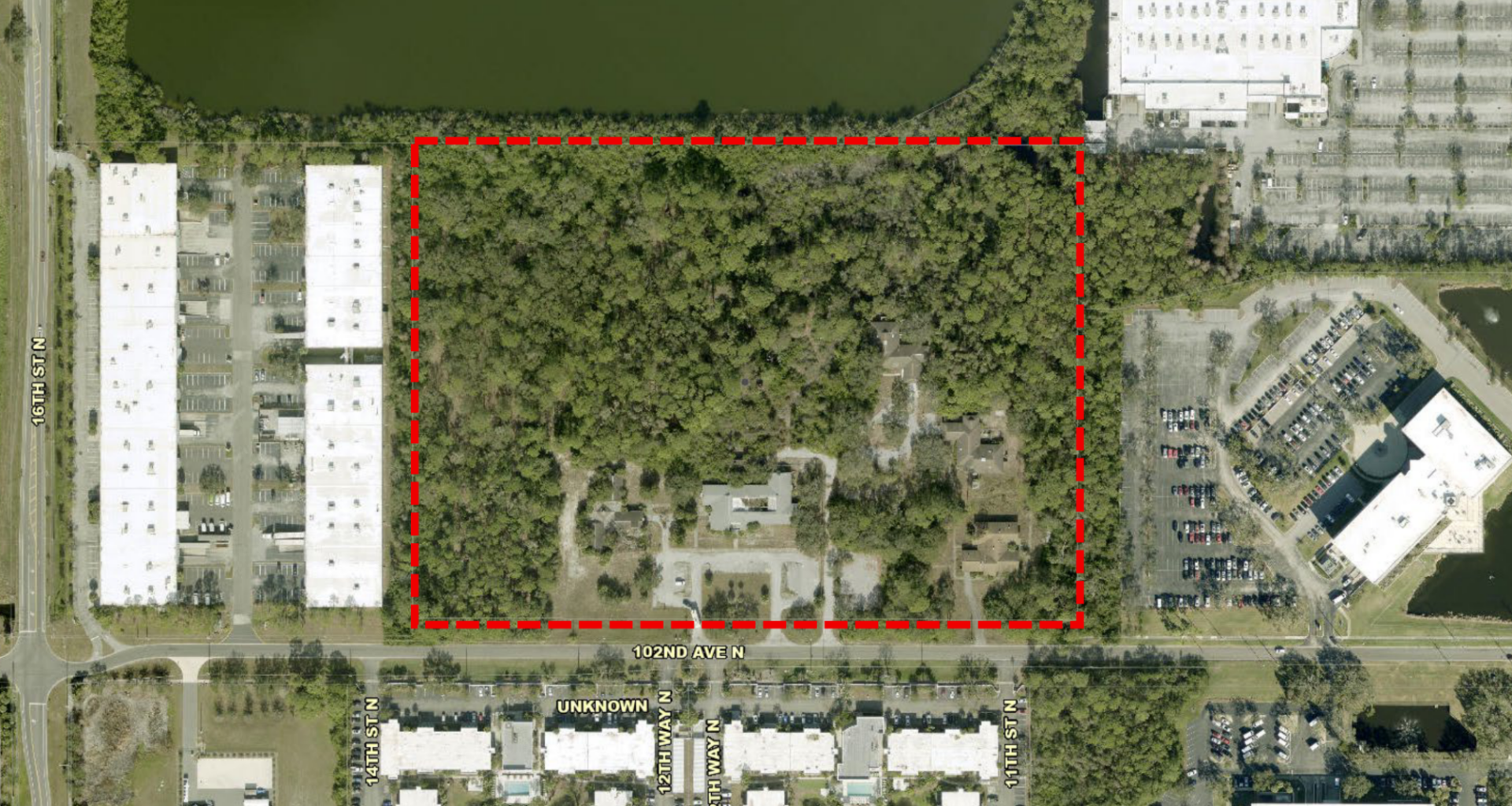
St. Petersburg commissioners hit pause on a proposed warehouse development last week after questioning whether a developer had done enough to justify removing all of the site’s largest protected trees, sending the project back for redesign rather than granting a sweeping variance from the city’s tree preservation rules.
The Development Review Commission unanimously voted July 1 to continue review of plans for two warehouse-light industrial buildings totaling nearly 296,000 square feet at 120110 2nd Ave. N.
While city planning staff recommended approval, commissioners repeatedly questioned whether the proposal struck the right balance between redevelopment and preserving the site’s existing tree canopy.
The central question before commissioners wasn’t whether the warehouses belonged on the site, but whether the developer had shown that removing every protected tree was necessary to build them.
The proposal would replace a largely wooded former state institutional campus with the two buildings, along with 328 parking spaces and stormwater ponds. Asked whether tenants had been secured for the buildings, Pierce Haggard, a development manager with McCraney Property Company, said the developer was in discussions with two local St. Petersburg companies but had not signed any leases.
Under St. Petersburg’s tree preservation ordinance, developers are generally required to preserve at least 25% of a site’s largest healthy shade trees. Planning staff determined the 20-acre property contains 263 such trees. A tree inventory prepared by consulting arborist Dark Moss identified more than 1,300 trees overall, including several “grand trees” measuring more than 30 inches in trunk diameter.
The inventory found a mix of native species, including laurel oaks, southern live oaks, cabbage palms, bald cypress and red maples, many of which qualify for protection under the city’s tree ordinance because of their size and condition. It also identified invasive species, including queen palms, weeping bottlebrush and Chinese tallow trees.
Rather than meeting that preservation requirement, the developer requested a variance that would allow all of those protected trees to be removed.
Planning staff said the mature trees are scattered throughout the property rather than concentrated in one area. The developer argued the warehouse layout, truck circulation, updated stormwater requirements, floodplain regulations and the need to place three to five feet of fill across much of the site made preserving those trees impractical.
Several commissioners questioned whether the project had been designed around the existing trees or around maximizing the site’s development potential.
“I have a hard time reconciling the 100% variance here,” Commissioner Sarah Jane Vatelot said. “[I] have a hard time … imagining that there are no trees that could be preserved “
Vatelot questioned whether the buildings and site layout had been designed around the existing trees or simply maximized the amount of developable square footage.
“I don’t like the notion that … it’s this, or it’s just nothing,” she said.
Commissioner Sam Blatt said he also struggled with granting what he viewed as an unusually broad exception to the city’s tree preservation ordinance, particularly for a speculative warehouse project without committed tenants.
“I don’t know if I can get behind a 100% tree variance for this project,” Blatt said. “Especially when we’re talking about spec development. I get that it’s a small site. They’re trying to maximize the value of their property, but 100% is a lot.”
Blatt said commissioners were effectively being asked to trust the developer that more trees would ultimately be preserved than the variance requested.
“They seem like they want to maintain some trees,” he said. “But they want us to take their word for it.”
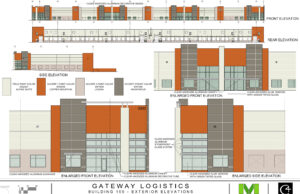
A conceptual rendering shows one of the two warehouse-light industrial buildings proposed for a 20-acre site at 1201 102nd Ave. N. Image: McCraney Property Company/City of St. Petersburg.
Commissioner Michael Kiernan said he was similarly uneasy with the applicant’s explanation that requesting a complete variance simply provided flexibility during the design process.
“When I heard … the stated reason was, ‘Well, we want to buffer just to kind of hedge our bets,’ that was, I have to say, troubling,” Kiernan said.
He also noted that many trees on the property were in poor condition, but said that did little to resolve his concerns.
“I am also struck by the number of trees that are not worth saving. They’re not protected, per se, so I struggle with this.”
Not everyone agreed.
Commissioner Kevin Reali argued the variance reflected the practical realities of redeveloping flood-prone industrial land and urged the board to weigh the loss of mature trees against the public benefit of creating employment-generating uses.
“I think there’s a balance here,” Reali said. “We also want these types of uses in the city, and this is the right place for it.”
Reali said modern floodplain regulations requiring the site to be elevated several feet left little opportunity to preserve existing trees.
“We almost can’t have it both ways,” he said. “If we have the coastal high hazard and we have to bring in fill to elevate the property, you by definition can’t sort of keep what’s on the existing surface.”
Rather than proceed to a vote, the development team asked commissioners for additional time to revise the proposal.
“We would ask that this be continued so that we can present this a little further and see if we can’t come back with a variance that’s not 100%,” project engineer Andrew Eiland said.