
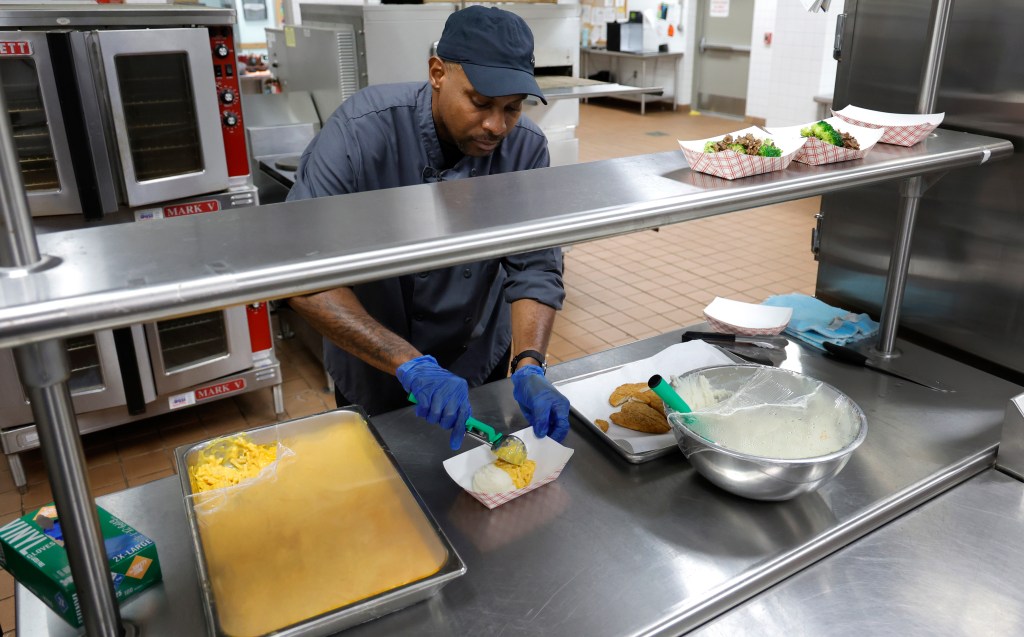
Broward school lunch prices, once known to be reliably rock-bottom, are increasing for a second year in a row.
Elementary school lunches will increase from $3 to $4 for the 2026-27 school year, middle school prices will go up from $3.35 to $4.35, and high school prices will increase from $3.50 to $4.50, according to recent action taken by the School Board. Reduced-priced meals will remain at 40 cents.
Breakfast will be available for free to all students, continuing a longstanding practice in the district.
Lunch will still be free for all students in the district’s 141 lowest-income schools, without the need for parents to fill out an application, due to a federal program. The list of schools participating is on the district’s website.
Families at a school that charges for lunch would have to fill out an application in order to qualify for free or reduced-price lunches.
For most years since 2012, the prices were about half what they’ll be this school year: $2 for elementary, $2.35 for middle and $2.50 for high school students. Then, during the pandemic, meals became free for all students, regardless of income. The district ended that practice last year due to the depletion of federal COVID-19 dollars.
But while students who didn’t qualify for free and reduced lunch were supposed to pay, many didn’t, officials said. Schools allowed students to have the charge added to their student account. Many of those bills never got paid.
“Students were of the mindset that it doesn’t matter. It’s free for me,” Valerie Wanza, chief of strategy and innovation, told the School Board at a June 16 workshop.
Mikyle J. Sukoo, a Fort Lauderdale High student who is one of the student representatives of the School Board, said at the workshop that the district must launch a clear communication plan to help families adjust to the change. He said many families who would qualify for free or reduced lunch don’t fill out the application.
“Many of them just think meals are still free for everyone. Some of them assume they won’t qualify. Others don’t understand that the application affects school funding, and a lot of families have never seen the emails or the robocalls that have been sent out,” he said.
The School Board agreed in April to write off outstanding debt for student meal obligations, totaling $720,433, for the 2025-26 school year.
But district officials plan to be more aggressive in trying to collect this year.
The district requested a review from the Council of Great City Schools, a national organization that works with large districts, on ways to improve the food services department and budget. The organization said the district needs more revenue and recommended increasing prices, among other strategies.
Even if all students paid for the meals they received, the district would still be losing money if prices remained the same, Ray Hart, executive director of the Council of Great City Schools, told the School Board at the June 16 workshop.
“The district is already [collecting money] well below the actual cost of the meals and the cost of the services, and so by not increasing the meal price again, that has budgetary implications,” he said. “So now the district is going to have to cover that additional meal cost for the entire year for the number of students that are paying for meals.”
Some board members were reluctant to increase meal prices.
Board member Rebecca Thompson said she has talked to high school students recently who “have said their friends don’t eat because the current prices are too much.”
She said the burden for dealing with the food service budget shouldn’t fall on families.
“We have found money for other things that is not as important as feeding children,” she said.
Some others reluctantly approved the change.
“I’m not sure how I feel about meal price increases but, you know everything’s increasing,” Board member Debbi Hixon said at the June 16 workshop.
Board member Maura Bulman added, “I’ll support that if we’re operating at a deficit. I don’t know that we have a lot of options there unless we have some guaranteed way to pay the debt a different way, and I’m not hearing anything right now.”
The board voted without discussion at a June 23 meeting to approve the price increases.