
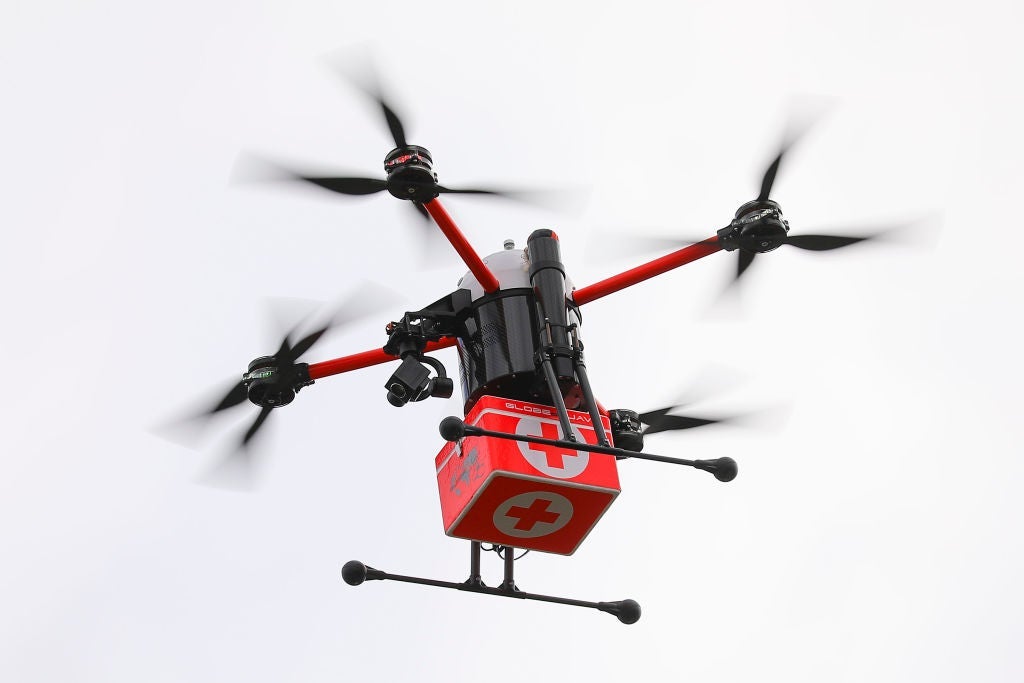
BayCare Health System will launch Tampa Bay’s first healthcare drone service in late 2027. The nonprofit plans to fly medications, lab samples, and critical supplies across the region. On Wednesday, BayCare announced its partnership with Zipline to begin operations in Pinellas County before moving into Hillsborough.
The flying service will transport lab samples from urgent care centers, emergency rooms, and home care patients to hospital labs. Patients can receive prescriptions at their homes. If a provider needs an acute medical intervention, a drone can deliver supplies and medications to a patient’s location within minutes.
The Clearwater-based healthcare network will join a small group of health systems nationwide that have announced drone-based medical logistics programs. Mayo Clinic in Jacksonville has one. BayCare operates 16 hospitals across the Tampa area.
Here’s how it works. A provider places an order into a Zipline drop box at a designated facility. A drone picks up a pod, flies to the destination, lowers the pod on a tether from up to 300 feet to the recipient, then returns to one of two charging stations in Pinellas County.
Zipline’s federally approved autonomous aircraft can reach 70 mph with a 10-mile radius, or 24 miles one way. The propeller design keeps the experience quiet. The pod makes precise deliveries even in high winds and bad weather conditions.
In 2025, the courier team drove more than 3.2 million miles servicing the healthcare network. Officials said the technology will not replace human workers but will serve as a tool to help team members optimize their routes.
“It can be challenging at times with traffic and there are those time-sensitive tests that we drop everything to get a courier there,” said Donna Lynch, vice president of laboratory services at BayCare Health System, according to Fox 13. “It will save a nurse a trip from having to drive a specimen to a hospital lab so they can spend more time with the patient.”
Some larger or specialized medical items cannot be loaded onto a drone. Lynch noted that while the organization can manage many operational factors, roadway traffic and accidents remain out of their control.
Zipline will not access patient information and is compliant with all patient privacy laws. The system collects just enough information to transport deliveries from point A to point B, including the weight, volume, and carriage requirements.
The drones reduce road congestion, vehicle emissions, and package theft while allowing for precise delivery windows. According to Zipline, its drones have transported blood, vaccines, supplies, gauze, and other items while serving more than 5,000 hospitals and healthcare facilities worldwide.