
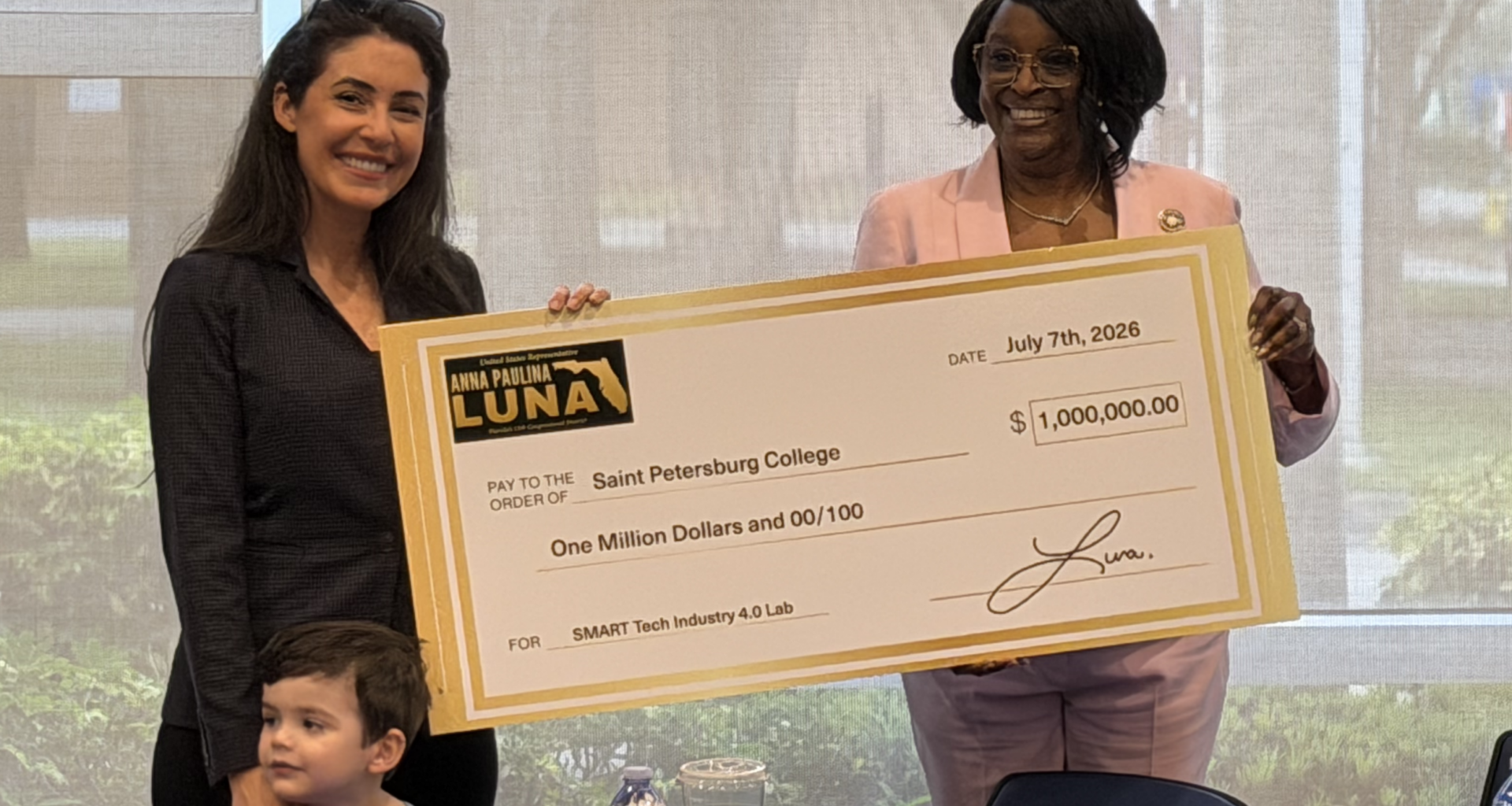
Congresswoman Anna Paulina Luna delivered $1 million in federal funding Tuesday morning to St. Petersburg College (SPC) to support skills training for SPC’s SMART (Semiconductor, Mechatronics, Automation and Robotics Training for Technicians) Tech Industry 4.0 Lab.
The money funds a pipeline for graduates to secure lucrative manufacturing jobs upon graduation, and will specifically be used to purchase advanced equipment, renovate existing educational spaces and give students real-world training opportunities.
The investment comes as manufacturers across Pinellas County and Florida continue searching for skilled technicians capable of working in semiconductor manufacturing, robotics, automation and advanced manufacturing — positions that employers have struggled to fill as the industry expands.
For Pinellas County, the issue isn’t attracting manufacturers; it’s supplying enough trained workers to meet demand.
The county is home to global manufacturers including Jabil, Honeywell, Lockheed Martin, Plasma-Therm and Bigorre Aerospace, and ranks second in Florida for manufacturing businesses and third for manufacturing employment. Yet employers have consistently identified workforce shortages as one of the biggest obstacles to growth.
According to the Florida Semiconductor Institute, the state’s semiconductor and electronics workforce is expected to grow roughly 25% by 2030, increasing from about 18,000 jobs today to nearly 23,000.
Much of that growth will require technicians with associate degrees and industry certifications rather than traditional four-year degrees, yet the state currently graduates too few engineering technicians to meet projected demand.
That technician shortage is exactly what SPC’s SMART Tech program hopes to address. The college has spent the past two years expanding short-term certifications and workforce programs in semiconductors, mechatronics, automation and robotics. Earlier this year, SPC also launched new technician training and announced plans to add both a semiconductor certificate and associate degree as employers continue seeking specialized talent.
When asked what manufacturers have to do to retain skilled labor in Pinellas, Luna pointed to partnerships between employers and educational institutions.
“We’ve worked a lot with the colleges to try and place students in these pipelines, so a lot of the manufacturers we’ve talked to are opening up apprentice programs,” Luna said. “I also think this gets into the bigger issue of affordability in the county.”
For context, Luna has previously introduced legislation aimed at preventing large corporations from purchasing single-family homes, arguing the practice drives up housing prices and creates another barrier for workers trying to establish themselves in the communities where they are employed.
Housing affordability has increasingly become part of the workforce conversation as employers attempt to recruit technicians into one of Florida’s most expensive housing markets.
When asked whether workforce programs like SMART could help attract additional manufacturers to Pinellas County, Luna said building the talent pipeline is often what businesses look for when deciding where to invest. “I think so,” she said.
She added that she isn’t particular about which manufacturers relocate to the region. “I’ll take anyone and everyone.”
The funding fits into Gov. Ron DeSantis’s push on the state level, and a federal push, to strengthen domestic semiconductor manufacturing following supply chain disruptions that exposed the nation’s reliance on overseas chip production.
Florida has invested tens of millions of dollars into semiconductor workforce training in recent years, in the hopes of positioning the state as a national hub for advanced manufacturing and electronics.