
A deadly disease called stony coral tissue loss disease is rapidly killing coral off the coast of Miami, threatening the largest coral reef in the United States, which stretches over 300 miles from Martin County to Dry Tortugas National Park. Blank Park Zoo in Des Moines is part of the Florida Reef Tract Rescue Project, working to save the coral through its “Salt Room,” a bio-secure, man-made life support system. “It’s a bio-secure system, trying to keep things clean because it’s all destined to restore the coral reef,” said Colin Brocka, a coral biologist at Blank Park Zoo.Inside the facility, hundreds of gallons of saltwater house coral rescued from the Florida coast are bathed in blue light to simulate underwater sunlight. “We’ve got about 10 different species in here and about 60 coral colonies,” Brocka said. These coral species are unique because they had never been kept in an aquarium or similar facility before, presenting a challenge for the Blank Park Zoo’s aquatics team. “The first step was figuring out how to keep them alive and how to take care of them,” Brocka said.The project has required a steep learning curve. “I’ve learned, like the right pattern of feeding, getting to know these different species of coral,” Brocka said. Since joining the effort in 2019, the team has made progress, but acknowledges there is still much to learn. “Part of the process over the last couple of years is, you know, how do we identify what normal is?” said Dr. Drew Gall, senior veterinarian at Blank Park Zoo. Gall uses ultrasound technology to study the coral’s anatomy, identifying structures like the mouth of the coral without removing it from the water or touching the animal. “If we have questions about whether something’s abnormal, can we also use an ultrasound to evaluate it, to identify like, OK, that is abnormal from what we’re used to as normal,” Gall said. “But it takes time to go through and evaluate every, every single coral.” The ongoing research may help uncover the mystery behind the disease killing stony coral in the ocean. “They thought it was a virus at first, but now they’re not sure,” Brocka said. “So still ongoing research.” The work at Blank Park Zoo is critical to preserving coral species and restoring the reef. “So we kind of serve as, like a coral nursery or like a gene bank, to maintain our genetic pool of coral, with the goal to spawn those coral and put back the young, the young recruits, the baby coral that we can grow up,” Brocka said. For the team, the effort is both challenging and rewarding. “It’s super important just to restore the coral reefs and, to respond to this, you know, devastating disease that’s out in, out in Florida,” Brocka said. “And hopefully we get to propagate coral and do a ton of cool conservation work here in central Iowa.” Blank Park Zoo is one of 21 Association of Zoos and Aquariums institutions participating in the Florida Reef Tract Rescue Project.To see this conservation work at Blank Park Zoo, you can book a behind-the-scenes tour on the zoo’s website.
DES MOINES, Iowa —
A deadly disease called stony coral tissue loss disease is rapidly killing coral off the coast of Miami, threatening the largest coral reef in the United States, which stretches over 300 miles from Martin County to Dry Tortugas National Park.
Blank Park Zoo in Des Moines is part of the Florida Reef Tract Rescue Project, working to save the coral through its “Salt Room,” a bio-secure, man-made life support system.
“It’s a bio-secure system, trying to keep things clean because it’s all destined to restore the coral reef,” said Colin Brocka, a coral biologist at Blank Park Zoo.
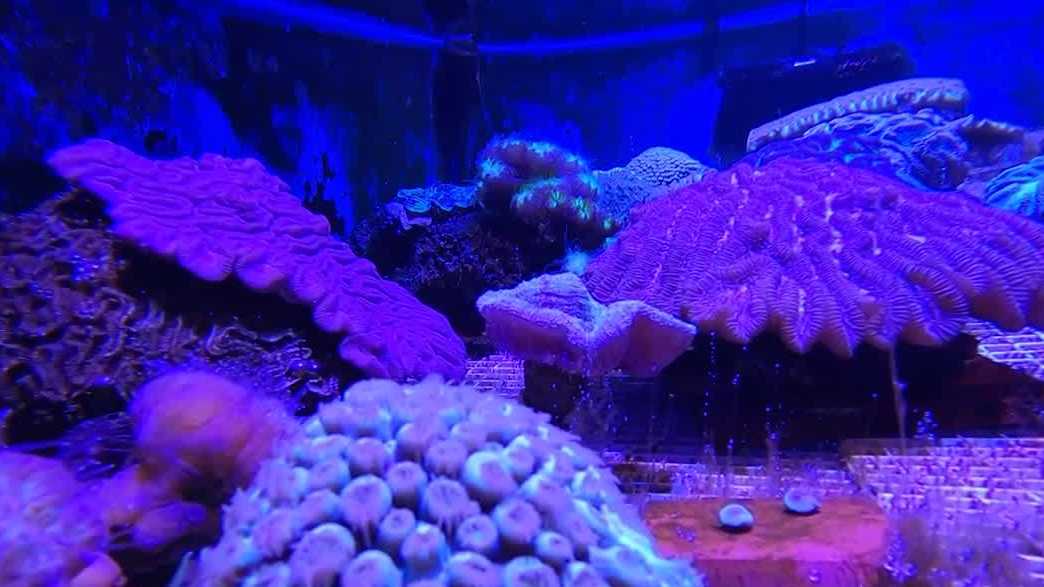
Inside the facility, hundreds of gallons of saltwater house coral rescued from the Florida coast are bathed in blue light to simulate underwater sunlight.
“We’ve got about 10 different species in here and about 60 coral colonies,” Brocka said.
These coral species are unique because they had never been kept in an aquarium or similar facility before, presenting a challenge for the Blank Park Zoo’s aquatics team.
“The first step was figuring out how to keep them alive and how to take care of them,” Brocka said.
The project has required a steep learning curve.
“I’ve learned, like the right pattern of feeding, getting to know these different species of coral,” Brocka said.
Since joining the effort in 2019, the team has made progress, but acknowledges there is still much to learn.
“Part of the process over the last couple of years is, you know, how do we identify what normal is?” said Dr. Drew Gall, senior veterinarian at Blank Park Zoo.
Gall uses ultrasound technology to study the coral’s anatomy, identifying structures like the mouth of the coral without removing it from the water or touching the animal.
“If we have questions about whether something’s abnormal, can we also use an ultrasound to evaluate it, to identify like, OK, that is abnormal from what we’re used to as normal,” Gall said. “But it takes time to go through and evaluate every, every single coral.”
The ongoing research may help uncover the mystery behind the disease killing stony coral in the ocean.
“They thought it was a virus at first, but now they’re not sure,” Brocka said. “So still ongoing research.”
The work at Blank Park Zoo is critical to preserving coral species and restoring the reef.
“So we kind of serve as, like a coral nursery or like a gene bank, to maintain our genetic pool of coral, with the goal to spawn those coral and put back the young, the young recruits, the baby coral that we can grow up,” Brocka said.
For the team, the effort is both challenging and rewarding.
“It’s super important just to restore the coral reefs and, to respond to this, you know, devastating disease that’s out in, out in Florida,” Brocka said. “And hopefully we get to propagate coral and do a ton of cool conservation work here in central Iowa.”
Blank Park Zoo is one of 21 Association of Zoos and Aquariums institutions participating in the Florida Reef Tract Rescue Project.
To see this conservation work at Blank Park Zoo, you can book a behind-the-scenes tour on the zoo’s website.