
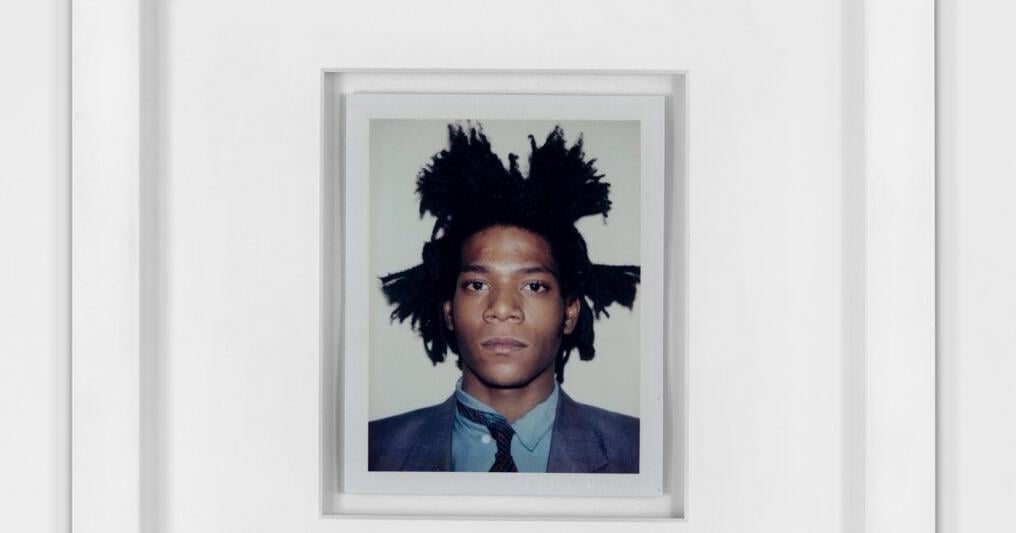
When Grant Bonnier learned that Pérez Art Museum Miami would be presenting 10 landmark Jean-Michel Basquiat works from the Kenneth C. Griffin Collection, he saw an opportunity to tell a different side of the artist’s story.
“I found out maybe six months ago that Ken’s collection was going on view,” Bonnier said. “I started organizing this back then to try and coincide with the PAMM show.”
The result is “Jean-Michel Basquiat: Selected Works, 1978–1988,” on view through Saturday, July 18, at The Bonnier Gallery in Miami’s Little River neighborhood. While the focus of PAMM’s “Basquiat: Figures, Signs, Symbols” is on 10 museum-quality paintings from a single private collection, Bonnier’s exhibition offers a broader look at Basquiat’s life, influences and artistic evolution, said the gallery owner.

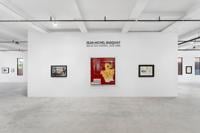
In The Bonnier Gallery’s “Jean-Michel Basquiat: Selected Works, 1978-1988,” there are approximately 100 works from early collages and postcards made while the artist was still a teenager in downtown New York through canvases completed in 1987, the year before his death.
(Courtesy of The Bonnier Gallery)
The exhibition brings together approximately 100 works spanning Basquiat’s career, from postcards and collages he created as a teenager to paintings, sculpture, photographs by Andy Warhol and personal ephemera gathered, all gathered from private collections.
“We have everything from postcards that he made when he was 18, 19, before he really entered the gallery scene, and he would sell those on the street for like $1 to $5,” Bonnier said.
From there, the exhibition follows Basquiat’s artistic evolution through early collages, works on paper, anatomical prints, hand-painted Xerox works and paintings that reflect recurring themes of his career.
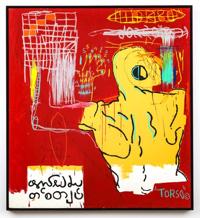
Among the exhibition’s centerpiece paintings is “Krong Thip (Torso),” 1983, a large-scale acrylic rooted in a lifelong obsession with Gray’s Anatomy — a book given to Basquiat by his mother.
(Courtesy of The Bonnier Gallery)
“Any significant motif that really has come up in Basquiat’s career, we’ve got something here touching on it,” Bonnier said. “There’s figurative work, text work, social commentary, the dichotomy of wealth versus poverty, the human body, animals.”
Bonnier also wanted visitors to better understand the influences behind Basquiat’s imagery. Copies of the medical textbook “Gray’s Anatomy,” which Basquiat’s mother gave to him after he was struck by a car when he was 7, are displayed alongside anatomical works that reference the book.
“If you’ve ever seen anatomical work by him, that tends to be the big reference point for him,” Bonnier said. “There were a handful of books that were really important. That’s one of them.”
The exhibition also includes photographs and personal ephemera from people close to the artist, including his last girlfriend, Kelle Inman.
“Andy (Warhol) used to run around with a 35-millimeter camera and take pictures of everything, so there’s a good chunk of photos that Andy took of Basquiat, including some really significant Polaroids,” Bonnier said.
Among the exhibition’s highlights is “Boone” (1983), a collage and oilstick work that reimagines Basquiat’s influential art dealer, Mary Boone.
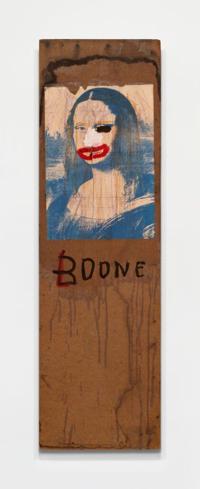
“Boone,” 1983, renders Jean-Michele Basquiat’s dealer Mary Boone as the Mona Lisa, executed in paper collage, marker, and oilstick on a narrow vertical masonite panel.
(Courtesy of The Bonnier Gallery)
“‘Boone’ renders Basquiat’s dealer Mary Boone as the Mona Lisa—or dresses the Mona Lisa in the dealer’s identity,” Bonnier said.
Another standout is “Brain” (1985), a three-dimensional sculpture assembled from individually painted wooden blocks. The work was on display at PAMM in the museum’s 2020-21 exhibition, “Writing the Future: Basquiat and the Hip-Hop Generation.”
In an unexpected pairing, a 1979 Basquiat painting is displayed beside dresses created through a licensed collaboration between the Basquiat estate and fashion label Alice + Olivia.
Bonnier hopes the exhibition brings people in who have been intimidated by stepping inside a commercial gallery.

“Brain,” 1985, is among the most structurally inventive works in the exhibition: a three-dimensional sculpture assembling Xerox paper collage, acrylic, and oilstick across 27 individually painted wood blocks mounted on a bootblack stand.
(Courtesy of The Bonnier Gallery)
“People tend to think we’re a museum,” he said. “The number of people who have reached out and asked what the tickets cost, we have to be like, ‘No, we’re a gallery. We’re a real gallery. We don’t charge for entry.’”
The distinction for the gallery owner isn’t about competing with museums but about making art accessible in a different setting. While commercial galleries also sell art, unlike museums, which are intended primarily for viewing, Bonnier wants people to know that they are welcome to experience the exhibition; they don’t need to spend money — they can simply spend time discovering the artist’s life. But if someone wants to buy, there’s the opportunity.
“What you get to experience here is the life behind the work … the person behind it,” Bonnier said.
IF YOU GO
WHAT: “Jean-Michel Basquiat: Selected Works, 1978–1988”
WHERE: The Bonnier Gallery, 7275 NW 1st Court, Miami
WHEN: 11 a.m. to 6 p.m. Wednesday through Saturday. Through Saturday, July 18.
COST: Free
INFO: 786-543-9161 or thebonniergallery.com.
ArtburstMiami.com is a nonprofit media source for the arts featuring fresh and original stories by writers dedicated to theater, dance, visual arts, film, music, and more. Don’t miss a story at www.artburstmiami.com.