
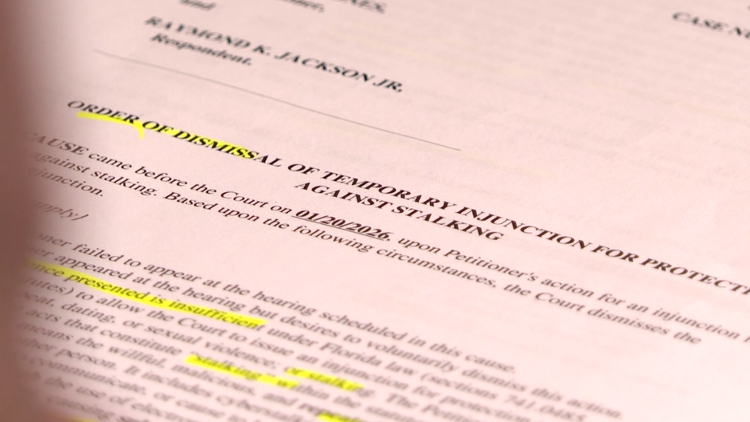
A Jacksonville woman’s death after court documents reveal she sought legal protection from her estranged husband has raised difficult questions about access and the effectiveness of stalking injunctions, the challenges survivors face when leaving abusive relationships, and what resources are available for people who fear they may be in danger.
Stephanie Brown, director of Community Education with Hubbard House, said one of the most dangerous times for someone experiencing domestic violence can be when they attempt to leave.
“When an abuser feels as though they’re losing control, a lot of times they will escalate their violence, potentially even to lethal violence,” Brown said.
She said survivors considering leaving a relationship should seek support before making that decision whenever possible, because safety planning can help reduce risks.
Understanding injunctions
Former chief assistant federal prosecutor Curtis Fallgatter explained that stalking injunctions are civil court orders designed to protect people from harassment or unwanted contact.
Fallgatter, who spent 17 years as a criminal prosecutor with the U.S. Attorney’s Office and about 30 years in criminal defense, said Florida law requires a person seeking a stalking injunction to show specific elements.
“It’s got to be a course of conduct, meaning more than one (incident) over a period of time directed at a particular person,” Fallgatter said.
The behavior must also cause substantial emotional distress and occur without a legitimate purpose.
For example, Fallgatter explained that communication between two parents about custody arrangements or picking up a child may have a legitimate purpose and would not necessarily qualify as stalking. However, repeated unwanted contact intended to harass or intimidate someone may meet the legal standard.
To request an injunction, a person files a petition describing the alleged behavior. A judge reviews the petition without the other party present. If the judge finds the allegations meet the legal requirements, a temporary injunction may be issued and a later hearing is scheduled.
At that hearing, both sides have the opportunity to present evidence. The judge then decides whether the injunction should become permanent.
The standard of proof in these hearings is not the same as a criminal trial.
“It’s a preponderance,” Fallgatter said. “More likely than not. Some people call it the 51% test.”
Fallgatter said injunctions are an important legal tool, but they cannot physically prevent someone from violating the order.
“The sad truth, unfortunately, is an order of a court doesn’t prevent some particularly angry person or dangerous person from going to the home or going to the car and hurting them anyway,” he said.
Violating an injunction can result in criminal consequences or contempt of court, but an injunction does not mean someone is physically monitored at all times.
Precautions beyond injunctions
Brown emphasized that an injunction should be viewed as one part of a larger safety strategy.
“I don’t want to dismiss the importance of an injunction,” Brown said. “There are absolutely abusers who would not be deterred, but there are so many who are.”
She said thousands of injunctions are granted in the community each year and remain an important protection for many survivors.
“The important thing for a survivor to know is that an injunction is a tool. It is not the only solution,” Brown said.
Brown said survivors should work with advocates to create individualized safety plans that consider their specific circumstances.
That can include questions such as:
When is the safest time to leave?
Is law enforcement involvement needed?
Where will the survivor go?
What important documents or belongings should be taken?
Does the abusive person have access to technology that could track their location?
Technology is an increasingly important part of safety planning, Brown said, because some abusers may use phones, accounts, or devices to monitor someone after they leave.
However, Brown said survivors should also trust their instincts.
“A survivor’s most important asset is their gut,” she said. “If your gut is telling you you need to get out, and you need to get out now, we don’t want you to wait to do that.”
If someone believes they are in immediate danger, Brown said calling law enforcement or 911 may be necessary, even if they do not have a complete safety plan in place.
Collecting evidence
Fallgatter said people seeking injunctions should provide as much documentation as possible.
Depending on the situation, evidence may include:
Photos of injuries or property damage
While a judge may find someone’s testimony credible, additional documentation can help support the claims being made.
“With the modern world, you get text messages that confirm it,” Fallgatter said.
He added that stalking cases may sometimes be easier to document because they often involve repeated communications or actions that leave a record.
Help is available
For survivors whose requests for injunctions are denied, Brown said it can feel overwhelming to navigate the legal system alone.
She encouraged people to contact advocates who can help them understand their options and create a plan moving forward.
“We are here to help. You are not alone,” Brown said.
Experts said the legal system can provide important protections, but survivors should not rely on a single resource when their safety is at risk.
Court orders, law enforcement, advocates, and personal safety plans can work together to help someone leave an abusive situation.
For anyone experiencing domestic violence, stalking, or threats, advocates encourage reaching out for help as early as possible.
Support is available 24 hours a day through Hubbard House at 904-354-3114.