
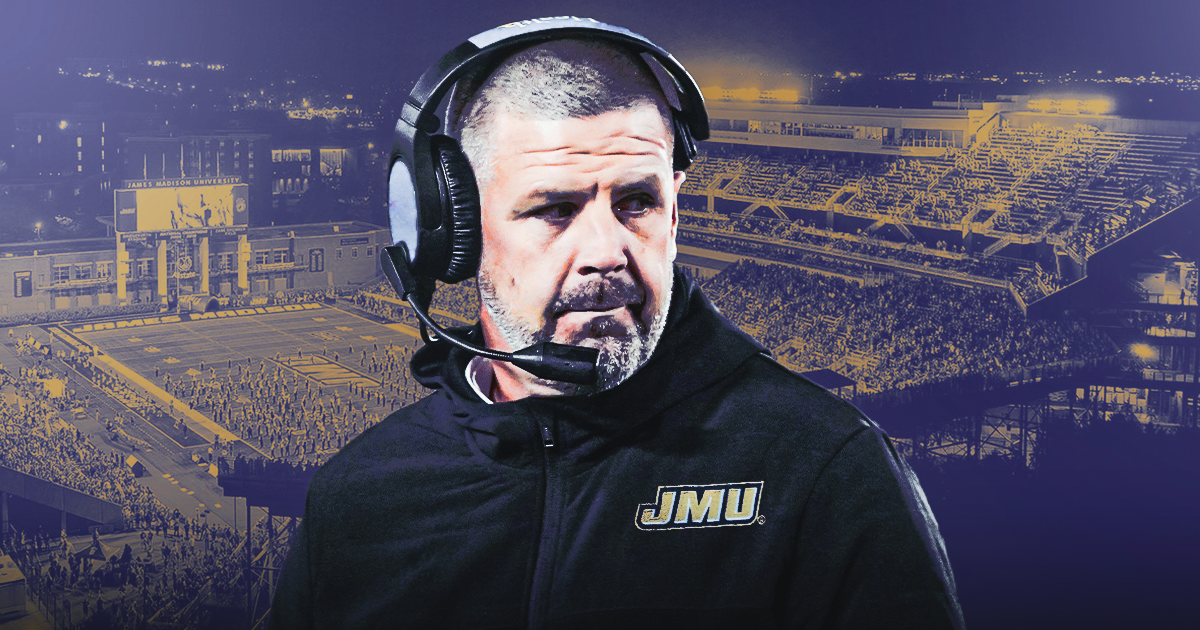
After Billy Napier got fired for the first time as a head coach this past year, he analyzed his four seasons at Florida. Napier wanted to coach again as soon as he could after the midseason dismissal, but after going 22-23 with the Gators, he understood he would have to change some things if he got another chance.
Napier felt like he had let down everyone in the program. He talked to assistants, staffers, head coaches he worked with in the past and opposing coaches to diagnose where the breakdowns occurred. Now the head coach at James Madison, Napier came to the conclusion that he should have delegated more — and sooner.
“I think that we really struggled to manage the workload that came with NIL, that came with the portal,” Napier told On3. “ I think in general there, the work continued to be loaded up in terms of my responsibility to our team and to our entire organization. So, for me, in general, if I can sum it up, I would say the ability to delegate and hire exceptional people in certain areas and hand over more responsibility to those guys and empower them to do their job at a high level.
“I think that you have to continue to adapt and evolve, and certainly college football the last few years, that part has been really important. We didn’t do that as well as I would like us to do it. And ultimately, that was my responsibility.”
Napier recognized he should have given up offensive play calling, saying, “I think that I probably was a little stubborn.” His skill as an offensive coach helped him get there in the first place, but Florida’s offense struggled for the majority of his tenure, never finishing better than 57th nationally in scoring. He held onto the responsibility even as he needed to spend more time on everything that came with roster management in the NIL era.
“I think that that took away from the level of detail that I had provided in a lot of those areas in the past,” Napier said. “And then once my back was against the wall, I wasn’t confident or comfortable enough to hand that over to somebody else.”
Napier gave up play-calling at James Madison, a decision he said he should have made “a while back.” He hired offensive coordinator Cam Aiken, whose offense at East Tennessee State averaged 32.5 points per game last season in the FCS. Aiken worked for the previous two years as an analyst at Ole Miss.
Though the on-field results were not there, Napier felt proud of other things he and his staff did at Florida. He thought the Gators improved their facilities and “the infrastructure of the football organization.” He mentioned Florida built its NIL collective during his tenure, and he pointed out new head coach Jon Sumrall kept about a dozen staff members who had spent multiple years with the team.
“I do think that we, just in general, built an organization from top to bottom that was impressive,” Napier said. “And I think that the fact that they retained the majority of those people within that organization, I think, speaks to that. I’m thankful for Jon for doing that. I do think that a lot of those people are incredible at what they do, and I think that they deserve to stay, and I’m glad that he saw that. That was able to create some stability for them. So, in general, I think that’s ultimately what we did. We finished up the facility piece and then obviously built a football organization that I think could go toe-to-toe with anybody in the country.”
But Napier understood his teams fell short. He called the results “a failure of leadership and my responsibility to our players, our team, our entire organization and staff.” Back in the Sun Belt conference, where he once coached at Louisiana, he will have to correct his mistakes. James Madison has gone 40-11 since moving to the FBS four years ago. It hasn’t suffered a losing season since 2002.
Napier has never been in this exact position before, taking over a program with so much recent success. Louisiana and Florida had both fired their coaches after losing seasons. James Madison opened because its past two coaches, Curt Cignetti and Bob Chesney, took Power Four jobs. It went to the College Football Playoff last season.
Napier spent about 10 days around the program as the Dukes prepared for their first-round game at Oregon, a 51-34 loss. He watched practice, evaluated the roster and began hiring staff. Napier spoke to people throughout the building, as well as former James Madison assistants, about what had been done well and what needed to be improved. He thinks being able to learn from those people gave him a jump start.
“Certainly success leaves behind some clues,” Napier said, “and I think that we really have dug deep into the past here to try to learn as much as we can about the place and what’s contributed to that.”
Going into Napier’s first season, James Madison signed 62 new players, including 41 transfers from a wide range of levels. It lost starting quarterback Alonza Barnett, star running back Wayne Knight and leading tackler Trent Hendrick. But Napier thinks the team kept enough players that it can maintain the same culture.
Though Napier coached in the Sun Belt before, college football has fundamentally changed since his last season at Louisiana in 2021. He called every Group of 6 contact that he had before he took the James Madison job to ask them about recruiting, retention and staff management, knowing he will have to handle more yearly attrition than he did at Florida. And that may not be his only adjustment.
“I’m delegating a lot more and empowering other people throughout,” Napier said, “and I think, ultimately, that’s been healthy for me.”