
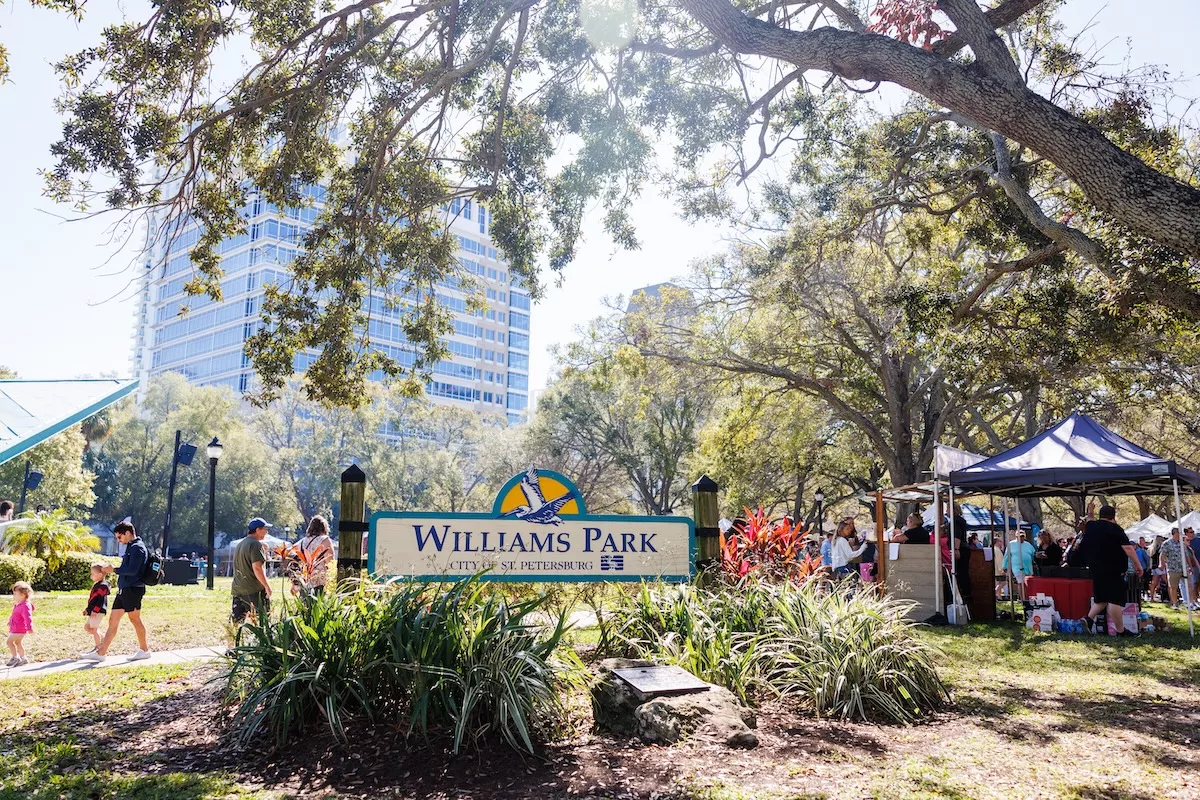
 Williams Park in St. Petersburg, Florida on Feb. 24, 2024. Credit: cityofstpete / Flickr
The Southern Poverty Law Center’s attempt to represent the interests of homeless individuals in a restaurant owner’s lawsuit against the city of St. Petersburg has failed. The lawsuit between the city and Ronicca Whaley, owner of the Shiso Crispy restaurant, addresses a new Florida statute that prohibits municipalities from regularly allowing outdoor sleeping on public property.
Whaley’s suit against the city claims that St. Petersburg is allowing regular outdoor sleeping in Williams Park—a location which has had an established homeless population for decades—near where Whaley chose to open her new restaurant. Whaley’s lawsuit argues that the homeless individuals sleeping in the park disrupt customers, taking business away from her new restaurant. She asks the court to order the city to comply with Florida statute 125.0231(2), something the city says it is already doing, noting that many of Whaley’s complaints are regarding occurrences on private property.
In lawsuits where a third party other than the plaintiff or the defense is affected by the outcome of the case, the third party may seek to intervene to ensure its interests are represented. Intervenors must prove an immediate and direct impact they would experience as a result of the lawsuit.
Last month, (Southern Poverty Law Center) SPLC filed a motion to intervene on behalf of Progressive People’s Action, an organization that runs a free store near Williams Park that provides food, medicine and services to homeless individuals in St. Petersburg. SPLC argued that PPA would not be able to carry out its mission if the individuals it serves were displaced from the park. PPA sought to represent the interests of homeless people in the park, something SPLC said neither party in the case could adequately do.
In an unusual move for a hotly contested suit, the plaintiff and the defense filed a joint motion against SPLC’s intervention. Both parties argued that PPA did not stand to see an immediate and direct impact from the outcome.
In today’s hearing, Whaley’s representative, attorney Sanford Kinne, said PPA was seeking to represent the interests of homeless people from an ideological standpoint and not the interest of PPA themselves. Kinne added that PPA does not have a valid legal interest in the outcome, as none of their members are homeless or at risk of being displaced by the outcome of the suit.
St. Petersburg City Attorney Joseph Patner told Judge Amy Williams that intervention from PPA would be a bad idea. Patner said that PPA, as an advocacy group, has attracted media attention to the case and that their involvement in the suit would mean “this whole thing would begin to spiral out of control and turn into a circus.”
SPLC senior staff attorney Jackie Azis rebutted in the hearing that media attention was already on the case before the motion to intervene, as the outcome is a matter of serious public interest. Azis said that PPA’s free store location was chosen because of its proximity to Williams Park in order to serve the homeless population there, and asked the court to allow PPA to intervene in the case to protect that group from being relocated.
SPLC has not yet responded to requests for comment.
Judge Amy Williams of the Sixth Judicial Circuit said at the end of the hearing that the lawsuit didn’t stop people from going to PPA’s free store, and that PPA therefore didn’t have a direct and immediate interest in the outcome of the case. She denied the organization’s motion to intervene, leaving the city and Whaley to continue as the only two parties in the suit.
Subscribe to Creative Loafing newsletters.
Follow us: Google News | NewsBreak | Reddit | Instagram | Facebook | BlueSky
Related