
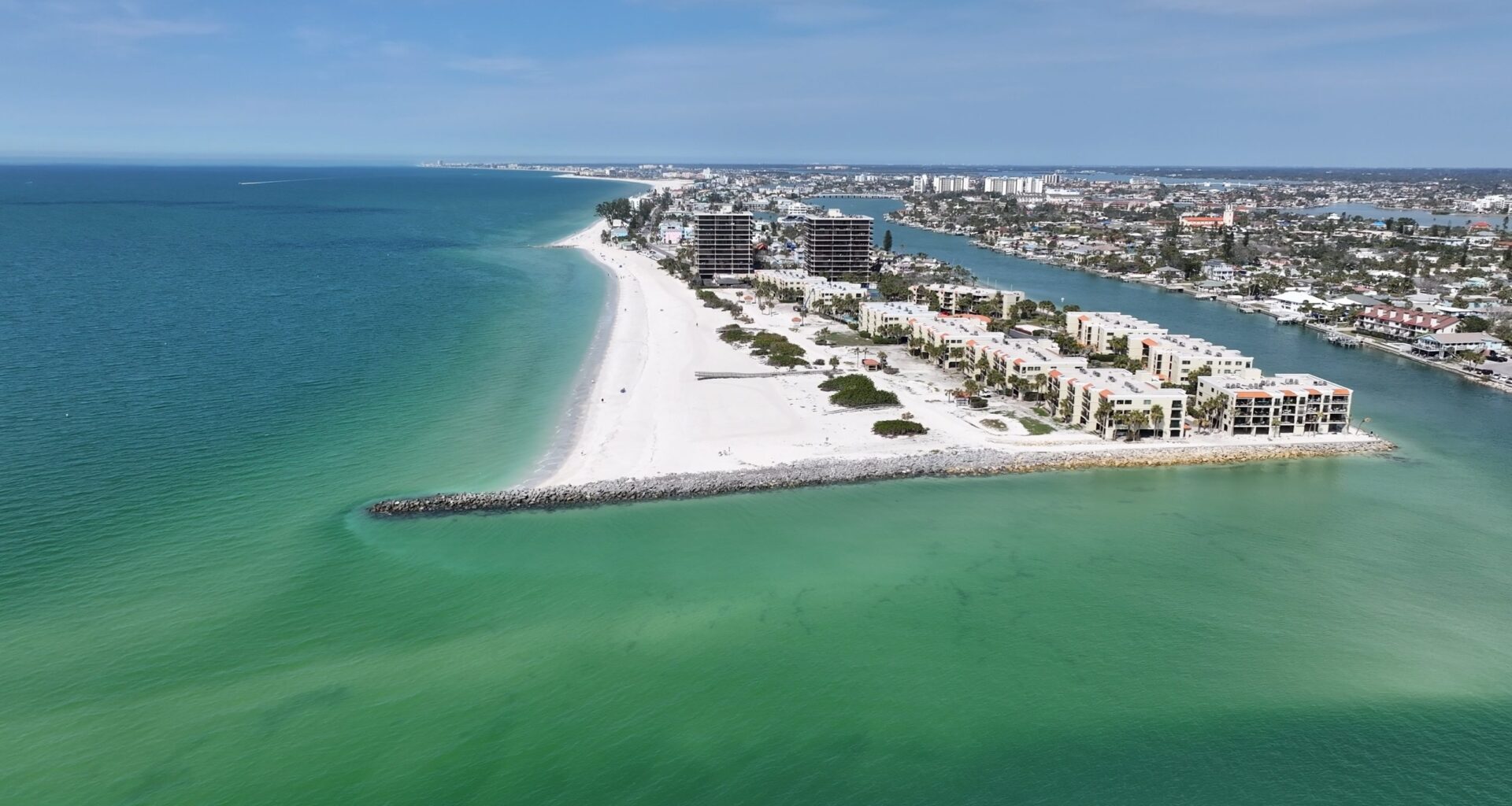
 St. Pete Beach Credit: ByDroneVideos / Shutterstock
Who controls access to St. Pete Beach: the public or beachfront property owners? That question will be the focus of a City of St. Pete Beach seminar Thursday, July 23, on Florida’s customary use doctrine and how it applies to the shoreline.
The free seminar will be held from 5 p.m.-6:30 p.m. in the City Hall Commission Chambers at 155 Corey Ave. It will feature a legal presentation on Florida beach access law, followed by a question-and-answer session for residents.
What does customary use mean?
Florida law generally treats the beach below the mean high-water line as public land held by the state for the people. Hotels, homeowners, and other private property owners may own portions of the dry sand above that boundary. This means those owners can hold title to portions of the beach.
The mean high-water line is not simply where the water happens to stop during high tide on a particular day. Florida law defines mean high water as the average height of high tides over a 19-year period. The mean high-water line marks the point where that calculated tidal level meets the shore.
This post first appeared at The Gulfport Gabber, which is part of the Tampa Bay Journalism Project (TBJP), a nascent Creative Loafing Tampa Bay effort supported by grants and a coalition of donors who make specific contributions via the Alternative Newsweekly Foundation. If you are a non-paywalled Bay area publication interested in TBJP, please email [email protected]. Help the Gabber keep publishing by making a donation.
In practical terms, beachgoers generally have the right to walk, swim, and recreate below that line. The legal dispute begins on the dry sand above it, where private ownership and the public’s historical use of the beach may overlap. Florida’s Constitution generally places beaches below the mean high-water line in state ownership, while the dry sand landward of the line may belong to the adjoining property owner.
The customary use doctrine may protect the public’s right to continue using privately owned dry sand when people have historically used that portion of the beach in a way considered ancient, reasonable, uninterrupted and free from dispute. Courts examine the history, geography and established use of the particular section of beach involved.
In 2025, Florida lawmakers repealed a law that required local governments to complete a specific court process before adopting a customary use ordinance. The change allows, but does not require, a local government to recognize customary use through an ordinance without first obtaining a judicial declaration. Affected property owners may then challenge the ordinance in court.
Beach signs intensify access debate
The City’s seminar comes shortly after Commissioners approved new restrictions on beach signage on June 23.
The ordinance prohibits signs, posts, and poles within 50 feet of the mean high or visible water line, with exceptions for government location markers. Property owners may still place removable A-frame signs outside the restricted area if they comply with City design and placement rules.
City officials said the changes are intended as a public-safety measure. According to City documents, posts, and other structures can interfere with emergency response and beach maintenance, create hazards during storms, and add visual clutter along the shoreline.
But the debate over signage quickly expanded beyond safety concerns. Some residents said “private beach” and “no trespassing” signs discourage public access and undermine the public’s historical use of the dry sand. Hotel and property representatives said signs are necessary to mark boundaries, protect guests, and help law enforcement identify private property lines.
The ordinance states that the City’s rules do not override Florida’s customary use doctrine, meaning signage regulations do not determine whether the public may use privately owned dry sand.
Pitch in to help make the Tampa Bay Journalism Project a success.
Subscribe to Creative Loafing newsletters.
Follow us: Google News | NewsBreak | Reddit | Instagram | Facebook | BlueSky
This article appears in July 09 – 15, 2026.
Related