
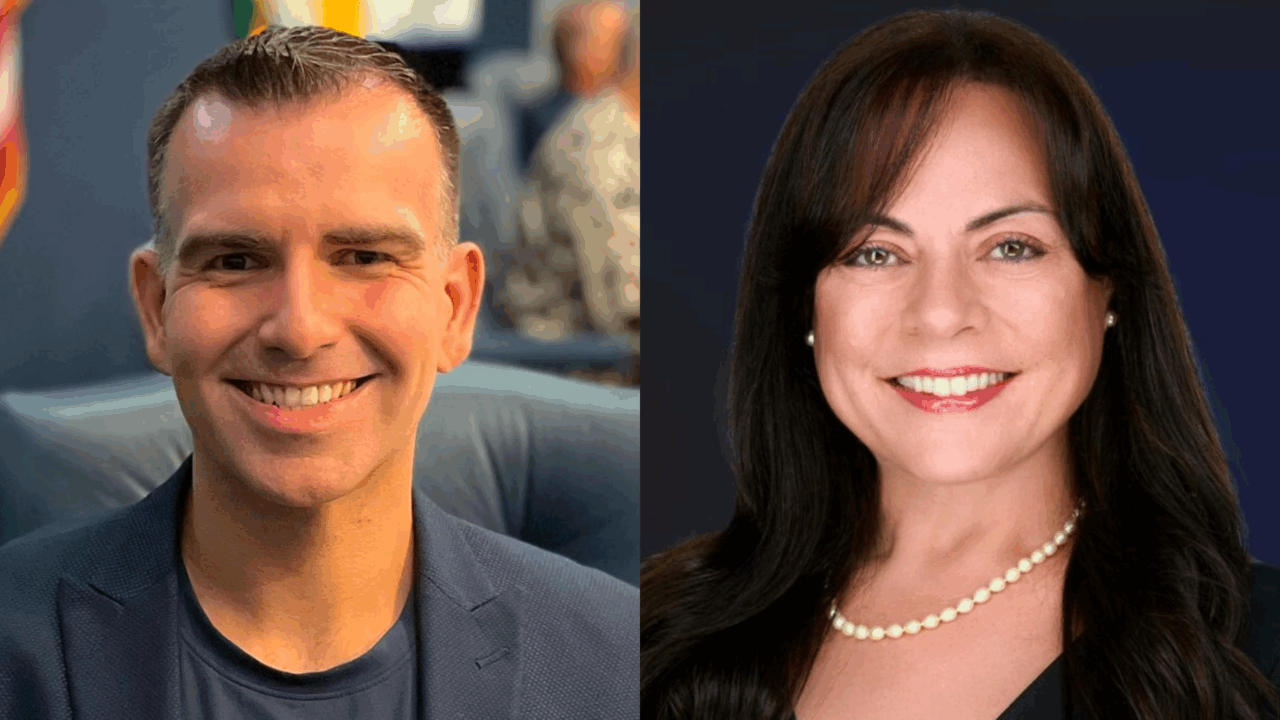
Miami Beach Commissioners Laura Dominguez and Alex Fernandez are keeping their elected jobs at City Hall after each defeated a single opponent in the city’s General Election on Tuesday.
A third race for the Commission’s Group 1 seat remains undecided as none of the six candidates running to succeed Kristen Rosen Gonzalez secured a large enough share of vote.
With 20 of 21 precincts reporting, Dominguez had 61% of the vote to defeat challenger Fred Karlton for the panel’s Group 2 seat.
Fernandez took 84.5% of the vote to deny challenger Luidgi Mary in Group 3.
In Group 1, two candidates are bound for a runoff, but who it’ll is up in the air. Monica Matteo-Salinas punched her ticket to the Dec. 9 contest with a 23.5% share of ballots cast in her favor. Two others, Monique Pardo Pope and Bryan Ehrlich, have 20.3% and 19.9% of the vote — well within the 0.5-percentage-point threshold requiring a recount.
That may change as more votes are tallied. This report will be updated.
For candidates Daniel Ciraldo, Ava Frankel and Omar Jimenez — who received between 7% and 17% of the vote — Tuesday marked the end of the road this cycle.
Voters headed to the polls before and on Election Day as the city confronted turbulence on multiple fronts, from state scrutiny over finances and charges that a local ordinance conflicts with Florida’s homelessness law to the removal of cultural landmarks due to their so-called “woke” significance and accusations of pay-for-play policymaking.
All Commission seats are elected at large, meaning every voter could weigh in on each race.
City Commission, Group 2
The race for the Miami Beach Commission’s Group 2 seat — which pitted Dominguez, a 54-year-old Democrat, against Karlton, a 65-year-old Republican-turned-independent real estate investor — was the city’s most contentious this year.
Domínguez, elected in 2022 to complete the term of her late partner, Commissioner Mark Samuelian, touted achievements in public safety, resiliency and fiscal management. She told the Herald she held to end “spring-break chaos,” secured police funding and advanced flood-prevention projects.
She enjoyed support from an array of unions, including the South Florida AFL-CIO, IAFF Local 1510, AFSCME Local 1554 and the Miami Beach Fraternal Order of Police, and by advocacy groups like Equality Florida, SAVE Action PAC and Ruth’s List Florida.
But her tenure was rocked by political crossfire. One of her peers on the dais, independent David Suarez, undertook a monthslong messaging campaign against her, funding negative mailers and contributing $25,000 to a pro-Karlton political committee.
In late September, resident Jo Manning filed complaints with the state’s elections and ethics agencies, accusing Suarez of illegally using the city seal and government letterhead in attacks against Dominguez.
 (L-R) Laura Dominguez and Fred Karlton. Images via the candidates.
Republican Rep. Fabián Basabe piled on, circulating a video clip of Domínguez he said showed her involved in a “backroom grift.” She called the charge “a baseless smear. The full video showed her speaking about potential future referendums, not campaign funding or developer kickbacks.
Domínguez stressed her record on neighborhood engagement and infrastructure. Her priorities for a second term included an affordable-housing trust fund, improved water quality via “nanobubble” technology and completion of West Avenue resiliency projects.
Karlton, a lifelong Beach resident and property investor, cast himself as a fiscal watchdog who would fight overdevelopment and government waste.
“I’m not anybody’s shill,” he told the Herald, adding that his 33 years in business equip him to negotiate contracts and improve efficiency. He said the city “grants too many favors to developers” and that he wanted stricter zoning oversight.
Karlton’s activism dated back more than a decade. In 2011, he began clashing with boaters who lived onboard near his ocean-facing backyard. He ended up traveling to Tallahassee years later to seek later-passed legislation addressing the issue.
Dominguez has raised almost $319,000 of which about a third came from her bank account. Donations came through a blend of business and personal checks.
Karlton’s raised and spent nearly $187,000 through the end of October, all of it self-given.
City Commission, Group 3
To secure a second term, Fernandez, a 39-year-old Democrat, had to get by Mary, a 45-year-old independent-turned Republican and former member of the city’s Black Affairs Advisory Committee.
In his first term, Fernandez, the only openly gay member of the commission, championed policies blending compassion and enforcement. He authored the city’s “Text Before Tow” program, which he said reduced resident tows by 90%, and Miami Beach’s homelessness ordinance, which Basabe argues is not in compliance with a newer state law.
Fernandez also led efforts to clean local waters, improve flood-control infrastructure, strengthen tenant and condo-owner protections, roll back late-night alcohol hours in residential areas, preserve the Art Deco Historic District and expand the Freebee micro-transit service.
 (L-R) Alex Fernandez and Luidgi Mary. Images via the candidates.
He was the loudest voice in local government against the Resiliency and Safe Structures Act, which the Legislature passed in response to the 2021 Surfside condo collapse, arguing its too-broad effects would destroy many of Miami Beach’s historic buildings.
He and several state lawmakers, including Basabe and Miami Gardens Democratic Sen. Shevrin Jones, worked to amend the measure’s language to mitigate its potentially negative impacts.
Mary ran a modest campaign emphasizing inclusion and transparency.
In addition to boilerplate priorities — stopping overdevelopment, improving public safety and standing up for small businesses — he said he wanted to clean up Miami Beach’s elections, end “backroom deals” that favor builders over residents and crack down on abuses by short-term rental property owners.
In terms of fundraising, there was a massive divide between the candidates. Fernandez has raised more than $414,000 between his campaign account and political committee, A Safer Miami Beach.
Ample donations came from real estate interests, local businesses and residents from in and around Miami Beach. He also loaned his campaign $25,000.
Mary raised about $6,200 of which roughly a third was self-given.
City Commission, Group 1
The contest for the open Group 1 seat — which Rosen Gonzalez vacated to run for Mayor — was the city’s most crowded this year. Candidates included a nonprofit consultant, two real estate pros, a lawyer, a restaurateur and a government worker.
Ciraldo, a former Executive Director of the Miami Design Preservation League, hoped to take his preservationist bona fides to City Hall.
He called overdevelopment “the most pressing issue, threatening our quality of life, traffic and environment” in answers to a questionnaire the Herald sent candidates. If elected, he promised to defend historic districts, curb traffic-intensive projects, ensure transparency in zoning and “put residents — not special interests — at the center of city decisions.”
A 42-year-old Democrat and the founder of Young Folks Consulting, which helps nonprofits, advocacy groups and public-impact startups, Ciraldo raised about $107,000 between his campaign account and political committee, Our Beach Our Future. He’s also notched several community endorsements.
Ehrlich, a real estate investor and former member of the city’s Historic Preservation Board and a Bass Museum trustee, pitched himself as a pragmatic modernizer.
“I see Washington Ave., Lincoln Road, 41st Street and Ocean Drive revitalized with energy and innovation,” the 44-year-old Democrat told the Herald.
But he also drew scrutiny for developer-linked donations to his political committee, Miami Beach in Focus, which, together with his campaign account, raised $190,500 through the end of last month.
Frankel, a Realtor who switched from Republican to no party affiliation in 2022, campaigned on a promise to bring new perspective to the dais while modernizing the city’s infrastructure, particularly its flood-mitigation systems.
At 28, she was the youngest person running for a Miami Beach elected post this year.
She reported raising about $18,000 through Oct. 30, roughly a third of which came through self-loans and donors with “Frankel” in their names.
 (Clockwise from top left) Daniel Ciraldo, Brian Ehrlich, Ava Frankel, Omar Jimenez, Monica Matteo-Salinas and Monique Pardo Pope ran to replace Kristen Rosen Gonzalez on the City Commission. Images via the candidates.
Jimenez, the founder of the Park View Island Sustainable Association and owner of Bella Cuba restaurant, cited firsthand success in securing $10 million for infrastructure upgrades to North Beach for sewer and stormwater systems, waterways and parks.
Cleaning up Miami Beach, specifically its waters, has been a focus of the 39-year-old independent’s for the better part of a decade, since a major sewer main break spilled 1.6 million gallons of raw sewage into public waters.
He’s led beach cleanups for years.
“I work for the people, not lobby groups, special interests or developers,” he told the Herald.
Jimenez raised $27,600. Of that, $23,000 came from his bank account.
City employee Monica Matteo-Salinas, 46, earned the Herald’s endorsement for her grasp of policy and pragmatic proposals. A former aide to two sitting Democratic City Commissioners, Matteo-Salinas, a Democrat, vowed to expand trolley service, pursue affordable housing purchases and establish a new “water czar” position in the city, paid by resort taxes.
She raised about $66,700 between her campaign account and a little-used political committee, Voters for Good Government, inclusive of a $25,000 self-loan.
Pardo Pope, a 44-year-old Republican lawyer, guardian ad litem and member of the city’s Commission for Women, ran a campaign emphasizing public safety, education and family services.
Of $168,000 she reported raising through her campaign account and political committee, Miami Beach Together, roughly a third came from her bank account.
Pardo Pope’s candidacy drew attention late last month after documentarian Billy Corben revealed that she is the daughter of former police officer Manuel Pardo, a serial killer and Nazi enthusiast who was executed for killing nine people in the 1980s.
She said in a statement that she forgave her father for his crimes in order to move on with her life and dedicate herself to service.
Despite the controversy, Pardo Pope earned endorsements from the Jewish-affiliated Teach Florida PAC, Miami-Dade Commissioner René García and former City Commissioner Jose Smith.