
By 9:40 a.m., the Florida heat has already settled thick over Marathon, Florida. Jungle geranium blossoms spill beside cracked concrete and oyster-shell mulch. Two orange-yellow butterflies dart through the fuschia bougainvillea as Rachel Bowman, Florida’s only female lionfish-certified commercial diver, loads tanks onto The Britney Spears, her boat parked just beyond her yard. Curly-haired, tattooed, wiry in the way of people who spend their days underwater, she moves with the practiced efficiency of someone who has done this a thousand times.
As we motor out, her partner Peter mounts the dive flag on a makeshift pole, her late father’s fishing rod. Her dad was a shrimper and charter boat captain; they never got to dive together. Now his ashes rest sealed in the wheel well, and he goes out with her every trip.
Peter unfurls the flag. Rachel pulls on her old Henderson wetsuit, worn inside-out and soft with use. “Don’t make fun,” she says. “It’s my favorite.” She blows up her safety sausage, rolls backward off the boat through diesel-salt air, and disappears into the blue.
A hundred feet down, on a sunken shrimp trawler, I watch her hover in the haze, scanning the wreck before striking — one, two, three lionfish, their striped bodies flashing bronze as they disappear into her zookeeper. Back on the surface, she empties her bounty into a cooler of ice, beautiful and lethal.
A red lionfish
Credit: Photo by Ken Marks
Rachel Bowman holding two lionfish
Credit: Photo by John McCain
Rachel Bowman with a fishing spear and lionfish container
Credit: Photo by Jerry Cowan
A fried lionfish at AJ’s Seafood in Destn
Credit: Courtesy of Destin-Fort Walton Beach
Divers first encountered lionfish in Atlantic waters in 1985, off Dania Beach, just north of Miami. Native to the Indo-Pacific, where large groupers, eels, and sharks keep the populations in check, lionfish arrived here with few effective natural predators and a staggering appetite. A female lays roughly 27,000 eggs every two and a half days. They eat snapper, grouper, parrot fish, juvenile lobster — nearly 170 species in all — corralling prey with ornate pectoral fins before swallowing them whole. A 2008 study found that lionfish arriving at a Bahamian reef eliminated the recruitment of native reef fishes by about 80% within five weeks.
Complete eradication isn’t possible: Lionfish can descend a thousand feet, far beyond any diver’s reach, and adapt readily to any challenges. But local pressure works. Studies out of the Florida Keys show targeted removal events cut populations by more than 50 percent, enough to let reef recovery begin. And unlike almost any other seafood, lionfish carry no bag limits, no season, no gear restrictions. “Lionfish is the only species that is one-hundred-percent wide open,” Bowman tells me. Hunting one is the rare act where more is always better.
About 20 years ago, conservation biologist Joe Roman proposed that human appetite might rank among our most powerful tools against invasive species — a strategy called invasivorism. For years, the idea lived in academic margins. Now it appears on Florida menus from the Keys to Pensacola. “Chefs are key in this,” Roman says. “I’m a biologist; you’re not necessarily going to listen to me. But if you have it at a local restaurant, you’re going to say, ‘This is actually pretty great. How can I get more?'”
A lionfish dish at Harbor Docks in Destin
Credit: Courtesy Destin-Fort Walton Beach
Lionfish sushi at Harbor Docks in Destin
Credit: Courtesy of Destin-Fort Walton Beach
Squid ink pasta with pan-seared lionfish at Sura Korean Steakhouse
Credit: Courtesy of Destin-Fort Walton Beach
A lionfish dish at Jackson’s Steakhouse
Credit: Courtesy of Jackson’s Steakhouse
Back at the dock in Marathon, Bowman and her crew clip the venomous spines from our catch with their three Maine Coon kitties looking on. Heat denatures the venom, and once filleted, the fish is as safe as snapper, and they know they will get a snack soon. The filled cooler goes straight to chef Christian Ledwith at Chef Michael’s in Islamorada, the day’s hunt becoming that evening’s dinner, with some set aside destined for Keys Fisheries and blackened lionfish tacos at lunch tomorrow.
That pipeline — diver to kitchen, sometimes within hours — is what Bowman has spent more than a decade building. Through her nonprofit, the Lionfish Invitational, she pairs recreational divers with scientists on multi-day liveaboard expeditions in the Flower Garden Banks National Marine Sanctuary, removing fish and collecting ecological data in the same dive. The Key Largo–based Reef Environmental Education Foundation compiled “The Lionfish Cookbook” — more than 60 recipes, from smoked lionfish dip to ceviche — free to download with approachable dishes for the home cook or professional chef. “When you order lionfish off the menu, you’re not ordering snapper or hogfish or grouper.” Bowman says. “You’re taking pressure off those species and helping our reefs recover.”
In Pensacola, chef Irv Miller of Jackson’s Steakhouse acquired a wholesale saltwater license to buy lionfish direct from divers and process in-house. The fish, as Al Massa of Brotula’s in Destin describes it, has “sweet, flaky light-white meat” that “takes a wide variety of sauces, from classic beurre blanc to a roasted-red-pepper broth.” It is not, as Okaloosa County Natural Resources Chief Alex Fogg is quick to note, like other invasive species that require culinary heroics to be palatable. “It’s not like wild hog or kudzu or carp, where you’ve got to make it unrecognizable,” he says. “Lionfish actually tastes good.”
Related: José Andrés Wants You to Eat More Lionfish
Each fall, Destin becomes the center of the fight. The Emerald Coast Open draws more than a hundred divers from across the country; this year’s tournament pulled 20,752 lionfish from the Gulf in two days. Fogg built the event from his own graduate research — the first tournament, in 2013, was organized to get samples into the lab. It yielded around 500 fish. This one nearly reaches 30,000.
The week of the tournament, Lionfish Restaurant Week transforms the local dining scene. Restaurants apply to participate, and a panel of judges, including me this year, evaluate them not only on their dishes but on how fluently their staff can explain an ecological crisis to a tourist over dinner — does the host mention lionfish at the door? Does the server describe the invasion, or just recite a special? Organizers donate the fish at no cost; restaurants price it above grouper and snapper. It sells out within a day.
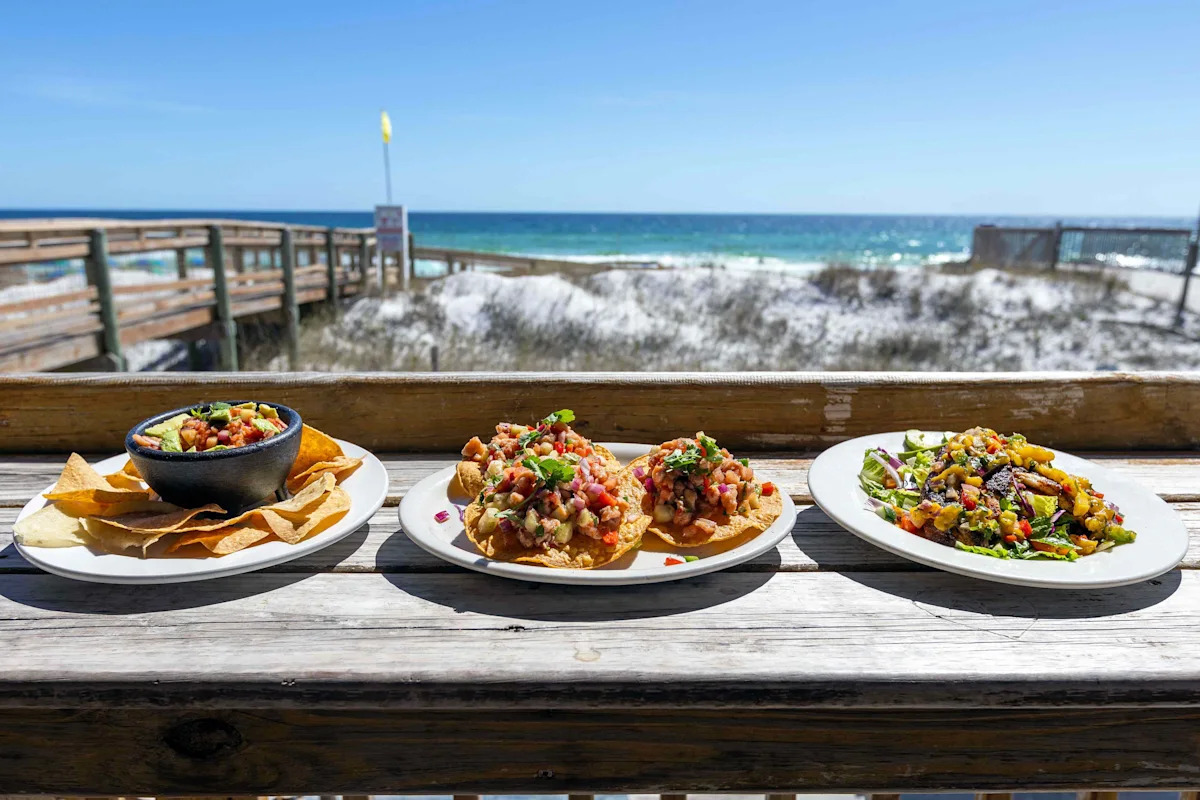
At La Paz, chef-owner Chatham Morgan has won Restaurant Week every year since its 2022 launch — deploying a mariachi band performing an original song about lionfish and sending floor manager Emily Her through the dining room in a wetsuit, mask, and flippers, a plush lionfish on her spear. His winning dish is chef Felipe’s grandmother’s recipe: Acapulco lionfish fajitas with mango salsa and dried chilies, mild and steak-like in the tortilla. Across town at Harbor Docks, where Chatham’s brother Eddie runs the family institution their father founded 40 years ago, lionfish appears as a sushi roll, delicate and clean, reminiscent of blue crab. Family business, family competition, and a shared conviction that the Gulf Coast restaurant industry has a role to play in what happens to the Gulf.
“It’s really nice,” Chatham Morgan says, “to be able to put pressure on a resource and have a positive impact.”
Roman believes the cultural shift is already underway — the same kind of pivot that turned raw fish from a novelty into a strip-mall staple. “Our willingness to eat raw fish changed in the United States over 50 years,” he says. “I could see something similar happening with lionfish, maybe faster.”
At the docks behind AJ’s Seafood, as weighed fish move to processing and then out to the restaurants, artist Harley Van Hyning works at a folding table, pressing fresh lionfish in ink onto rice paper. Gyotaku, the centuries-old Japanese art of the fish print, applied to an invader. Around him, coolers stack up, divers compare counts, and the Gulf keeps giving up its fish. Van Hyning peels back the paper to reveal each print: striped, spined, precise. Conservation rendered in brushstrokes. It’s the right image for how Florida is combating this fish — not erasing it, exactly, but making something of it with every piece of art, pair of earrings, and delicious dish.
Where to eat lionfish in Florida
Ordering lionfish wherever you find it on a Florida menu is one of the easiest ways to support reef recovery. Lionfish availability varies; call ahead outside of tournament season. The Emerald Coast Open Lionfish Tournament and companion Restaurant Week take place in Destin each spring. These restaurants have made it a regular or seasonal feature or offer a hook and cook option.
Florida Fish and Wildlife designates the first Saturday after Mother’s Day as Lionfish Removal and Awareness Day, with festivals across the Panhandle. The Reef Environmental Education Foundation hosts its annual Florida Keys Lionfish Derby & Arts Festival each spring in Key Largo, featuring competitive diving, lionfish tastings, and a public conservation festival. Finz Dive Center hosts the Key West Lionfish Derby each July. The Northeast Florida Lionfish Roundup brings the tournament north to Jacksonville each summer. Ace Diving’s Lionfish Derby runs annually out of downtown Miami. The Apex Predator Summer Showdown, held in South Florida each August, welcomes divers from personal boats and charter vessels alike. The Emerald Coast Open Lionfish Tournament and Restaurant Week take place annually in Destin each fall.
Read the original article on Food & Wine