
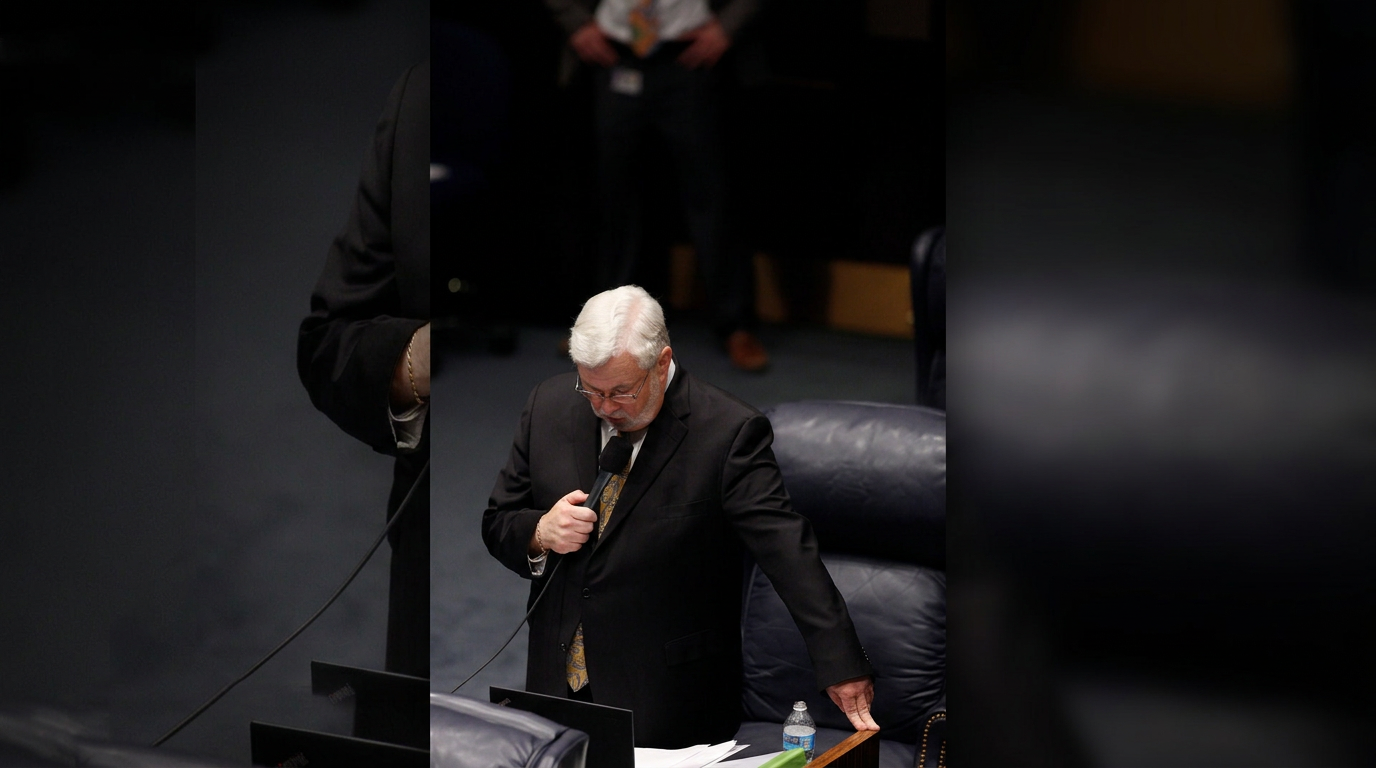
Friends, Floridians, countrymen, lend me your ears. I come to bury Jack Latvala, not to praise him.
The evil that men do lives after them; the good is oft interred with their bones. So let it be with Jack.
Shakespeare gave Mark Antony the greatest funeral speech ever written, then had him deliver it to a crowd that had already made up its mind. Rome loved Caesar once. Then the knives came out, and suddenly everyone agreed he’d had it coming.
It’s the question Antony puts to that mob that has been rattling around my head since Wednesday evening, when I learned that Jack Latvala was suddenly gone at 74: “You all did love him once, not without cause. What cause withholds you then, to mourn for him?”
In Antony’s mouth, the question was rhetorical. In Tallahassee and beyond, it has an answer, and everyone reading this knows what it is.

We’ll get there. I promise.
But the town did love Jack once. And not without cause.
The sentiment I keep running into on social media, over and over, is that everybody has a Jack story.
It’s true. And the stories are as wide as the Pinellas waterfront, from the deeply personal to deeply impactful public policy — which tells you something about the size of the man’s footprint.
Jack Latvala was one of the ten or so most consequential figures in recent Florida political history. He built that standing without ever winning a statewide race, without ever becoming Governor, without ever claiming the Senate presidency he wanted so badly.

Think about how much harder it is to matter that much from where he sat.
Because none of us are obituary writers, we tend to frame someone else’s death through our own perspective of them. I had hoped to avoid doing that here.
I can’t.
On Wednesday afternoon, I called Jack out of the blue. It would be the first time we had spoken since Chris Latvala was hospitalized last year. I called to tell him he was a son of a bitch.
I meant it as a compliment. Mostly. Because everything I know about campaigning — almost every tool I am deploying right now to help my wife in her effort to elect Charlie Crist Mayor of St. Petersburg — I learned, in part, from Jack Latvala, some 25 years ago.
Hours later, he was gone.
That call, it turns out, was goodbye, full of gratitude.
Because there is no Florida Politics without Jack Latvala.
When this operation was still SaintPetersBlog, Jack was my very first campaign advertiser. Whatever you think of what I’ve built, he’s in the foundation.
I think back to my time at the Mallard Group, in 2002. By then I had taken over creating the firm’s direct mail and ramped our output from 35 pieces in the 2000 cycle to more than 135.
This was a different printing era. A hundred and thirty-five mailers weren’t oversized postcards you gang-ran in an afternoon; each one took a week to produce.
At the end of a long day right before the primary, my colleague Kathy Carroll looked at me and said, “Jesus Christ, you’re just like Jack.”
I assumed she meant our boss, Jack Hebert, who had worked for Latvala.
She didn’t. She meant the Senator, hard-charging, tough, determined, not always easy to work with, but at the end of the day, someone who would fight for what he believed in and never be outworked by the competition.
I honestly don’t know if I took it as a compliment, considering how tough Sen. Latvala was on me at that point in my life.
Jack was the first person to ever jam a pointed finger into my chest and demand I do something again, or better, which he did often, whenever the mail we designed for one of his clients fell short of his demanding standards.
And if I’m being honest, Jack was almost always that way with me. He wasn’t kind to me. I was never treated as well as others in his orbit, despite being one of his most public defenders and advocates.
And defend him I did.
I was such an ardent Latvala supporter during his war with Joe Negron for the Senate presidency that those in the rival camp offered to show me their tally of the secretive pledge cards — documents so closely held the Senate refused to release them to the Tampa Bay Times — just to convince me my guy wasn’t going to win.
For many, many months, I felt like I was the one running for Senate President.
That fight consumed the chamber for years, spilled into the 2015 redistricting mess, and ended with Jack conceding in exchange for the Appropriations gavel — a perch, it should be said, from which he was arguably more powerful than the presidency would have made him.
Then came November 2017.
When POLITICO’s Marc Caputo, Matt Dixon and Alexandra Glorioso reported that six women had accused Jack of groping and harassment, I turned over editorial control of this outlet’s coverage of the story to my colleagues.
I did it because, if I’m being honest yet again, I was carrying water for Jack. I believed what he told me. I didn’t want to believe what others were saying.
I remember embarking on a Disney cruise in December 2017. The last thing I did before the ship left the dock was talk to Sen. Latvala. He promised me it was his word against another person’s, and that he would prevail.
Little did I know, a special master’s report was about to detail a wave of stomach-churning allegations.
Retired Judge Ronald Swanson‘s 33-page report found probable cause that Jack had repeatedly groped a Senate aide, and — through testimony and text messages — that he may have violated public corruption laws by trading legislative support for sex.
It was never his word against another person’s. There were texts.
Soon thereafter, Jack resigned, ending his Senate career and his campaign for Governor in the same stroke.
I can never forgive Jack for what he did.
Or for lying to me about it.
Rachel Perrin Rogers, who went public with her allegations in 2017 and later settled with the Senate for nearly $1 million, posted something this week that stopped me cold: “Jack Latvala did a great deal of good for his community and for the causes he believed in. This was a huge part of why myself and others stayed silent for so long about the bad acts. Reminder — two things can be true.”
(An aside: it is incredibly magnanimous of Perrin Rogers to say that about the man. And in one of life’s unbelievable twists — again underlining the strangeness of my role in all of this as the town crier — minutes after I hung up with Jack on Wednesday, Perrin Rogers sent me a beautiful note thanking me for my handling of her beloved son’s passing. RPR’s just incredible.)
Here is another confession. Part of me was relieved when Jack was taken off the public stage.
He was such a powerful political boss in this corner of Florida that it was difficult for the rest of us in local politics to maneuver around him. And his reach never really ended; his firm is working for Jim Large in the St. Petersburg mayoral race against Crist at this very moment.
Had Jack not resigned, had he simply run for Governor and lost, he would have found his way onto the Pinellas County Commission, or otherwise remained enormously powerful.
Men like Jack don’t retire. They get removed or exiled. Jack, somehow, managed both.
Understand, Jack and I were allies, but we were not friendly. I did not like the lecherous behavior. He did not care for the way I blur the lines between media and political operative.
When the Florida Phoenix debuted, he commented on Facebook about how happy he was to see real journalists working, no more having to deal with “pay-to-play outlets.” That was not a subtle dig, and it wasn’t meant to be.
He would call and yell at me about my coverage of his post-scandal career, right down to the time I noted he was selling his house in Tallahassee. He didn’t think that was news.
It was.
Scrolling through what has been written about Jack over the last decade, the coverage has not been kind. Deservedly so.
The comp that keeps coming to mind, believe it or not, is Pete Rose. The all-time hits leader, banned from the game he loved, dead before baseball got around to forgiving him.
Jack did so much, in so many policy silos, and so much for Tampa Bay and Pinellas County in particular, that there should be buildings with his name on them, the way there are buildings all over this region named for Congressman C.W. “Bill” Young.
Yet there never will be for Jack, just as Rose died waiting on a Hall of Fame that only reopened its doors once he couldn’t walk through them.
And yet.
Because of the history Because of the battles we fought with and against each other, I am deeply saddened by Jack’s passing.
Damnit, Jack and I had a weird relationship!
The night I proposed to Michelle at Cassis, Jack showed up at the party. He was just out of surgery and could barely walk. I was so surprised to see him there. He told me he wouldn’t have missed it for the world. The Tampa Bay Times even wrote it up.
That was Jack. The same man who jammed a finger in my chest dragged himself out of a hospital bed to stand up at my engagement.
And I recognize that I have a particular responsibility, maybe a unique one, given what this publication owes him, to make sure this man’s story is remembered as more than the scandal that knocked him down.
That’s why I called him the Lion of the Senate. The moniker cuts two ways: there was the young lion, and then there was the old lion.
This was the Senator who spent decades defending state workers when his own party had stopped bothering, who fought prison privatization, who killed a pension overhaul with the observation that state employees “haven’t had raises in six or seven years,” and who, as Appropriations Chair, finally delivered those raises.
He’s the Senator who sponsored the bill letting Florida’s Dreamers, kids who grew up in our high schools, pay in-state tuition, and dared his own party to stop him.
The Senator who built the state’s dedicated beach renourishment program. The Senator who fought for Florida Forever land-buying dollars.
He’s the Senator who saved VISIT FLORIDA when the House wanted it gutted, dragging the fight into a Special Session and walking out with $76 million for tourism marketing.
The Senator who cut taxes on manufacturing equipment because he wanted north Pinellas making things again, and who fought his own party’s Public Service Commission appointee for being too cozy with the utilities and not cozy enough with ratepayers.
The Senator who quietly procured the money to build and outfit the Willa Carson Health and Wellness Center in Clearwater’s North Greenwood neighborhood, because his constituents there were forgoing healthcare entirely.
He’s the Senator who steered millions to the Clearwater Marine Aquarium, Winter the dolphin’s home, including the $5 million that helped land the “Dolphin Tale” sequel and everything it did for Clearwater tourism.
The Senator who found $1 million for water taxis to carry people across the bay, back when the Cross-Bay Ferry was still an experiment that needed a friend in the budget.
The Senator who helped make Toni Jennings the first Republican woman to serve as Senate President.
And he’s the Senator who, in his final act, was the moderate check, the one Republican with the juice to stop legislation he thought was too extreme for the Florida he knew.
I want the world to remember all the parts of Jack Latvala. Including the father who rallied behind his hospitalized son when Chris was deathly sick.
I have gone through Facebook and read so many tributes. But I have also noticed who is missing.
Precious few of Jack’s former legislative colleagues have expressed their grief, because, given the way he left the Senate, they can’t.
Antony saw this coming two thousand years ago: “O judgment! thou art fled to brutish beasts, and men have lost their reason.”
The silence isn’t a verdict on whether Jack mattered. It’s a measure of what he cost himself.
But when I think about Jack’s death, the words that keep coming back to me aren’t Shakespeare’s after all. They’re Shatner’s.
At the end of “The Wrath of Khan,” William Shatner‘s Kirk stands over his friend’s casket and says: “Of all the souls I have encountered in my travels, his was the most” — and here his voice breaks — “human.”
That’s Jack. The humanity of the man. The brilliant mind. The career-destroying appetites, all of them self-inflicted.
He was everything that is right about politics — and proof of everything that is wrong with the institutions that practice it.
On the night Jack died, David Rancourt, a great friend and adviser to Jack, and a dear friend to me, called.
“Man,” he said, “you’ve got a really tough job tonight. A tough and important job.”
He meant this. The funeral oration for a slain Caesar, delivered by someone who loved him once, not without cause; who cannot forgive him; and who came anyway.
So let it be with Jack.