
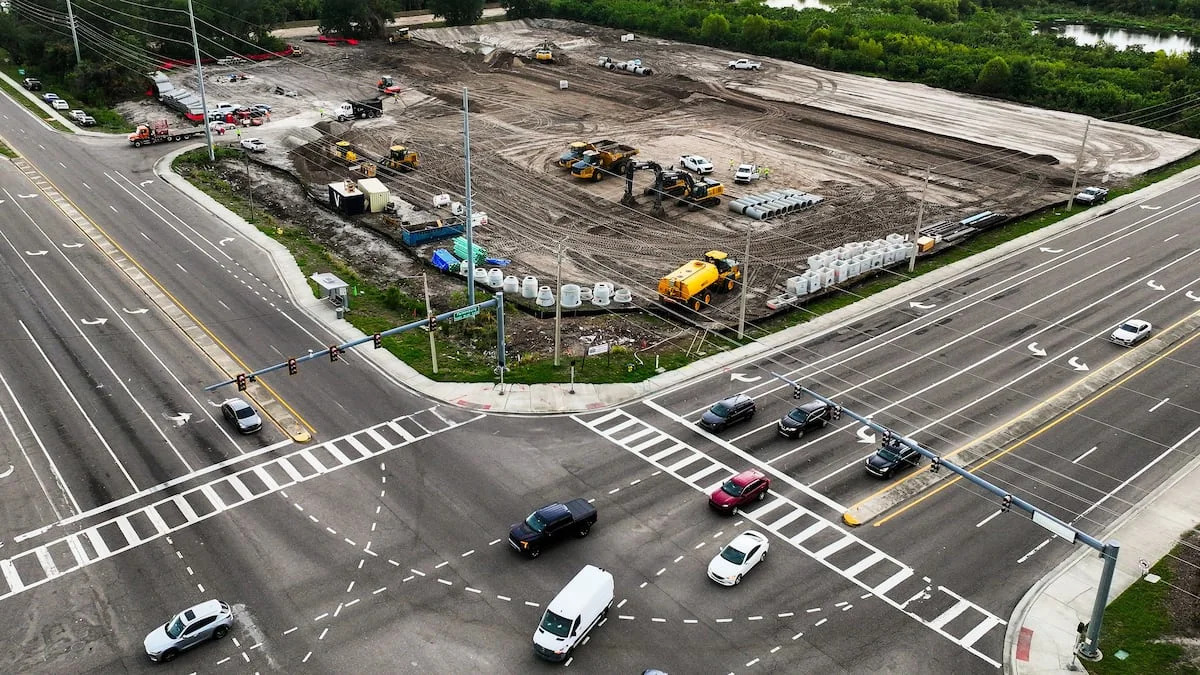
Last summer, the owners of an East Tampa trucking company illegally filled an acre of wetlands. Regulators fined the company but ultimately allowed it to continue building as long as it restored another wetland elsewhere.
Days later, a developer on an unrelated project got the go-ahead to develop another 2 acres of wetlands. This time, it was a gated, 211-unit apartment complex in Riverview that enticed residents with a golf simulator, swimming pool and dog park.
And a month after that, regional permitting officials approved a commercial projectthat will stripa half-acre of flood-reducing wetlands from Progress Village, a historically Black community with chronic drainage problems that was inundated during Hurricane Milton.
All three developments led to wetland restoration20 miles away.
What do these projects, and more than a dozen others in Hillsborough County, have in common?
They would have been impossible more than a year ago.
A law that vastly expanded the scope of Florida’s wetlands mitigation banking system, where developers offset their environmental harm by purchasing credits for restoration elsewhere, went into effect with little fanfare last summer.
Over the past year, the state law has required regulators to greenlight development projects that had stalled when these credits ran out in heavily developed metro areas, including Tampa Bay.
The result: More than 32 acres of wetlands, equal to about two dozen football fields, were paved in Hillsborough County alone.
Under old rules, restorationhad been restricted to the watershed where developers built and filled in the original wetland. If a developer filled a wetland that drains into Tampa Bay, for instance, it would have to create awetland in that same basin. This meant that the wetland’s benefits — as a habitat to imperiled wildlife and as a natural flood barrier — would not be lost in that watershed.
Lobbyingfrom developers and others last year pushed through legislation that did away with the requirement. Now, developers looking to make up for wetland destruction can do so outside the impacted zone — for an added fee. Those in the industry told the Tampa Bay Times the law is a necessary compromise that has reduced project delays and given them more business.
But environmental groups who opposed the state bill from the start say it tightens developers’ grip on an already flawed system that commodifies Florida’s natural resources.
Bonnie Malloy, an attorney with environmental nonprofit Earthjustice, said the law will degrade habitats in urban areas in exchange for inferior, man-made wetlands in rural places.
“For decades now, Florida has not allowed this for a reason, and that reason is based on science,” Malloy said.
 What is wetland mitigation?
What is known as mitigation banking began in Florida in 1996 after environmentalists and developers pleaded for a better alternative to the patchwork of efforts that emerged after the Clean Water Act passed.
For two decades prior to that, the country’s wetland rules required developers who damaged a wetland to restore it on site. But researchers found that restoration projects often failed to improve habitats’ ecology.
Florida lost more than 260,000 acres of freshwater wetlands — nearly the size ofNew York City — from 1985 to 1996, according to the Florida Fish and Wildlife Conservation Commission.

So, the federal government found a way to regulate mitigation projects by creating a tradable credit that represents a wetland’s ecological value. This gave rise to the mitigation banking industry, where property owners restored degraded land in exchange for these credits. Mitigation banking became the de facto method in 1993 under the Clinton administration. A few years later, Florida followed suit.
The ultimate goal was to preserve the ecological benefits of the lostwetland by restoring another in the same watershed. Regulators and the industry call this idea “no net loss.” And to ensure projects are successful, the state withholds some of the banks’ funding until they are completed.
Still, during the first 20 years of mitigation banking from 1996 to 2016, more than 140,000 acres of wetlands, equivalent to three-quarters the size of Pinellas County, were paved over, according to a Massachusetts Institute of Technology study from April. The study also found that Florida companies trading these environmental credits made $2.4 billion in profit over the last 25 years.
But Florida’s rampant growth during the last few years threw the industry out of equilibrium.
Regulators release credits when banks have shown they are making progress toward restoration. Because demand outpaced the number of credits available in some basins, developers’ projects there came to a grinding halt.
What does the law do?
The 2025 law allows developers to seek wetland credits outside of the watershed where they are building, but only when there are no nearby credits available.
When restoring out of basin, regulators apply a “credit multiplier.” For instance, if developers paved overa wetland in the Tampa Bay drainage basin and restored another in the adjacent Hillsborough River basin, they will have to purchase 20% more credits. The farther away that restoration happens from the original watershed, the higher the multiplier.
Thomas Mullin, a Miami-based land use and environmental lawyer who advises developers on wetlands permitting, said the multiplier means that out-of-basin restoration benefits “a much larger geographic area.”
Mullin said the result is 20% more wetlands created than what had been destroyed. He called the law “a compromise” between business and conservation interests.
“The only land available nowadays, you know, is going to have environmental concerns,” Mullin said. “Could we always do more? Of course, but at some point you have to say, ‘Hey, listen, 20% is pretty good.'”
Industry weighs in on new rules
One year into the law’s lifespan, Mullin said he hasn’t seen the increase in permit approvals that developers had hoped for.
“There’s not been any real new releases, and the few that are bought, they’re bought up very quickly,” Mullin said.
Victoria Bruce is the CEO of the Mitigation Banking Group, a Florida company that manages mitigation credit sales, and a Winter Springs city commissioner.
While some areas, like Osceola County, are still nearly out of credits, she said regulators have ramped upreleases in places like Jacksonville, South Florida and Tampa Bay.
“I think the process has been wonderful, personally,” she said.
In Hillsborough County, state regulators approved 16 development projects over the past year that could not have moved forward without the law, according to the Environmental Protection Commission of Hillsborough County.
The Southwest Florida Water Management District, known as Swiftmud, approved 13 of those permits. The Florida Department of Environmental Protection, the agency in charge of regulating the state’s mitigation banking industry, oversaw three project permits.
It’s unclear exactly how many projects have been approved across the state.
An agency spokesperson did not respond to threeemails from a Times reporter asking for a complete list of statewide out-of-basin permits approved under the 2025 law.
“The Florida Department of Environmental Protection is taking steps to ensure the new law is applied consistently, including creating standardized credit availability forms for agencies and mitigation banks,” Alexandra Kuchta wrote in an email.
Michael Lynch, wetlands director for Hillsborough County’s Environmental Protection Commission, applauded the state agency’s enforcement of the law. State officials host monthly meetings with other local regulators to standardize howitis applied across agencies.
“The criticism really is that mitigation isfarther from where the actual impacts are,” Lynch said. “And that’s kind of the question: Does this reduce the ecological connection between the impact site and the mitigation site? I think this is one of the things that — it’s going to take more time, a little bit more data collection.”
 How could this hurt the state’s dwindling wetlands?
Decades of research shows that the ecological benefits of mitigation banking in Florida had been unproven long before the new law.
A state-led study in 2007 reviewed the first decade of mitigation banking in Florida. It found that banks placed more importance on permit-related tasks, like removing invasive species and filling ditches, than they did on achieving a functional wetland.
A decade later, another group of researchers revisited the topic after noticing that the distance between where wetlands were destroyed and where they were restored had grown. They found that mitigation banks didn’t prevent “a decrease in the surface area of wetlands in Florida.” The researchers doubted that “no net loss” of habitat could be achieved by banks.
Malloy, the environmental lawyer, said the law will cause the distance between banks and developed land to grow even more. It also puts one species at greater risk than before: the Florida panther. South and southwest Florida, the last remaining habitat for the likely fewer than 200 adult panthers left, is “under insane development demand,” she said.
“One of the large reasons why some development hasn’t been occurring in those areas is because they can’t get mitigation credits,” Malloy said. “This is a handout to developers and especially ones that want to develop in the high-pressure zones in Florida.”
• • •
The Tampa Bay Times launched the Environment Hub in 2025 to focus on some of Florida’s most urgent and enduring challenges. You can contribute through our journalism fund by clicking here.