
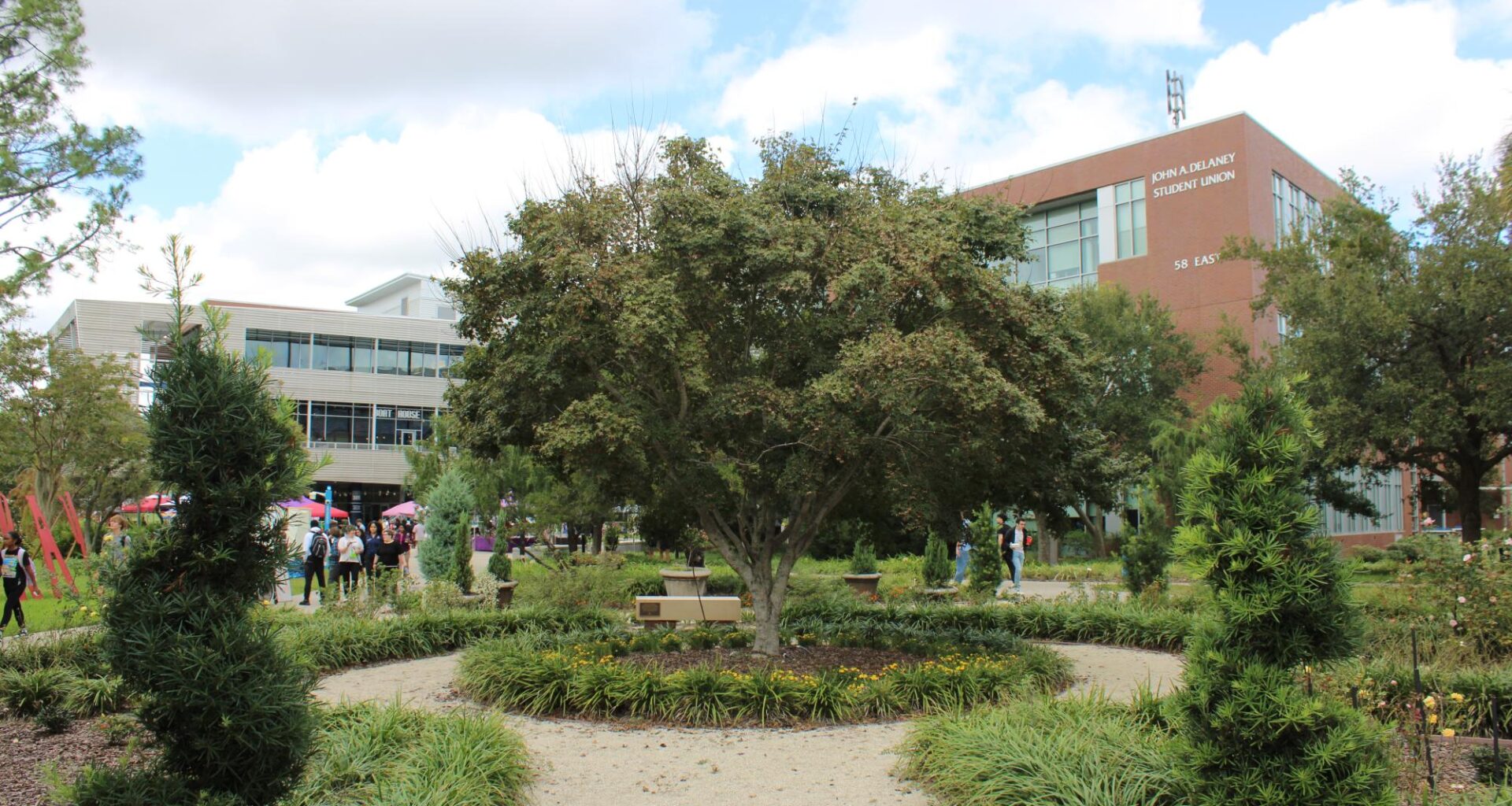
As artificial intelligence reshapes the job market through applicant tracking systems, faculty at the University of North Florida are teaching students how to adapt to new AI tools.
With nearly 99 percent of the 500 largest U.S. corporations using some form of ATS, according to Jobscan, resumes can be scanned by algorithms and applications filtered before reaching employers. To combat this, John Parmelee, director of the School of Communications at UNF, said the university is adapting by introducing AI-focused coursework.
Job rejections
David Rodebaugh, a UNF student double majoring in Finance and International Business, is no stranger to the “struggles” of the new era job application process, with the AI systems often generating a rejection letter just minutes after submission.
“It just gets so discouraging knowing that no one is actually looking at your application,” Rodebaugh said. “Sometimes it’s like 3 a.m., minutes later, so you know it’s probably AI,” he said.
That discouragement is something UNF faculty are actively working to address with new coursework and programs to make them better job candidates, according to Rachel Riggs-Achorn, an assistant professor of public relations in UNF’s School of Communication.
“Students still need to understand how to use these AI systems for the workplace,” Riggs-Achorn said. “We are being told that companies are using these programs, and we want students to know how to use these tools,” Riggs-Achorn said.
AI vs. AI
Rodebaugh said that one of the university’s finance professors, Pieter de Jong, highlighted the importance of resume and cover letter formatting for the AI applicant tracking system.
“He sent us a list of flag words and tools to use on your resume,” Rodebaugh said. “Things like don’t use multiple columns. If the PDF isn’t readable, the system will throw it away.”
De Jong, a finance professor at UNF and the director of the Master of Science in Fintech program, said AI tracking software is becoming more prevalent in the job market, forcing applicants to become more proactive in the job market.
“It is particularly difficult for entry-level positions since there are now so many applicants applying for the same position, and it seems that candidates would need to tailor their resumes to match with the keywords in the job description,” de Jong said.
De Jong said students can use AI to tailor their resumes depending on the job posting, but said that there are limitations, with AI having its imperfections.
The AI is programmed to appeal to the student using the algorithm, but also is being asked to appeal to the employer of the application, which “could result in a false positive”, according to de Jong.
“It is always better to have a human check your work,” de Jong said.
AI in the classroom
Parmelee said that UNF had added several new AI-centered courses into the curriculum to help students learn AI tools that could be implemented in the workplace.
The curriculum includes Global Communication in the Age of AI, Content Creation and AI, Advanced AI Literacy, AI and Media Ethics, and AI Video Effects, according to Parmelee.
Parmelee said student organizations like the School of Communications Multimedia Club and the Public Relations Student Society of America often host events with industry professionals. This allows students to get comfortable with AI tools in a professional context before entering the workforce, according to Parmelee.
“If students take the time to be involved in all these activities, they will already be on a first-name basis with many of these media executives they want jobs from, and that will increase the callback rate,” Parmelee said.
Using AI as a tool, not an author
UNF faculty members are hoping that students will use AI responsibly, allowing their critical thinking to stay in the process and using artificial intelligence as a tool rather than a shortcut, according to Riggs-Achorn.
“Being able to form thoughts and coherently write them down, revising, and actually thinking your idea is what demonstrates a cognitive sense-making process that you skip if you just put that into ChatGPT and copy-paste your output,” Riggs-Achorn said.
According to Riggs-Achorn, students solely relying on AI systems for problem-solving isn’t effective long-term.
“If you remove the friction from that and you just plop in what your problem is, they are only going to give you what has been done in the past,” Riggs-Achorn said. “At some point, that is not going to be enough, and we will have to think critically.”
Riggs-Achorn said that faculty understands that students are entering a difficult job market and recalls being in college during the 2008 recession, watching her older cousin enter a similarly unsteady workforce.
“The world kind of felt how it does now, where everything seemed kind of in flux,” she said. “The market will stabilize. We have been here before.”
Riggs-Achorn said the faculty do not want students to feel demotivated by the job market.
“It’s not perfect right away, and you have to pivot sometimes,” Riggs-Achorn said. “If you cannot, then we will not have anyone who will be able to help us fix all the larger problems in the world.”
___
For more information or news tips, or if you see an error in this story or have any compliments or concerns, contact [email protected].