
There’s something vaguely familiar about a night at O-Ku.
Neon script casts a light purple hue on the bar where guests sit elbow-to-elbow sipping lychee martinis and sake flights. In the packed dining room, blonde wooden booths curve throughout the space while diners fawn over plates of glistening nigiri and sushi rolls, charcoal-grilled robata skewers and cook-your-own wagyu displays.
In the back of the room, near the jam-packed bar, a sign reading “Omotenashi” lends a nod to the Japanese philosophy of selfless hospitality.
In an increasingly saturated landscape of broadly themed pan-Asian concepts and high-end Japanese eateries, this new South Tampa restaurant could get lost in the noise — just another place taking a stab at the upscale sushi game. But O-Ku, the latest from the Charleston, South Carolina-based Indigo Road Hospitality Group, manages to impress, and that’s likely because the restaurant is already a well-oiled machine.

Yes, O-Ku is a chain: The group runs 10 locations across the South and Southeast, including ones in Alys Beach and Jacksonville Beach. A great deal of its success likely hinges on culinary director Masatomo Hamaya, a Tokyo native and tenured chef whose resume includes esteemed restaurants like Uchiko in Austin, Texas, and Ozumo in San Francisco. The menus at O-Ku vary from place to place, and the chefs tapped to lead each location — in Tampa’s case, executive chef Billy Brannen — are given a good amount of creative leeway, which helps shake off some of the one-size-fits-all vibes.
The menu here is massive (I counted more than 60 dishes, not including the voluminous nigiri or sushi options) and feels designed both with raw fish enthusiasts and those with slightly less adventurous palates in mind. And though it can be hard to know where to start, keep in mind that the focus is on sharing, so most of the menu is made up of a collection of small plates.

Crudos and any of the raw preparations are a good primer, including a gorgeous raw scallop dish — Hotate Haru ($27) — that features Hokkaido scallops fanned out alongside juicy strawberries in a floral strawberry ponzu. Each bite is punctuated by the salty pop of ikura (salmon roe) and the light zing of yuzu oil. In the Sake Usuzukuri ($21), silky slices of salmon swim in a truffle ponzu, with a crackle of black lava salt. And the Otoro toast ($30) makes for a particularly decadent bite, where crispy planks of Japanese milk bread come topped with silky bluefin tuna belly and a buttery lobe of uni, paired with caviar and pickled wasabi stem and finished with a truffle-laced ponzu.
As with a few other upscale Japanese restaurants in the area, O-Ku sources a good deal of its fish from Tokyo’s esteemed Toyosu market. Bluefin tuna frequently comes from Spain or Mexico. When available, Brannen said, he plans to incorporate local fish, too.

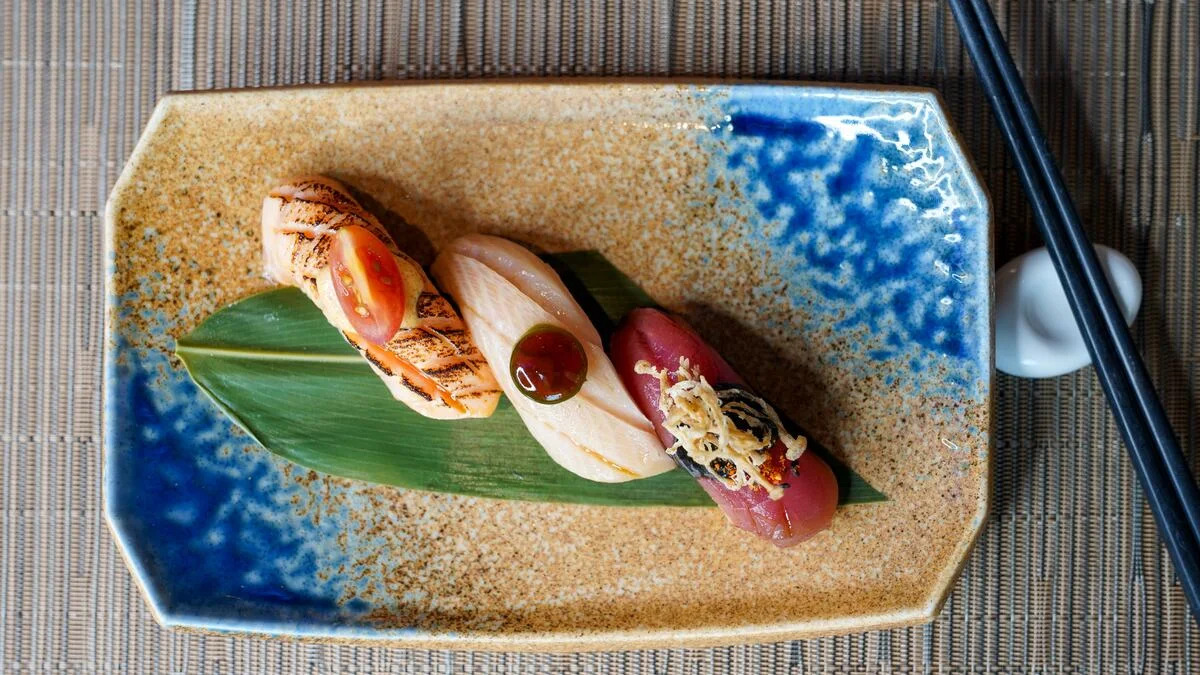
Guests can order from a selection of standard nigiri or sashimi or opt for one of the kitchen’s many signature creations. These are pricier, hovering between $10-$12 for one piece, but also very good. It’s lovely to watch a procession of each fish arrive, from the delicate Madai Hana (Japanese sea bream) with yuzu kosho and a shiso flower; to the Hama Toro (yellowtail belly) dotted with a sweet ponzu jelly and topped with a sliver of serrano pepper; to the Sake Mentaiko, where barely torched salmon belly comes with a dollop of creamy mentaiko (pollock roe) mayonnaise and a tiny slice of cherry tomato.
There’s an expansive list of rolls, ranging from the hakozushi — Osaka-style pressed rolls — to temaki (handrolls) and traditional makimono (rolls). For the sake of brevity, I’ll dole out two favorites: For the hakozushi, the spot’s Black Magic is eye-catching (and a constant on all O-Ku menus), featuring a jet-black plank of squid ink rice topped with tempura-battered lobster, masago (capelin fish roe) and a spicy aioli. On the temaki list, a version featuring Japanese A5 wagyu ($20) is a stunner, coupling the just barely torched steak with soy-braised shiitake mushrooms and chili crisp.


As the menu winds along into more composed dishes, the kitchen takes some strides into Japanese and pan-Asian themes, with a particularly strong robata program. In a nod to traditional Japanese robatayaki, skewers of meat, fish and vegetables are cooked over charcoal from Japanese oak, imbuing everything with a light, but not overpowering, smoky flavor. These range from the Chicken Negiyaki ($16), where chicken thighs are stacked beside green onions in tare (a sweet and savory soy-based sauce) to bacon-wrapped scallops ($22), which arrive lacquered in a tasty ponzu butter. Sweet and smoky chargrilled corn ($12) arrives drizzled in kewpie mayo and topped with togarashi.
While most of the menu here reads rehearsed and polished, it’s not always perfected, in particular when seasonally finicky items come into play. That was the case with a kanpachi crudo ($25) on one visit, where a visually striking plate paired thick slices of raw amberjack with mealy slices of plum. The sweet lychee vinaigrette, smoked trout roe and herb oil on the plate worked beautifully together, but I couldn’t get past the unfortunate pairing with a plum that had definitely seen better days. On another visit, a hanger steak ($46) was cooked perfectly, but overpowered by a thick glaze of black garlic shoyu and a medley of kimchee peaches, both which felt like they were competing for attention.


There have been improvements. On separate visits, both the cocktails and service were notably better the third time. And while on my last visit the restaurant was, unfortunately, out of the delectable-sounding miso caramel soft-serve (the machine was broken), our server’s recommendation to get the Sata Andagi ($13) more than made up for it, with the Okinawan-style donuts dusted with sesame sugar and dipped into a delicious sweet and salty miso caramel sauce.
The restaurant, which sits in a newly developed corner space on the ground floor of Bayshore Gardens overlooking Bayshore Boulevard, is a beautiful, buzzy space filled with beautiful, buzzy people — this is the heart of South Tampa, after all. And for now, O-Ku is the new hot kid on the block: Without a reservation, you’re going to have a hard time getting in close to primetime.
And for good reason: In a landscape teeming with upscale Japanese and pan-Asian options, O-Ku still stands out.
 If you go to O-Ku
Where: 2907 W. Bay to Bay Blvd., Tampa. o-kusushi.com/location/tampa
Hours: Dinner, Sunday through Thursday from 5 p.m. to 10 p.m., Friday and Saturday from 5 p.m. to 11 p.m.
Prices: Robata, $11 to $22; nigiri and sashimi, $10 to $21; makimono $14 to $24; chef’s specialties, $17 to $60; entrees, $28 to $46.
Don’t skip: Otoro toast; wagyu temaki; bacon-wrapped scallops; Black Magic roll.
The details: Parking is available on-site in a garage behind the building complex but needs to be validated at the front desk with the host. Wheelchair accessible.
• • •
The Tampa Bay Times Food Hub launched in 2026, a four-person team covering Tampa Bay’s dynamic and expanding food scene. You can contribute to the hub through our journalism fund by clicking here.
Want food news weekly in your inbox? Sign up for our newsletter.
Top 50 Restaurants: Check out our food critic’s list of the area’s best spots.
Follow our updates on the local restaurant landscape on Instagram at @tampabaytimesfood.