
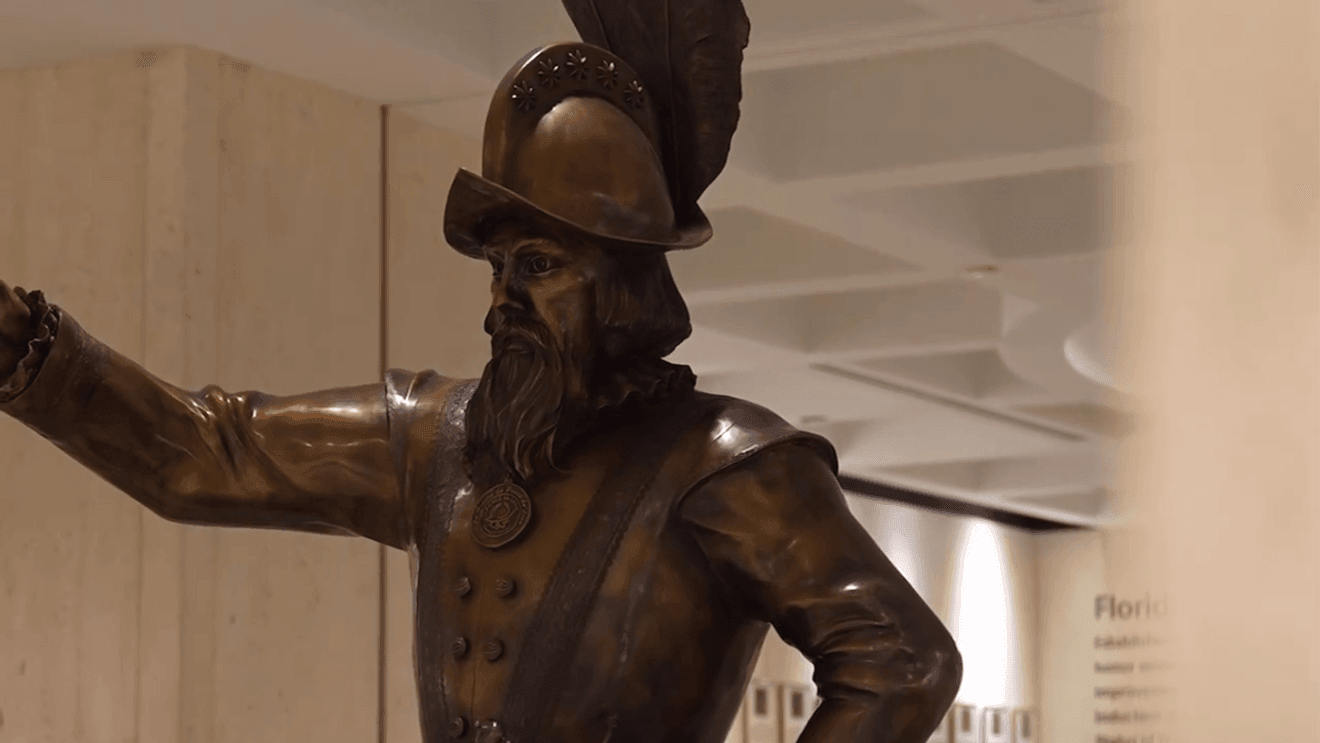
LEON COUNTY, Fla. — A new statue honoring Spanish explorer Juan Ponce de León now stands inside the Florida Capitol in Tallahassee, unveiled by Gov. Ron DeSantis as part of the state’s broader effort to highlight Florida history ahead of the nation’s 250th anniversary.
The statue is positioned within the Capitol, across the main plaza from a statue of President George Washington. It is intended to commemorate Ponce de León, who led what is described as the first notable European expeditions to Florida in the early 16th century.
“Today, we unveiled a new statue of Juan Ponce de Leon at Florida’s Capitol, honoring the explorer whose arrival in 1513 marked the beginning of Florida’s written history and gave our state its name,” DeSantis said. “Florida’s story began long before statehood or even at America’s founding—it stretches back more than five centuries and helped shape the nation we know today. As America celebrates its 250th anniversary, Florida is leading the way by preserving and celebrating our history.”
Florida Department of Environmental Protection Secretary Alexis A. Lambert said the agency maintains historical records tied to early exploration.
“It is an honor to take part in commemorating Ponce de León for his pivotal role not only in Florida’s history, but in world history,” Lambert said. “Today, the Department of Environmental Protection maintains many of the original Spanish language land records from the exploration of Florida, preserving this priceless piece of our state’s history.”
Secretary of State Cord Byrd pointed to the 1513 expedition as a key moment in Florida’s recorded past.
“The first record of Europeans in Florida was the Juan Ponce de Leon expedition in 1513,” Byrd said. “Ponce de Leon’s legacy of exploration still echoes through the centuries, and on this 250th anniversary of our nation, the spirit of discovery continues to shape Florida.”
Bryan Griffin, president and CEO of VISIT FLORIDA, said the statue recognizes the explorer’s role in the state’s origins.
“Ponce de León played an instrumental role in our state’s history, even bestowing upon us the name La Florida,” Griffin said. “Our rich history is a fascinating and important story, and it is fitting that we honor the individuals who shaped it with lasting monuments for residents and visitors to enjoy.”
According to the information released with the unveiling, Ponce de León’s expedition reached an unfamiliar coastline in March 1513, which he named La Florida (“the flowering”) for its natural beauty. While the exact location of his landing remains disputed, he navigated the Atlantic coastline south to the Florida Keys. On his return to Florida in 1521, he was wounded and killed by the native Calusa people. He was interred within the Cathedral of San Juan Bautista in Puerto Rico, where his tomb is inscribed: “Under this structure rest the bones of a lion, more for his great deeds than for his name.”
The statue unveiling is part of Florida’s America250FL celebration, which includes educational initiatives, historical exhibits, commemorative events and public monuments intended to highlight the state’s role in American history and promote civic understanding.
The Ponce de León statue is also described as the latest in a series of monuments tied to the namesakes of Florida counties. On July 1, DeSantis unveiled a replica of the Liberty Bell in Liberty County.
Last year, DeSantis announced plans to place statues of America’s Founding Fathers in counties bearing their names across Florida, including Thomas Jefferson, Benjamin Franklin, James Monroe, Alexander Hamilton, George Washington and James Madison. Other recent Florida statue unveilings cited include President Ronald Reagan at Florida International University, Frederick Douglass in St. Augustine, President Calvin Coolidge at Bok Tower Gardens, and Abraham Lincoln in The Villages.