
On a sweltering afternoon in early July, the future kickball field behind Accord Social looks like the aftermath of a small earthmoving campaign. Fresh tread marks from heavy equipment crisscross the compacted earth. Concrete utility covers protrude from the ground like stepping stones to nowhere. A pile of uprooted brush waits to be hauled away, while stacks of landscaping materials sit off to one side. The broad lawn the owners keep describing is already there, if you’re willing to squint.
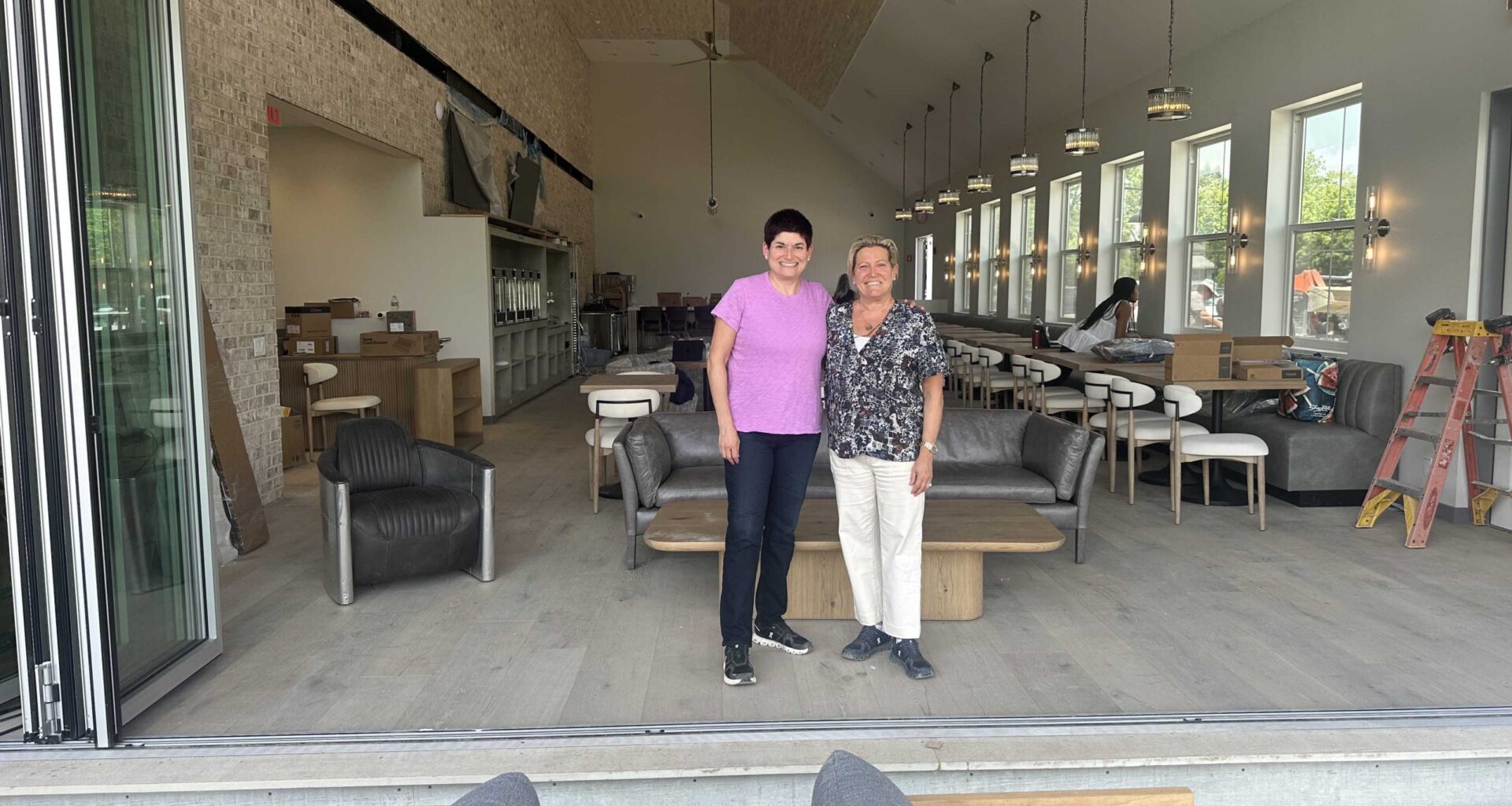
Inside, however, the restaurant already feels remarkably complete. Afternoon light pours through a wall of folding glass doors that opens onto a broad covered terrace overlooking the valley and Mohonk Mountain House in the distance. The dining room, with its soaring wood ceiling, caramel leather banquettes, and generous scattering of couches, is arranged less like a traditional restaurant than a place people might settle into for the better part of an afternoon. Along one wall, a self-pour system stands ready to dispense wines, beers, cocktails, and nonalcoholic drinks by the ounce. There are details still to finish before opening day, but very little imagination is required to picture the room filled with people.
Leslie Firtell walks toward the unfinished field and points. “We’re going to play kickball here,” she says. Not children. Adults.
It is an odd thing to hear from someone preparing to open a restaurant, but the more time you spend talking with Accord Social’s owners, Firtell and her wife, Michelle Morgan, the more the remark begins to make sense. Kickball, after all, has almost nothing to do with food. It has everything to do with why they’re here.
An Adult Clubhouse
Restaurants usually begin with a chef or a cuisine. Accord Social begins with a different premise. Firtell and Morgan believe the Rondout Valley has room for another restaurant, certainly, but what it really needs is something closer to an adult clubhouse with a serious kitchen attached: a place where people might spend time together without feeling hurried along. Somewhere you might stop for a drink and wind up staying for dinner. Somewhere you might bring a laptop on a Friday afternoon, meet friends on the patio, join a mahjong game, or simply strike up a conversation with the people on the next couch.
The physical space grows directly out of that idea. Firtell and Morgan didn’t renovate an existing restaurant; they demolished a house and built this one from the ground up. They resisted filling every square foot with dining tables, choosing instead to carve out corners where people can linger over a bottle of wine and a charcuterie board. They installed the self-pour wall not because it’s novel—though around here it is—but because they liked the idea of someone tasting three wines before deciding on a glass. Even the broad lawn behind the building was conceived not as scenery but as programming, a place for adult kickball leagues, lawn games, concerts, and the sort of unplanned encounters that are difficult to manufacture.
 The future kickball field behind Accord Social was still taking shape in early July. Rather than treat the lawn as scenery, owners Leslie Firtell and Michelle Morgan designed it as an extension of the restaurant itself.
Neither woman comes from the restaurant business. Firtell spent three decades building a legal staffing company before selling it to private equity. Morgan is an obstetrician-gynecologist. The couple bought a home in Accord in 2014, long before they began imagining a restaurant, and over the ensuing decade came to know the rhythms—and the absences—of life in the Rondout Valley. They found restaurants they enjoyed, but they kept returning to the same idea: there wasn’t quite a place that invited people simply to stay.
They’re well aware that restaurants are an improbable second act, a business defined by narrow margins, exhausting hours, and spectacular flameouts. They also know that if the goal were simply to make money, there were easier ways to spend the next chapter of their lives. “We reached a point where we wanted to do something different,” Morgan says. “We wanted to do something for the community that we love.”
That sentence is easy enough to dismiss as opening-day optimism. Every new restaurant promises to become a gathering place. Every coffee shop aspires to be the neighborhood living room. Hospitality is full of borrowed language about community.
Accord Social, though, has been designed around that idea in a way that feels unusually literal. The architecture encourages lingering. The programming extends well beyond dinner service. Even the menu is built around sharing. Whether any of it works is another question, but it’s difficult to accuse Firtell and Morgan of treating community as a branding exercise. They’ve invested too much concrete—and too much actual money—in the proposition.
There was only one problem. Neither of them had ever opened a restaurant before.
Finding a Guide
A mutual friend suggested they sit down with Ric Orlando, the chef behind New World Home Cooking, the influential Saugerties restaurant he ran for a quarter century. They needed advice. Orlando assumed he’d offer some. “I asked, ‘What do you do? What’s the plan?’” he recalls. “They said, ‘We’re building a restaurant.’ I asked, ‘Really? Where?’ They said, ‘In Accord.’ I was like, ‘Really? You’re not planning on making money, right?’”
The line gets a laugh, but it isn’t entirely a joke. Orlando has survived enough Hudson Valley winters to know that opening a restaurant and keeping one open are two very different propositions. Summer and fall carry the business. February asks harder questions. He remembers New World finishing Columbus Day with a healthy bank account only to spend the next several months watching it slowly disappear while waiting for spring. “It’s an egg-shaped economy,” he says. “We ended by Columbus Day with a big, fat bank account and by April [we were] waiting to pay your bills.”
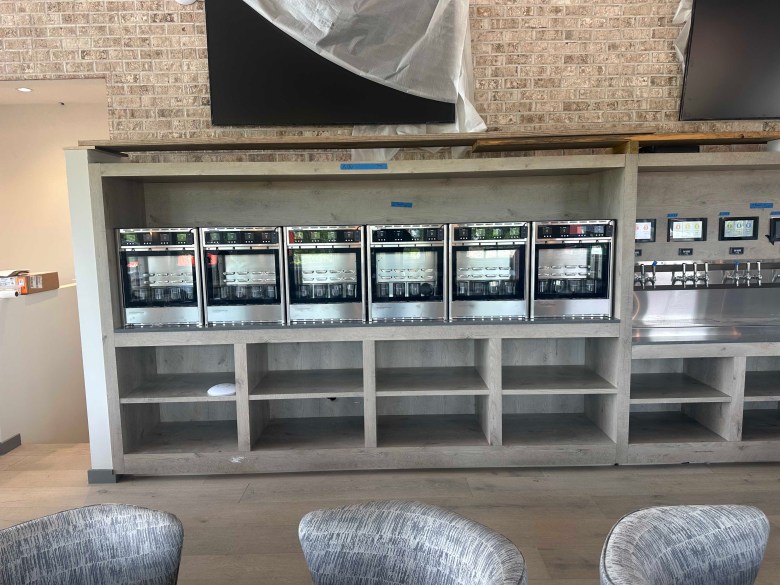 Accord Social’s self-pour wall allows guests to sample wines, beers, cocktails, and nonalcoholic drinks by the ounce before committing to a full pour—a feature owners Leslie Firtell and Michelle Morgan hope encourages lingering and exploration.
What began as an introductory meeting gradually turned into something else. Firtell and Morgan weren’t looking to recreate New World, nor were they searching for a marquee name to stamp on the menu. They already knew the kind of place they want to build. What they needed was someone to translate that vision into the practical language of restaurants: menus that can survive a Saturday-night rush, kitchens that flow, equipment that makes sense, pricing that keeps the lights on, and service that encourages people to linger without bringing the dining room to a halt.
For Orlando, the role proved unexpectedly appealing. Since closing New World in 2018, he has spent the better part of eight years constructing what he jokingly calls his culinary bucket list. He consults on restaurant projects, cooks fundraisers, develops products, and leads increasingly popular food tours through Sicily, Puglia, and northern Italy. It is a life with fewer late nights and a good deal more freedom than running a restaurant, and he hadn’t been looking to give it up.
Then something surprised him. He missed the hurly-burly of a busy restaurant kitchen. “It’s my happy place,” he says. “I really like it. I really miss it.”
What Orlando missed isn’t ownership or the pressure of Saturday-night service. It’s the peculiar social world that exists inside a working kitchen. “I miss having five, six, seven people bouncing around, talking, joking all day and moving the body,” he says. “I do like that part of my life.”
A Jazzy Italian Kitchen
“When we first started talking [about the menu], I was doing global food,” Orlando says. “I was doing Ric food. We were all over the place.” Friends working in branding pushed them to simplify. “They said, ‘Pick something.’ So I suggested Italian.” Even that comes with an asterisk.
After spending much of the last eight years leading culinary tours through Sicily and northern Italy, Orlando returned less interested in reproducing traditional Italian cooking than in borrowing its spirit. “It’s not red sauce house, and it’s not that by-the-rules, austere Italian,” he says. “It’s a little jazzy Italian.”
The menu reflects that looseness. There are familiar Italian touchstones—Sicilian braised short ribs ($36), house-made pastas, and Ciccio’s rotisserie chicken ($29 half/$56 whole) carved for the table—but they’re filtered through Orlando’s lifelong fascination with global flavors. His signature Thai Italian Love ($29) returns from the New World years, marrying Penang-spiced Bolognese with coconut milk and pappardelle. An oyster mushroom carbonara ($28) delivers all the smoky satisfaction of the Roman classic while quietly acknowledging that many younger diners are looking for meatless options that don’t feel like consolation prizes. Even the pan-blackened string beans ($13), another New World staple, sneak onto the menu under the guise of Italian vegetables.
More revealing than any individual dish, however, is Orlando’s obsession with value. For all the changes in Hudson Valley dining over the last decade, one trend troubles him. Menus have grown shorter. Prices have climbed. Going out to dinner has increasingly become an occasional splurge rather than an ordinary weeknight pleasure.
There’s even a term for it, he says: “menu fatigue.” “I have plenty of money,” Orlando says, “but I still cringe when it’s $208 for two glasses of wine and some food.”
Accord Social isn’t trying to compete with destination restaurants where dinner becomes an event. Orlando pushed instead for a menu with multiple entrees under $30, a $10 glass of house wine, and enough shareable plates that a table can assemble a meal without committing to a parade of expensive mains. It’s an argument for frequency over spectacle—for creating a restaurant people can afford to visit twice a month instead of twice a year.
Firtell and Morgan’s original ambition depends on that philosophy. If the point is to build a place where people gather, then the economics have to encourage gathering. The couches are an invitation to linger. The self-pour wall encourages curiosity. The menu, Orlando hopes, gives people a reason to come back before the memory of the last meal has faded.
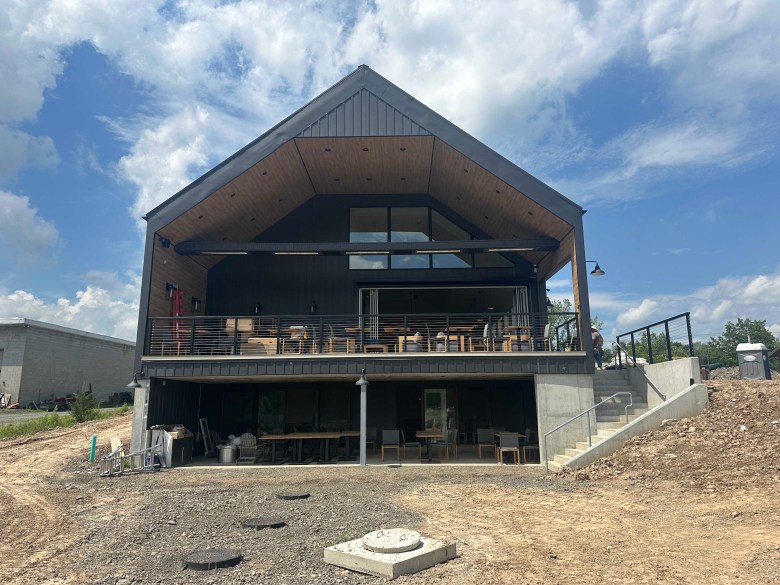 Accord Social was designed to blur the line between indoors and out. Folding glass walls open the dining room onto a covered terrace overlooking a lawn that owners Leslie Firtell and Michelle Morgan plan to use for concerts, lawn games, and community events.
The Social Experiment
Restaurants are built around a simple equation. Fill the seats. Turn the tables. Do it again.
Accord Social is making a different bet. It wants people to linger. To order another glass of wine. To wander out to the lawn. To come back for mahjong on Wednesday and kickball on Friday. It is, in effect, trying to bolt an adult clubhouse onto a restaurant.
Whether the food is good will become apparent quickly. Whether the proposition work may take years to find out.
Accord Social is located at 4977 US-209, Accord and is slated to open in early August.
Related