
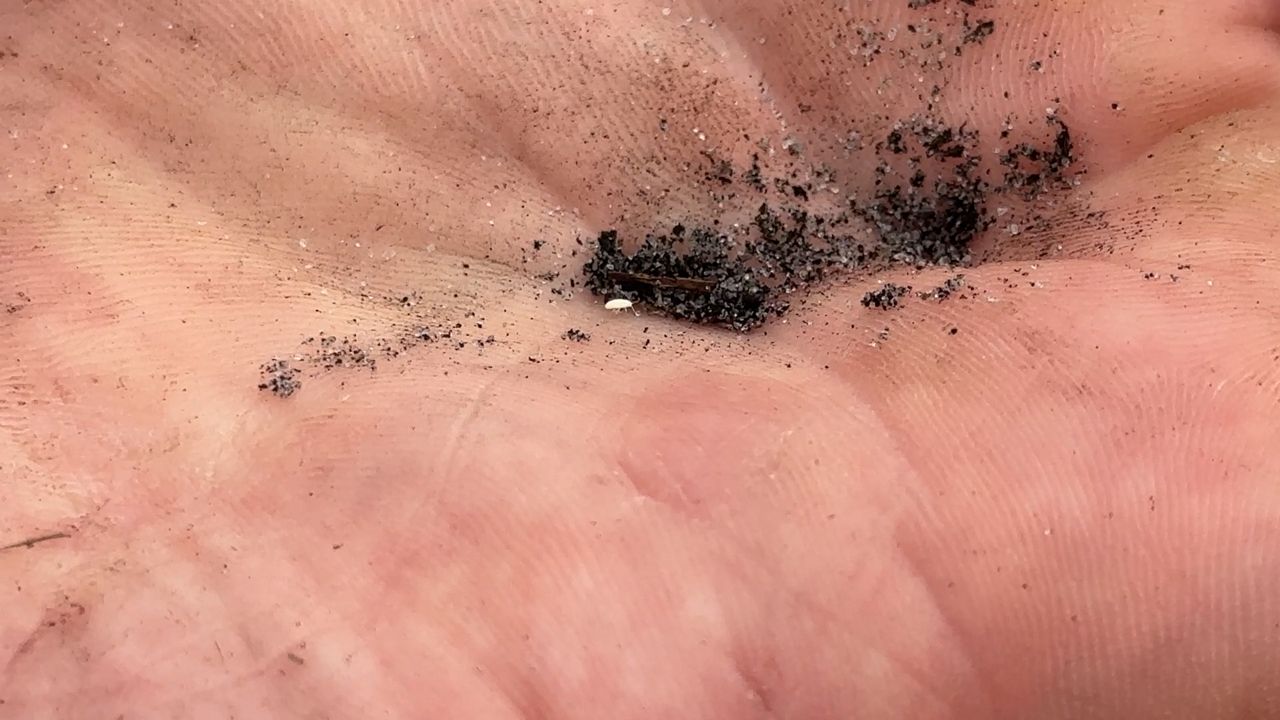
FROSTPROOF, Fla. — A recently discovered insect in Florida is damaging grass and creating challenges for cattle farmers, including at Crooked Lake Ranch in Polk County.
The pasture mealybug feeds on a variety of grasses and sugarcane.
David McCullers has worked at Crooked Lake Ranch for decades and said he has never dealt with an infestation like this.
“I’ve been doing this since I was 10. I’m 66 years old, and that’s the first time I’ve ever experienced something that would actually take out the plant,” David said.
The pasture mealybug is tiny and looks more like a speck of snow than an insect. McCullers said he did not immediately know what was causing the red color in the grass.
“I noticed the production was dropping off in the return of these rotations, where I rotate through here with cattle,” he said. “So, as I noticed that I was thinking I was having a nutritional deficiency.”
David said he has spent thousands of dollars on sprays to fight the infestation, but the treatment killed only about 70% of the bugs.
His son, Dakota, a ranch and pasture specialist at Coastal AG Supply, said the Pasture Mealybug was discovered in Florida about three months ago.
“The way that they live in their habitat, you know, it’s really hard to get them to feed or either get an insecticide to actually touch the bug, to kill the bug,” Dakota said.
The insect is new to Florida, but not to the United States. Texas A&M professor David Kerns said the pasture mealybug is thought to have first shown up in Texas in 2022, though that was not known until 2025.
Before that, Kerns said, the bug was mainly found in Australia.
“I guess you could equate it to like how a mosquito feeds, but this insect… injects a toxin into the grass, and that toxin eventually can kill the grass,” Kerns said.
David said he is not the only cattle farmer dealing with the issue. He said just about every cattle farm south of I-4 is facing the same challenges.
“We’re trying to expand our herd with the drought that’s been going on, and with the mealybug, the expansion is going to be put on hold,” he said.
David said he worries the infestation will cost thousands more dollars before the problem is solved. For now, he said he is doing what he can to protect his grass and cattle.
Dakota said the pasture mealybug has natural predators, including ladybugs and fire ants. He said he believes a combination of natural predators, chemicals and more rain will eventually solve the problem.