
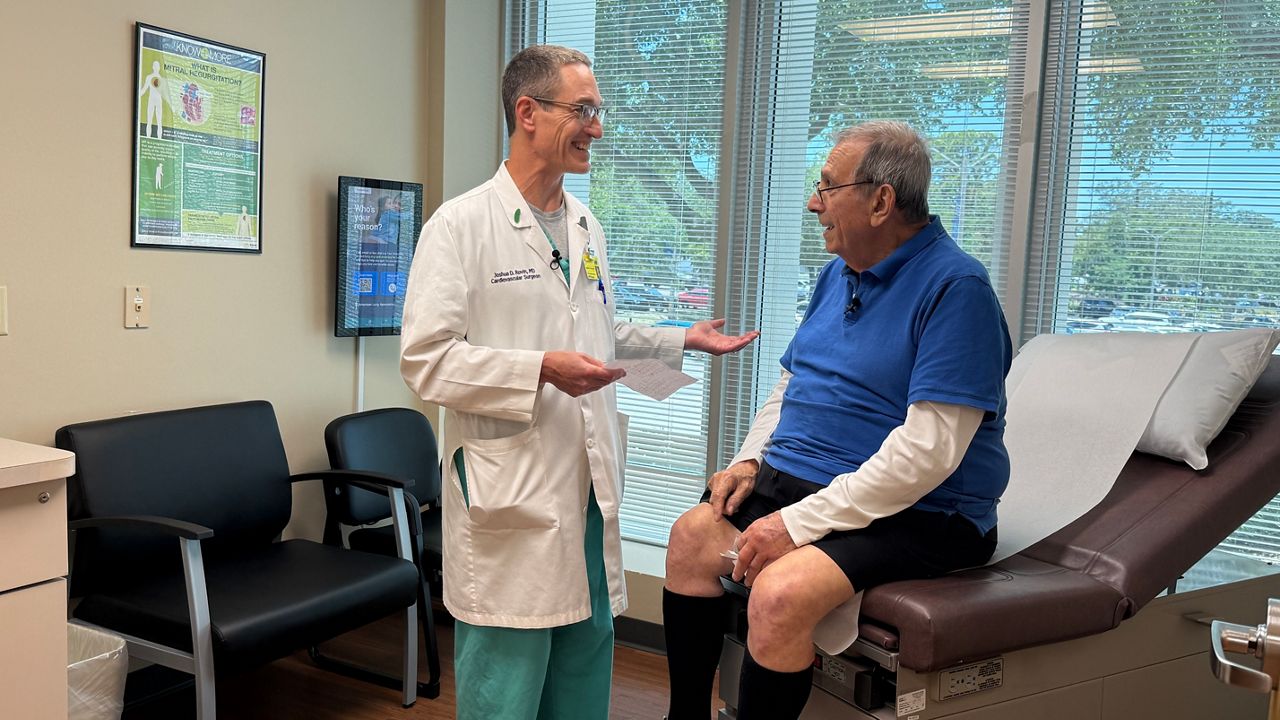
CLEARWATER, Fla. — When following up after any surgery, this is what doctors and patients always want to hear.
“I feel great,” said Leonard Marino.
“You look great,” said Dr. Joshua Rovin, the Structural Heart & Advanced Valve Center Director at BayCare’s Morton Plant Hospital.
“I feel really great, day and night,” said Marino.
These two are beaming during a checkup because the surgery Marino just underwent a month ago was the first for the Sunshine State.
“I was first, number one. Uno!” Marino said with glee.
The 85-year-old is extra happy because he knew that without the surgery, seeing the age of 86 or 87 might not have been in the cards.
He suffered from aortic regurgitation. That is when blood leaks back into the pumping chamber of the heart, causing a long list of ailments.
Perhaps the bigger issue, though, is that the only way to fix it until recently was open-heart surgery.
“At 85 years old, Doctor Rovin said uh-uhhh,” said Marino.
Many in their 80s and older are often not candidates for open-heart surgery. But Marino knew through Rovin that a new procedure was about to be approved by the FDA.
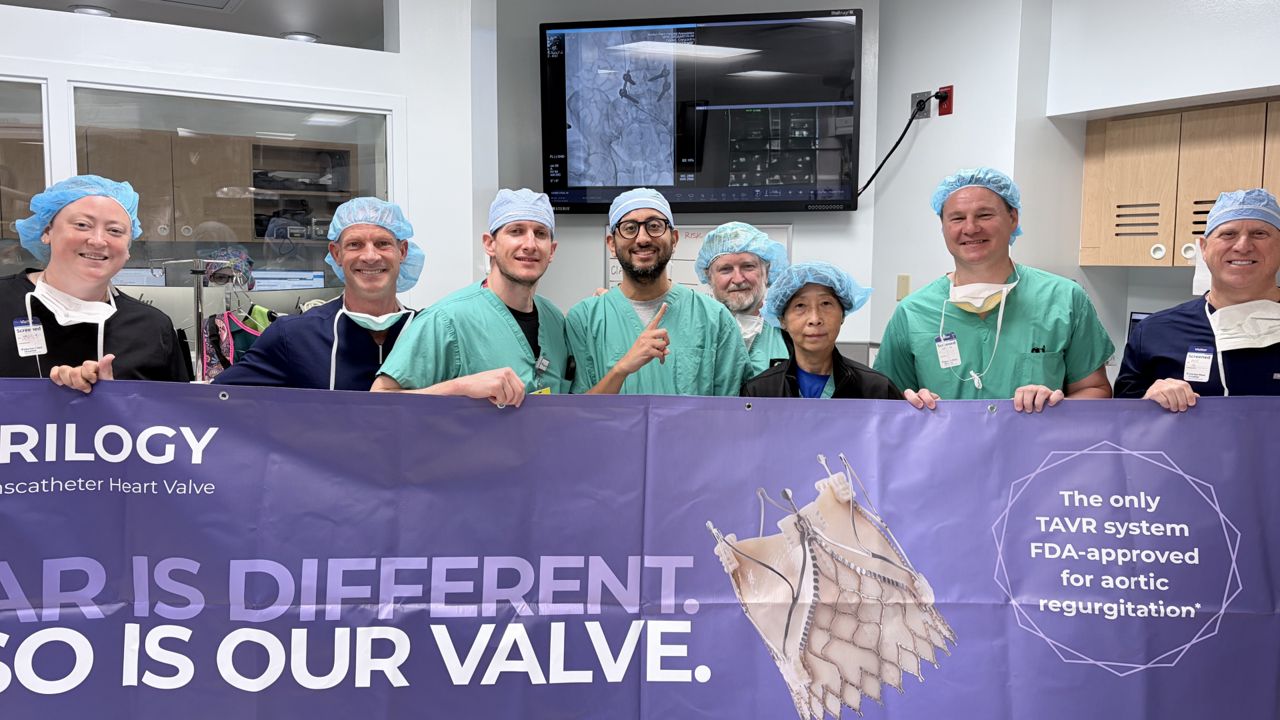
Photo courtesy: BayCare’s Morton Plant Hospital
“Lisa, his nurse, had said to me that just as soon as they approve, this valve will be on the phone to you. And she was,” said Marino.
“What we are looking at is the aorta, and the ventricle, and all of this bright yellow flow is the leakage back,” said Rovin, pointing to one of Marino’s early heart ultrasound scans.
In June, a team at Morton Plant Hospital placed a transcatheter aortic valve replacement device called JenaValve into his heart. They did this procedure through his femoral artery.
“What you see here is this TAVR valve, which is in this position here, and the valve is being pumped out, and it is just not leaking out or regurgitating back in,” Rovin said while showing the scans taken following Marino’s procedure.
BayCare has done a handful of these surgeries now, with several more patients to be next.
“This is game-changing technology for a subset of patients that can’t have open-heart surgery,” said Rovin.
This valve was studied at Morton Plant, and after excellent outcomes, the FDA has approved it for patients who are at high risk for open-heart surgery.
More and more minimally invasive procedures are getting approved for heart conditions these days.
“I think that absolutely this is the trend, right? We’re looking at different technologies that are less invasive, that allow patients to recover faster and get back to their quality of life,” Rovin said.
“Oh, difference? Are you kidding me? Day and night, day and night,” said Marino. “I have a lot to be thankful for.”
Rovin said this is for patients who have severe aortic regurgitation, not low or moderate risk.
But he said there are current studies underway for those types of patients. This could lead to most patients with aortic regurgitation not needing to undergo open-heart surgery.