
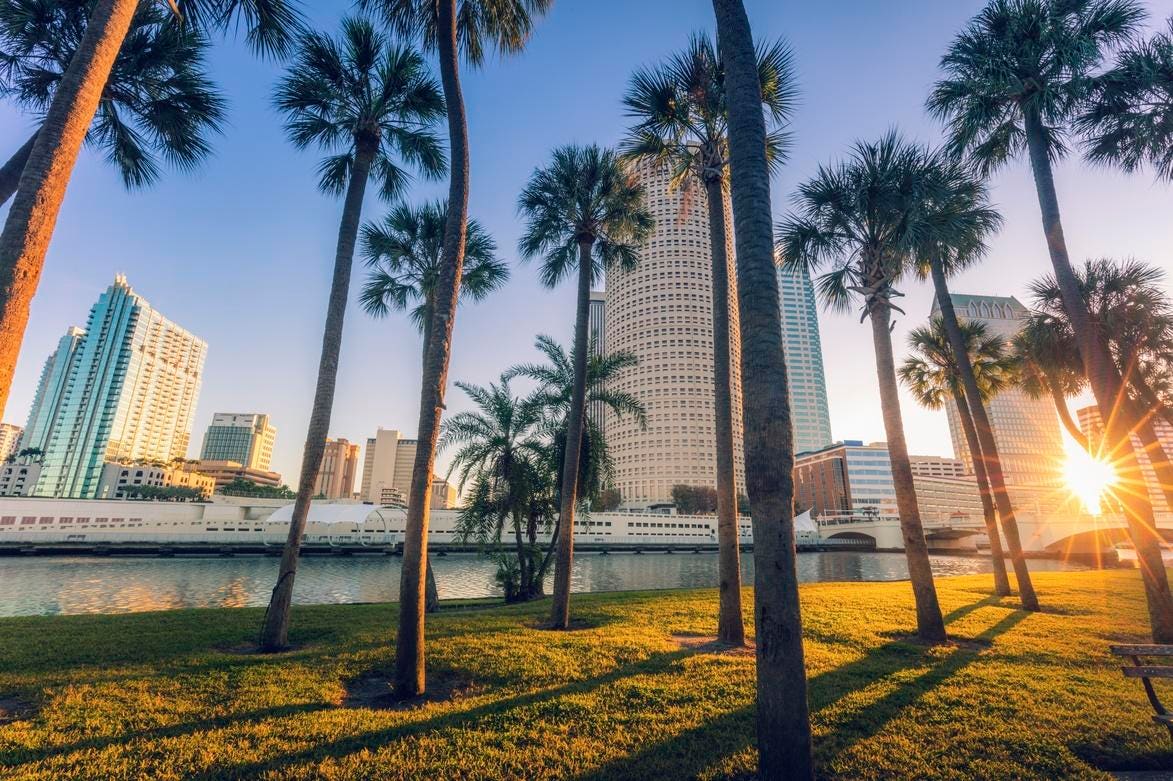
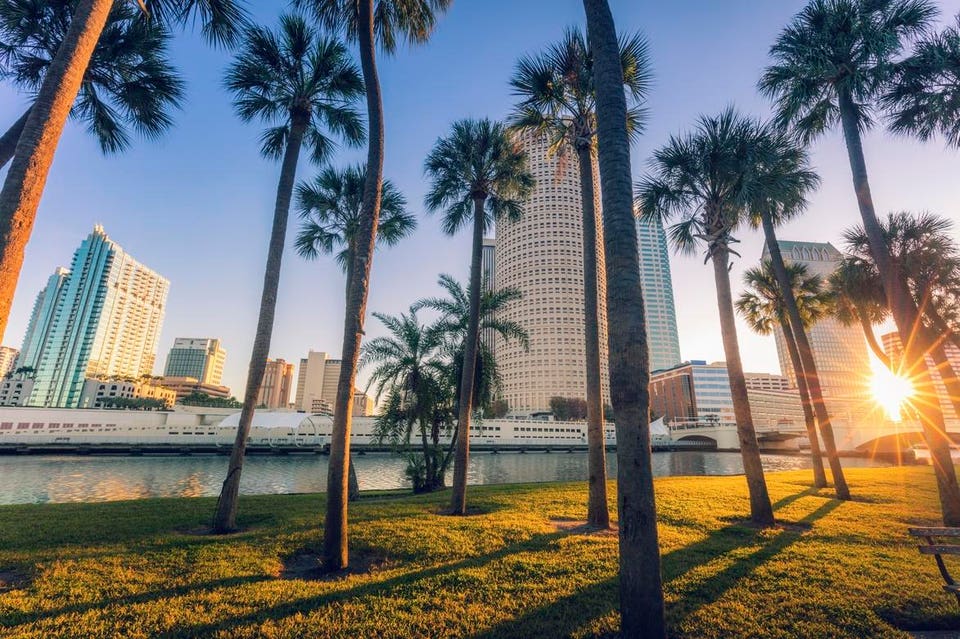
Downtown of Tampa. Tampa, Florida, USA.
getty
In 2023, the Tampa Bay metro posted a 95% net gain in millennial relocations, the highest of any U.S. metro that year. Nearly double the number moved in versus out. More than Austin. More than Nashville. More than Charlotte.
That stat has been a point of civic pride ever since. And if you’ve spent any time in Tampa’s Water Street district, a $3 billion mixed-use development that turned 50 acres of underused downtown land into a functioning waterfront neighborhood, you understand the pull. Restaurants. High-rises. A Marriott Autograph Collection hotel. The Amalie Arena two blocks away. It feels like a city that bet on itself and won.
Kenyetta Hairston-Bridges
Kenyetta Hairston-Bridges
“A lot of influencers live in Water Street,” Kenyetta Hairston-Bridges told me. She would know. Hairston-Bridges has been president and CEO of Tampa Downtown Partnership since July 2024, recruited from Detroit where she spent two decades running economic development across real estate, small business, and construction. If anyone has a read on who is actually choosing Tampa and why, it’s her. “When it boils down to it,” she said, “it’s the opportunity and the culture.”
That’s the pitch. It’s a compelling one.
But lifestyle doesn’t pay the rent.
The Vibe-First Move Has a Price Tag
The “lifestyle city” label has become Tampa’s signature. Time named it one of the World’s Greatest Places in 2023. Forbes called it the best place to live in Florida. TikTok filled up with relocation vlogs shot from rooftop pools. The content practically writes itself.
What the content doesn’t show is the spreadsheet.
Tampa Bay wages run 15.6% below the national average. That gap doesn’t disappear just because the weather is good and the state has no income tax. The math gets trickier when average rent in Tampa now sits at $2,010 a month, up sharply from where it was before the migration surge hit.
This is what I’d call the sunshine gap: the distance between the city’s quality-of-life reputation and what the job market can actually support. It’s the tension underneath every “I moved to Tampa and never looked back” post.
What the Job Market Actually Offers
To be fair to Tampa, the economy is not a one-trick pony. That’s the thing Hairston-Bridges wanted me to understand before I filed a quick “warm weather and low taxes” take.
The city’s industry mix includes financial services, a large tourism economy with working cruise ship terminals, healthcare, and a tech sector that is growing faster than most people outside of Florida realize. The city’s tech job base has expanded 30% over the past five years, with more than 50,000 residents now working in tech occupations. Forbes ranked Tampa the number one emerging tech hub in the country. Over 3,700 new tech positions are projected by 2027, concentrated in cybersecurity, fintech, and health tech.
Hairston-Bridges mentioned the Moffitt Cancer Center’s innovation corridor specifically. A contact of hers from Detroit relocated to Tampa for a role there. That’s not a lifestyle decision. That’s a career move.
“Tampa is diverse in its economy,” Hairston-Bridges said. “You have financial services, tourism, a tech scene that’s growing at leaps and bounds. The opportunities are starting to really show themselves to the younger workforce.”
This is where Tampa’s pitch gets credible. Not because the vibe is good, but because the sector mix means a millennial professional isn’t betting everything on one industry’s health.
The Gaps Bridges Doesn’t Sugarcoat
I asked her directly what Tampa underdelivers on for millennial workers. She didn’t pivot.
Transit is Tampa’s Achilles heel. A city that has absorbed a significant influx of new residents, many from Chicago, New York, and other transit-rich metros, still runs almost entirely on car dependence. For a generation that built its urban identity around the ability to get around without a vehicle, that is a real quality-of-life trade.
Housing affordability in the downtown core is the second gap. The partnership Hairston-Bridges leads recently completed a framework study on the north end of downtown, where more than 300 acres sit largely underused. Sixty percent of that land is underutilized. Her office sees it as the city’s next growth opportunity, with intentional affordability built in from the start. That’s a promising plan. It is also still a plan.
“Our market is still maturing,” Hairston-Bridges said, “to a fully transit-oriented place.”
That sentence is doing a lot of honest work.
For Black and Brown Millennials, an Honest Accounting
Florida’s political climate is not a footnote for everyone. I asked Hairston-Bridges directly, as a Black woman who relocated from Detroit, whether diverse professionals have cause for concern.
Her answer was careful and real: “Politics are going to be anywhere you go. You have to be mindful of some of the policies coming out from state and federal government right now, and how they impact the region.”
She hasn’t regretted her own move. She was clear about that. But the caveat matters for readers who are weighing Tampa against cities with different political postures.
What Bridges is working to build in response is concrete. Her office is developing a retail incubator specifically for underrepresented small business owners who cannot yet afford permanent downtown space. The model gives entrepreneurs a proof-of-concept foothold, a chance to operate in the core before committing to a lease. It won’t close the policy gap by itself, but it reflects an intentional effort to make the city’s economic growth legible to people who don’t always see themselves in the pitch deck.
So Should You Go?
If the opportunity exists, yes. That was Hairston-Bridges ‘ unvarnished answer, and I believe it.
But the operative word is opportunity. Tampa rewards the millennial who moves there with a job offer in hand, a clear sector match, or an entrepreneurial bet they’ve already done the math on. It is not yet the city for someone who shows up on vibes and figures the rest out later. The wages-to-rent ratio leaves too little margin for that.
One woman Hairston-Bridges told me about chose Tampa by pulling up a map of Florida, pointing at it, and building her life there. She said she never looked back.
Not everyone has that latitude. The honest version of Tampa’s story is that the city is real, the growth is real, and the gaps are real too. Go in with a plan, and you might find exactly what the influencers have been posting about. Go in for the aesthetic alone, and the math will catch up with you faster than the sun goes down.