
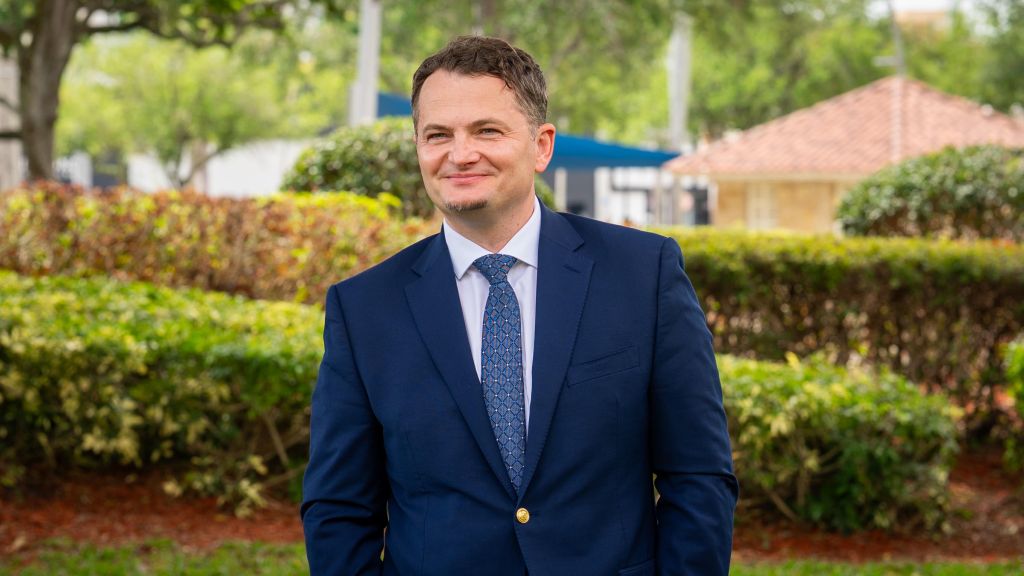
Name: Eugen Bold
Campaign website: EugenBold.com
Date, place of birth: 1982, Romania
Education: Master of Public Administration, Florida State University (FSU); Master of Business Administration, International Business; Bachelor of Arts, Philosophy; Certificate, U.S. National Intelligence Studies
Occupation: Small-business owner; Former Director of Policy and Public Affairs for Broward County Commissioner and County Mayor Tim Ryan
Work history, past 15 years. List in reverse chronological order.
2025-present: Founder and Principal, Aveli Innovation Group LLC
2019-2024: Director of Policy and Public Affairs, Office of Broward County Commissioner Tim Ryan’s office
2012-2019: Associate Director, Ross University School of Medicine
2006-2012: Admissions and management roles, American InterContinental University
2005-2005: Internship, United States Senate, Subcommittee on Federal Financial Management, Government Information, Federal Services, and International Security, under the Committee on Homeland Security and Governmental Affairs (HSGAC)
Will you vote for or against Amendment 3, the November ballot question to cut local property taxes and expand the homestead exemption, and why?
I’ll vote against Amendment 3 as written. I want property tax relief — as a longtime Hollywood resident and small-business owner, I see how these costs ripple through to everyone — but this is the right goal in the wrong instrument, and the design flaws are serious.
Once fully phased in, it strips an estimated $12 billion a year from local budgets statewide — about $5 billion in the first year, growing to nearly $12 billion by 2031 — with no mechanism to replace it. It also authorizes the Legislature to phase out additional non-school homestead taxes later, without returning to voters. A permanent constitutional change of that magnitude should be explicit about how the lost revenue gets backfilled. This one isn’t.
And the relief is narrower than it appears. The exemption benefits homesteaded primary residences, while the cost shifts to renters, commercial property, second homes, and new residents held to the current exemption for five years. A family buying their first home in 2027 would help subsidize a long-tenured owner next door — worth naming honestly before we amend the Constitution around it.
Closer to home, the County Commission sets the county millage every year, and that’s where I’d deliver disciplined, fundable relief: rolling back millage when tax-base growth outpaces legitimate service needs, targeting seniors, longtime residents and working families, and requiring every department to justify recurring spending before I’d support another increase.
That approach lowers the burden on residents without destabilizing the funding for law enforcement, fire rescue and flood protection — services District 6 can least afford to gamble with. I’d rather earn a reputation for relief we can sustain than back a cut the county has no plan to absorb.
If you had to cut spending in one area of county government, what would it be, and why?
I’d start with outside professional-service contracts and duplicative administrative consulting — and I say that from experience, having reviewed these contracts inside County government.
Broward leans heavily on consultants for planning, communications, legislative advocacy, organizational studies and project management. Some deliver specialized expertise the County genuinely can’t keep in-house. But others duplicate work our own employees should be doing, or run for years as familiar line items no one revisits — an organizational study that lands on a shelf, a communications contract shadowing work staff already perform.
I’d require every major consulting contract to answer four questions before renewal: What specific expertise are we buying? What are the measurable deliverables? Which County employee owns the outcome? And does this build lasting internal capacity, or just rent it indefinitely? Recurring contracts shouldn’t renew on autopilot simply because they’ve always been in the budget.
This isn’t indiscriminate cancellation. The airport, seaport, transit and resilience programs need specialized engineering the County should absolutely pay for. The goal is to end overlap, stop outsourcing our own core competence, and redirect the savings into services and infrastructure residents actually touch — while protecting frontline public safety, transportation, libraries, parks and human services.
And I’ll be straight: trimming consultants won’t balance a budget by itself. But how a government spends on contractors reveals its discipline. A county that builds its own capacity, instead of renting it year after year, is one that respects both its employees and its taxpayers.
The county has approved spending $20 million for Tier 1 resilience projects, and District 6 is an area highly prone to coastal flooding. What types of resiliency solutions do you think the county should pursue first?
The first $20 million should fund construction-ready projects that deliver measurable flood reduction in the communities facing the greatest near-term risk.
In District 6, that means removing drainage bottlenecks, enlarging undersized culverts, improving canals and outfalls, preventing tidal backflow, and expanding pump capacity with backup power and remote monitoring. Seawalls and flood barriers must meet consistent, forward-looking elevations, so one low property or jurisdiction doesn’t undermine the drainage system around it.
But new pipes aren’t the whole answer. Recent Hollywood CRA inspections along A1A found heavy debris, sediment, physical obstructions, leaking backflow valves and infiltration — infrastructure taxpayers already funded, working at a fraction of its capacity. Resilience spending must include systematic inspection, cleaning, repair and maintenance, not just new construction. We should restore what we already own before we’re asked to buy it twice.
Projects should be ranked by a clear public standard: homes and businesses protected, reduction in flood depth and duration, protection of evacuation routes and critical facilities, construction readiness, matching funds, and long-term maintenance cost. Every funded project should carry a public schedule, a life-cycle cost and a measurable performance target.
Water doesn’t respect city limits. Broward must coordinate closely with Hollywood, Hallandale Beach, Dania Beach, West Park, Pembroke Park, the drainage districts and the South Florida Water Management District. I bring direct experience to this: in County government I worked closely with Broward’s Chief Resilience Officer, Dr. Jennifer Jurado, on regional water and resilience initiatives — exactly the multi-jurisdictional coordination this work demands.
Broward has done the planning. The challenge now is disciplined, accountable execution.
More than half of every dollar in property taxes collected by the county is spent on public safety. Do you believe that Sheriff Tony has been a responsible steward of taxpayers’ money, and why?
I am a strong proponent of public safety – something reflected by FOP’s endorsement of our campaign, but I would not give Sheriff Tony – or any constitutional officer – an unqualified pass.
BSO performs essential work, and I strongly support the deputies, firefighters, detention personnel and communications professionals who protect Broward. During my almost 6 years in county government, I witnessed it firsthand. Competitive compensation, adequate staffing and safe equipment are entirely legitimate expenses. We are competing with Miami-Dade and Palm Beach and as such, we must ensure BSO provides competitive packages in order to retain its best talent.
However, supporting public safety does not require approving every budget request without serious scrutiny – and unfortunately, I have seen it happen during my time at the county. The recurring budget disputes, questions concerning cost overruns and inadequate supporting detail have weakened public confidence in BSO’s financial management. For FY27, BSO requested an increase from approximately $833 million to $937 million—about 12%—driven largely by personnel costs. That level of growth requires detailed justification and measurable outcomes at a time when most taxpayers grapple with increased costs and a severe affordability crisis.
I would require quarterly financial reporting, clearer separation of regional and contract-service costs, detailed overtime and vacancy data, capital-project controls, and service-level performance measures. The Commission must negotiate in good faith and fund genuine public-safety needs, but it also has a duty to protect taxpayers. Respect for law enforcement and rigorous oversight should reinforce one another, not be treated as competing principles.
What is your opinion on the proposal, now under study, for an independent airport-seaport law enforcement agency to replace the sheriff’s office there?
I support continuing the evaluation of an independent, County-controlled airport police department — but I would not vote to create a combined airport-seaport agency until the County completes separate operational, staffing, financial and transition analyses for each facility.
The current airport arrangement needs reform. Broward has paid BSO to police Fort Lauderdale-Hollywood International since 1996, without a competitive review in nearly 30 years. The County’s auditor deemed the payments broadly reasonable — but also found that for a portion of what the airport paid, BSO couldn’t produce documentation of its actual costs, leaving auditors unable to verify those charges. When the County can’t fully confirm how its own money is being spent, that’s an accountability gap worth closing.
The County’s feasibility study concluded an in-house department is achievable and could improve budget transparency, management control and mission alignment, while cautioning that staffing and cost need further analysis — and estimating the transition would cost more than $85 million over four years.
Tellingly, that study examined only the airport; the seaport was deliberately set aside for separate review. That’s exactly right. Port Everglades — maritime cargo, cruise operations, federal partnerships and different security risks — doesn’t map onto airport policing. Folding both into one new agency before a port-specific analysis would be premature.
Before I’d vote, I’d require the full workload, staffing, life-cycle-cost, recruitment, labor-impact and transition analyses. If the evidence shows equal-or-better security, stronger accountability and a defensible long-term cost, I’d support it. The goal is safer operations and responsible stewardship — not simply moving authority from one institution to another.
Why are you running for this office?
I know this government from the inside — and I’m running to reform it, not protect it.
For more than five years, I served as Director of Policy and Public Affairs to Commissioner Tim Ryan. I wrote policy, reviewed budgets, negotiated with cities, and pushed the administration for answers. I advised and often represented Commissioner Ryan at Tri-Rail and CareerSource Broward, and helped build the relationships — with FDOT, our legislative delegation and regional partners — that bring real dollars back to Broward. When Commissioner Ryan took extended medical leave, I took on significant additional responsabilities. That’s as close to doing this job as anyone in this race has come.
That vantage point is exactly why I’m running. I watched good employees deliver real results — and I watched worthwhile projects stall for reasons that had nothing to do with merit: overlapping or no authority, a decision that needed three agencies to agree and so never got made, momentum lost to who-does-what instead of what’s-right-for-residents. From the outside that looks like bad luck. From the inside, you see it’s a system that too often protects process over people. You don’t fix that by admiring it. You fix it by knowing precisely where it jams — and having the relationships to unstick it.
District 6 can’t afford a learning curve. It holds Port Everglades and Fort Lauderdale-Hollywood International Airport, alongside neighborhoods facing flooding, rising housing costs and uneven investment. That demands command of the budget, the departments, the capital process, and our regional and municipal partners on day one.
I’m also running for my kids, Ava and Eli — and every Broward family — who deserve a county that’s more affordable, more resilient and better prepared than the one we have. I know how it works. I know where it’s stuck, I know the levers and the stakeholders. And I’m running to make it deliver more for our residents, faster.
Do you agree or disagree that special interests often have too much influence over county government decisions, and why?
I agree — though the problem isn’t that businesses, labor, nonprofits and neighborhood groups advocate. Officials need informed input. The problem is the imbalance of access.
Broward controls billions in contracts, leases, land-use decisions and capital projects. Sophisticated interests engage early, retain lobbyists and know the process; residents often don’t hear about a proposal until the week of the vote. Influence rarely takes the form of an explicit quid pro quo. It’s repeated access, long relationships and unequal resources quietly shaping which ideas advance and whose concerns get heard.
The fix has to live in the county’s own process, not just in speeches. I’d push for earlier, clearer public notice on major items, so residents and small businesses aren’t ambushed by a decision that’s effectively been made. I’d want every relevant lobbyist contact disclosed alongside the agenda item, and plain-language summaries of who actually benefits from a contract or land-use change. And the routes where influence hides — sole-source awards, change orders, last-minute add-ons — deserve the most scrutiny, not the least.
This starts before Election Day, too. Candidates should disclose their major funding sources plainly and keep a clear wall between fundraising and official business. Voters are entitled to weigh who funds a candidate against how that candidate is likely to vote.
Fundraising totals get treated as strength. The better measure is whether an official can still say no to the people who helped them — and to their own party’s insiders — when the public interest requires it. That independence is what I’m offering District 6.
Do you support or oppose giving voters the option to create the office of county-wide elected mayor, and why?
Yes — and I’m not speaking about this abstractly. In Commissioner Tim Ryan’s office, I helped lead the work on this exact proposal.
Broward has no single, directly accountable regional leader. The county chairmanship rotates every year, so no one holds the seat long enough to carry a multi-year priority — resilience, transit, housing — from vision to completion. Leadership resets before the work finishes, and the same problems resurface cycle after cycle. That’s not a personality problem; it’s a structural one, and it’s at the root of too many of Broward’s stalled efforts.
A countywide mayor could give the public a clearer mandate and a consistent voice in Tallahassee and Washington. But voters shouldn’t be handed a title without knowing its powers. Any charter proposal must define the mayor’s agenda-setting authority, veto and override process, appointment powers, term limits, compensation, and relationship to the county administrator and district commissioners. It should preserve district representation, bar any unilateral control over procurement and contracting, and disclose the full fiscal impact and transition plan before a referendum. I favor keeping professional day-to-day administration while adding real elected leadership — accountability, not a power grab.
Here’s why I feel strongly. The proposal I worked on would have simply let voters decide. Sitting commissioners — the very officials whose power it would check — declined to put it on the ballot, a choice I respect but disagree with. In my opinion, the individuals who hold a County Commission office shouldn’t get the final say over whether the public can choose their own mayor.
This isn’t about copying Miami-Dade. It’s about whether a well-designed structure would give Broward the accountability and follow-through it clearly lacks. Voters deserve that choice.
Broward pays more than 30 contract lobbyists in the annual legislative session a combined total of several hundred thousand dollars a year. Is this an effective use of tax dollars, and why?
No. Specialized legislative representation can be an effective use of tax dollars when appropriate. An army of lobbyists is not.
Broward operates an international airport, a major seaport, a transit system, water and wastewater infrastructure, and extensive resilience and human-service programs. State decisions on appropriations, regulation, preemption and unfunded mandates can affect the County by tens or hundreds of millions of dollars. Preventing a harmful preemption can be as valuable as securing an appropriation.
The concern is duplication and accountability. Each firm should have a defined subject-matter assignment, legislative targets and expected deliverables. After every session, the County should publish a scorecard identifying appropriations secured, harmful bills amended or defeated, policy objectives achieved, and work that duplicated internal Intergovernmental Affairs staff or another firm. Compensation should be competitively procured and evaluated against results over multiple sessions, not relationships or generalized activity reports.
I would consolidate overlapping scopes and retain outside representation where specialized expertise, relationships or capacity produce measurable value—particularly for the airport, seaport, transportation and resilience priorities. I would not eliminate advocacy merely to claim a symbolic savings. I would insist that taxpayers can see what they received for the money. Additionally, I would deepen and reinforce the relationships with Broward’s legislative delegation – the State Representatives and State Senators representing our citizen’s interests in Tallahassee.
Have you been arrested, charged or convicted of a crime, received a withheld adjudication or had a matter sealed or expunged? If yes, explain.
No.
Have you been a plaintiff or defendant in a civil action, including bankruptcy or foreclosure or had a restraining order issued against you? If yes, explain.
No.