
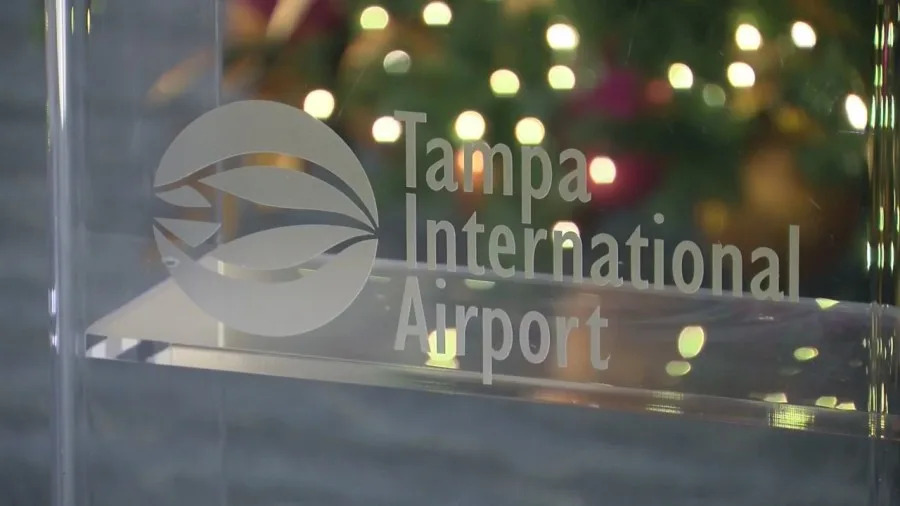
TAMPA, Fla. (WFLA) — Tampa International Airport is moving toward a security screening partnership to increase efficiency, according to a spokesperson.
In a statement to 8 On Your Side, Tampa International Airport said it was opting into TSA Gold+, the Transportation Security Administration’s public-private partnership program.
TSA’s new CT scanners may pose a problem for some carry-on bags: What to know
Under the partnership, the TSA will maintain regulatory oversight over screening operations at Tampa International Airport, but instead of using federally employed agents, the operations will be run by a private workforce instead.
“It’s selling the safety of the American people to the lowest bidder. That’s what it is,” said Chris Finlay, the president of the local American Federation of Government Employees.
He said nearly 800 TSA workers at TPA will be impacted by this change.
One traveler at the airport Monday said they aren’t on board with it either.
“I’d rather the government heading the coordination for the security of all the passengers,” said Jeffrey Geraci, a traveler.
In an email sent to TPA employees, it said their options include employment with the private company once selected, reassignment to another airport, federal positions with another agency, and retirement if eligible.
“TPA’s decision to join TSA Gold+ reflects the Airport’s strong commitment to modernization, innovation, and operational resilience in aviation security,” the TPA statement read. “The change to privatization not only reduces disruption risks caused by lapses in federal appropriations or government shutdowns but also allows greater flexibility in exploring new screening checkpoint infrastructure and technology to enhance the customer experience.”
According to the TSA Gold+ website, Long-term Screening Partnership Program contracts will direct money toward private partnerships to use the latest in security screening technology.
Benefits touted by the TSA Gold+ site include faster screening for travelers, enhanced security, and the ability for airports to explore “new revenue opportunities” outside of federal budget cycles. The vendors themselves would provide the equipment rather than the TSA, although the federal agency will oversee them to ensure they meet security standards.
Jeff Price has worked with airports that implemented the Screening Partnership Program, which TSA Gold+ is an expansion of.
“The airports that have the private screening personnel have reported more efficiencies in their line queue management, more efficiencies in staffing because they’re getting the same amount as the it would take to put TSA personnel in the airport,” Price said. “It’s really an extension of that model of the previous one that’s been around for 20 years. And it works because if it didn’t, TSA would not allow it.”
Price said if there is a government shutdown, the private contractors would still get paychecks, making it a benefit of the program.
“Yeah, that’s great. But your pay is also going to get cut 25%, probably more. You know, your benefits are not going to be the same. You’re not going to have your federal benefits,” Finlay said. “Why are we trying to fix something that is not inherently broken? If the primary cause or a reason for this is, you know, a shut down, that officers don’t come in, well then pay the people. There’s legislation right now waiting to be talked about and dealt with that would solve that. That would be a non-issue if they passed it.”
While the TSA already subcontracted screenings at select airports through the Screening Partnership Program, SPP partnerships relied on the TSA to provide equipment instead of the private partners.
Prior to this announcement, TSA Gold+ was already launched at the Orlando Sanford International Airport and the Sarasota-Bradenton International Airport.
Everett Kelley, the president of the American Federation of Government Employees labor union, voiced his opposition to TSA Gold+ and SPP in May. In a statement to the House Committee on Homeland Security, Kelley said he was concerned private officers may not have the standardized training TSA agents have had since 9/11.
“In practice, the federal government would be ceding direct operational control of the most sensitive technology in the aviation security enterprise to private vendors,” Kelley said.
8 On Your Side has reached out to the TSA for additional information.
Finlay questions why the government can’t pay for new equipment without jeopardizing the employees working to secure travel.
“This is just another way for the rich to get richer and, you know, the civil service to get the short end of the deal,” Finlay said.
According to the email, there will be a series of screening workforce town hall meetings where TSA officers will get status updates, learn about pay and benefits, and once selected, they’ll be introduced to the contracting company.
Before 9/11, having private contractors for screening was normal in the aviation industry and the contractors were hired by airlines at lower costs.
“I think there’s still a perception out there that private screeners equal ineffective screening, because that’s what the perception was prior to 9/11, which was one of the reasons that TSA took over screening, as was the perception, and that it was not as effective. And I can tell you from being in the industry both prior to and after 9/11, I don’t think it was effective either,” Price said.
Price also said if the program didn’t work, TSA wouldn’t allow it. But Finlay argues there’s no data to prove that.
“If it wasn’t profits over the mission, why are we making this change? TSA has got a flawless record. There’s not been another 9/11,” Finlay said. “Everybody can tell you where they were and they say, never forget. And I feel like right now they’re forgetting.”
Copyright 2026 Nexstar Media, Inc. All rights reserved. This material may not be published, broadcast, rewritten, or redistributed.
For the latest news, weather, sports, and streaming video, head to WFLA.