
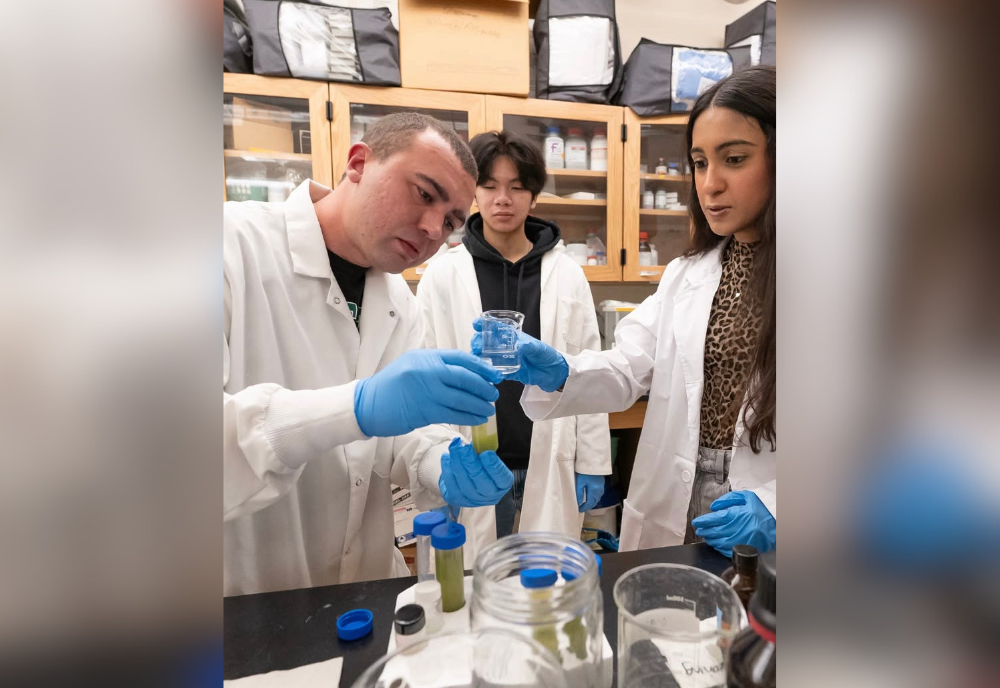
Ivan Martinez Diez-Muro wants to make drinking water as safe as possible aboard the
International Space Station. And, the 28-year-old undergraduate student in USF’s College of Public Health (COPH) hopes a novel idea takes off.
With a boost from a national spaceflight organization, Martinez Diez-Muro has been
investigating new energy conversion technologies that might enhance the quality of
water for astronauts and even people at home.
“The knowledge we gain could improve water purification systems for future space missions
while also inspiring cleaner, more sustainable technologies here on Earth,’’ the health sciences student said.
In a paper titled “Dark Adsorption in Space: Testing Cactus-Modified TiO₂ Films Beyond
Earth,’’ his team looked at how microgravity affects the interaction between certain
materials enhanced by, of all things, a cactus extract. The investigation focused
on the earliest stages of photocatalysis − the acceleration of a chemical reaction
on materials that absorb light energy.
He explained that gravity constantly influences how liquids move on Earth. Warm fluids
rise, particles settle and natural mixing occurs continuously. In microgravity, those
effects nearly disappear, so liquids behave very differently. Scientists can observe
molecular interactions without Earth’s gravity affecting the results.
“That allows us to better understand fundamental processes like adsorption, chemical
reactions and fluid movement,’’ he said. “In many cases, gravity masks these subtle
interactions, so removing it gives researchers a unique laboratory that simply doesn’t
exist on Earth.’’
The team included Riva Nathani, a biomedical major in the College of Arts and Sciences, and James Ma, a computer science major from the College of Engineering. Faculty support came from Dr. Norma Alcantar, professor and associate dean for research
in the College of Engineering; and Dr. Saundra Johnson Austin, director of Student Engagement for Research and Innovation (SERI) in the office of USF Research.
“Working together on a project with real-world applications in space research allowed
me to grow as a student researcher and gain a deeper appreciation for the importance
of interdisciplinary teamwork,’’ Nathani said. “I believe this project has significant
merit because it explores sustainable, nature-inspired approaches to water purification
in microgravity. Understanding how adsorption and fluid behavior change in space is
essential for developing reliable life-support systems.’’
Their paper raised plenty of eyebrows, winning a Top 3 honorable mention from the
Student Spaceflight Experiments Program (SSEP), part of the National Center for Earth and Space Science Education. This competitive, nationwide research initiative involved 3,700 students from across
the country and gave 10 teams awards for microgravity experiments with the potential
for flight aboard the International Space Station. In its inaugural appearance in
the program, USF produced three winners – including first place.
The program encourages curiosity, teamwork, critical thinking, and innovation while
showing young scientists that their ideas can contribute to real-world discoveries.’’
Ivan Martinez Diez-Muro
That top prize went to the study “Microgravity Effects on Chitosan Hydrogel Structure
for Potential Wound-Care Applications,’’ led by principal investigator Krystal Walford,
an engineering undergraduate student. Their experiment is scheduled to go into orbit
in October.
Along with Martinez Diez-Muro’s team, another USF group won an honorable mention for
its research study “Nutritional Retention of Germinating Black Currant Seeds in Microgravity,’’
led by principal investigator Karam Shahrouri, a mechanical engineering major. Both
honorable mentions were recognized for their strong scientific design, innovation
and competitiveness at the national level.
“SSEP is unique because it gives students the rare opportunity to design real experiments
that can be conducted aboard the space station.Instead of simply learning science
in a classroom, students become researchers solving authentic scientific problems,’’
Martinez Diez-Muro said. “The program encourages curiosity, teamwork, critical thinking
and innovation while showing young scientists that their ideas can contribute to real-world
discoveries.’’
Martinez Diez-Muro also was invited to present at a national conference at Kennedy
Space Center, where he spoke on student-led research that connects public health with
spaceflight and scientific innovation. In addition, he presented his research at a
recent OneUSF Research Day on campus.
Austin said Martinez Diez-Muro is making and difference through his commitment to
research excellence and scholarly engagement.
“I witnessed these qualities firsthand’’ in SSEP, she said … “where Ivan and fellow
researcher Riva Nathani were recognized as Top 3 finalists at USF, exemplifying scientific
rigor and leadership that distinguish him as an exceptional emerging physician-scientist.’’
Although his team’s experiment won’t be aboard the space station, the group continues
to test its underlying mechanisms in the laboratory. Martinez Diez-Muro is honing
his scientific chops by working as a research assistant with the Hibernation Intelligence
Base for Education Research & International Alliance, an international research collaboration
based in New Zealand.
Martinez Diez-Muro had been dreaming of doing space-related work since 2009, when
he attended NASA’s Space Camp.
“It was one of those moments that didn’t feel real at first,’’ he said of the national
honor. “Deep down, I believed our team had created something meaningful, but hearing
that we were recognized among the Top 3 honorable mentions nationally was incredibly
rewarding.’’
“It validated the countless hours we spent researching, writing, revising and learning
together,’’ he added. “It’s an experience I’ll always remember because it reminded
me that persistence and hard work truly pay off.’’