
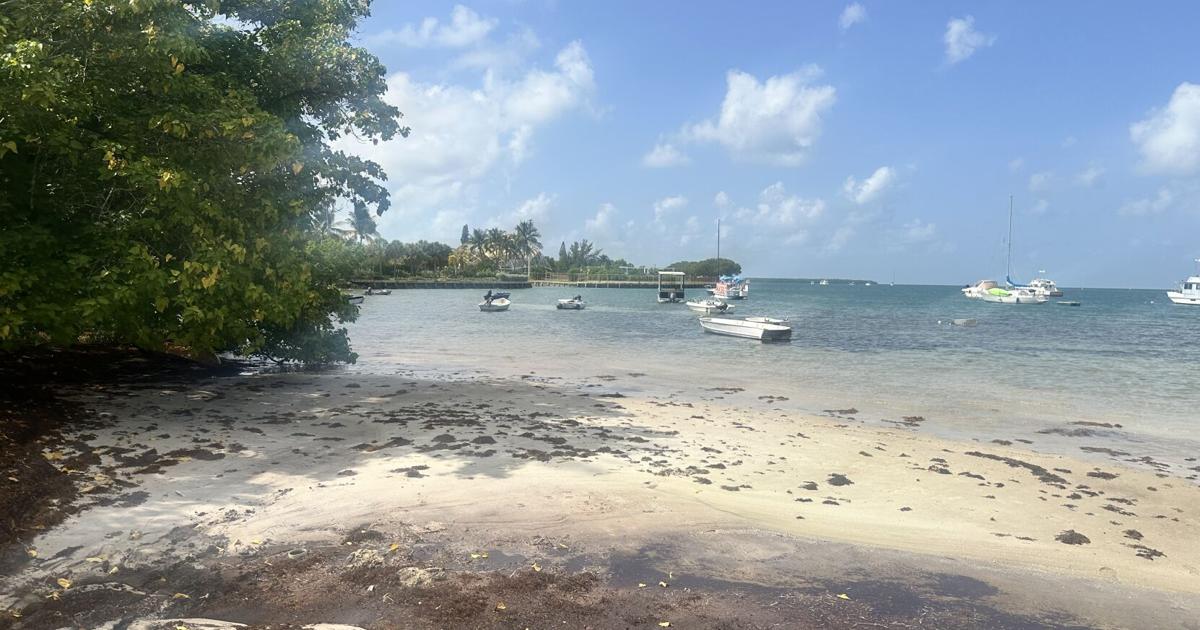
Ears perked up this past week for Miami-area environmentalists and Key Biscayne residents, who got a first look at firmer details of what the former Miami Seaquarium waterfront location soon might look like.
A “Fishermen’s Wharf” permit rendering that was obtained from the Florida Department of Environmental Protection by the Friends of Biscayne Bay shows 325 boat slips (some capable of anchoring mega yachts and luxury boats), and a dry stack that could store another 500 boats in the plans from developer David Martin, CEO of the Terra Group.
Some argue that so many docking pylons, the likely need for some dredging, and a fuel service center could be harmful to an already precarious bay, while others were concerned with more traffic on Rickenbacker Causeway, especially on weekends.
This past Friday afternoon, the Friends of Biscayne Bay volunteer group hosted a virtual meeting to discuss several projects, such as the proposed 195-dock mooring-ball field at Miami Marine Stadium, that could also possibly impact Biscayne Bay.
Islander News learned at that meeting that a lengthy letter would be sent to Martin this week explaining the ramifications of his specific marina project along with the following sentence:
“We respectfully request that the applicant consider voluntarily withdrawing the current application and initiate a comprehensive community engagement and planning process, before pursuing permit approvals.”
Martin, who has two major construction projects in the works on Key Biscayne, reportedly was out of the country this weekend but still found time, with his firm, to exclusively answer five Islander News questions and maybe clear up some possible misconceptions about the project off Virginia Key, a few miles from the Village entrance.
Q: Friends of Biscayne Bay is asking you to withdraw your application and instead meet with the public first. Any thoughts?
A: This project has been discussed publicly since September of 2025. As a result of the bankruptcy of the prior lease of the Seaquarium, Terra was chosen by the bankruptcy court to move forward with a plan to revitalize the Seaquarium site. The County Commission, recognizing that site could be tied up in bankruptcy proceedings for years and place marine mammals and animals in harm’s way, approved a Term Sheet to pursue a new and modernized Seaquarium, while creating new public access to the site with a new public baywalk and public marina.

Terra CEO David Martin addresses Key Biscayne residents’ questions about the planned redevelopment of the former Silver Sands property during a June 2024 meeting in the Village Council Chamber.
Photo by Bill Durham
Our team will absolutely engage the public throughout this process, as meaningful community outreach is part of every Terra project. We are in the process of developing a master plan for the new Seaquarium, and when we have a complete master plan proposal, we will engage the public in a conversation. We want to hear from residents, anglers, boaters, environmental organizations, and our neighbors on Virginia Key and Key Biscayne. We firmly believe that input from a broad range of local stakeholders will help make the project better.
This project is about more than simply redeveloping a property. We are setting out to transform a seventy-year-old attraction into a public waterfront destination that restores environmental benefits, expands public access to the water and the waterfront, and creates a model for how development and conservation can work together. We are excited about meeting with the community, and we welcome that conversation.
Q: If they collect a thousand signatures, would that change your mind about stepping back?
A: We respect anyone who takes the time to become engaged in their community, regardless of whether they support or oppose a specific project. Our responsibility is to carefully evaluate the site and determine how the property can create new public and environmental benefits, listen to the community, and continue improving the plan throughout the public review process, while also ensuring that the project is positioned to be financially feasible and sustainable for the long-term.
We believe good projects balance the need for public benefits and financial feasibility, and they become better through thoughtful dialogue. Ultimately, this project will be evaluated through extensive public review by Miami-Dade County and multiple state and federal agencies based on science, environmental performance, and public benefits.
Q: Does the Rickenbacker Marina lawsuit (vs. City of Miami to remove the referendum for various causes regarding expansion of the Virginia Key marina) change your outlook or cause you to pause?
A: The lawsuit you referenced involves the separate Rickenbacker Marina redevelopment proposal located on the opposite side of the Rickenbacker Causeway and Virginia Key. It is the subject of a public referendum in November of this year (Editor’s note: this is separate from the August referendum to restore Miami Marine Stadium) and unrelated to the Miami Seaquarium project. The Seaquarium redevelopment is proceeding through its own independent public approval process with Miami-Dade County and the appropriate state and federal agencies.
Q: Residents say they were blindsided by the number and size of boat slips. Was this always the plan?
A: The marina has always been envisioned as one component of a much larger public waterfront destination, but it is important to understand what is being proposed. This is not intended as a mega-yacht marina or a charter boat facility. Miami-Dade County has roughly 50,000 registered boats, but only about 1,000 public marina slips, creating significant overcrowding at existing facilities and congestion at public boat ramps.
An aerial view of the Miami Seaquarium renovation plan blueprint.
The Miami Seaquarium marina will help address that shortage while creating a better managed, safer, and more environmentally responsible boating facility. It is being designed to meet the needs of Miami-Dade County and will attain “clean marina” certification that is a benchmark of environmental stewardship.
Equally important, the marina will be designed as an environmental asset rather than simply a place to dock boats. Through living seawalls, oyster habitats, fish refuge structures, water-quality improvements, and Biscayne Bay restoration, we believe the property’s shoreline can support more marine life than exists today.
We are also exploring partnerships with local fishing guides, conservation organizations, and scientists to ensure the marina contributes to healthier fisheries and improved public access to Biscayne Bay.
Q: How can you guarantee the marina will not pollute the bay or harm the environment?
A: Environmental performance is the foundation of this project. The master plan is being developed in line with what we call “Science-Led Design” in partnership with scientists at the University of Miami Rosenstiel School of Marine, Atmospheric and Earth Science.
Rather than simply meeting minimum environmental requirements, our objective is to produce measurable environmental improvements.
Current concepts include:
• A living shoreline that replaces hard seawalls with biologically productive habitat.
• A closed-loop stormwater treatment system capable of polishing approximately one million gallons of stormwater every day before it reaches Biscayne Bay.
• Continuous circulation and polishing of approximately 250 million gallons of bay water daily.
• Habitat improvements, including oyster restoration, fish refuge structures, and other ecological enhancements.
• Marina features designed to exceed Florida Clean Marina standards, including turtle-friendly lighting, grated dock decking, fuel spill prevention measures, vessel pump-out facilities, and responsible waste and fishing line disposal stations.
• Real-time scientific monitoring of water quality and ecological performance by University of Miami researchers, with results shared transparently.
We also recognize that recreational fishing is an important part of Biscayne Bay’s identity. We are exploring a Fisheries Enhancement Program that would include habitat restoration, partnerships with local fishing guides, scientific monitoring, conservation education, and improved public access for recreational anglers.
The question should not simply be whether the marina avoids harming the bay. The better question is whether we can use this once-developed waterfront to measurably improve water quality, create more marine habitat, support healthier fisheries, and leave Biscayne Bay better than we found it. That is the standard we are designing toward.
Martin: Why we invested
At the Friends of Biscayne Bay’s recent meeting, the operative word was “environment” and ways to protect it.
That should also be the focus at the next Friends of Biscayne Bay meeting this Friday at 11 a.m. and also at the next Virginia Key Advisory Board meeting, at 5:30 p.m. on Aug. 25 at the City of Miami’s City Hall Chambers.
There are so many projects coming, or in discussion stages, all at once, it’s tough to get a handle on everything, said Friends of Biscayne Bay meeting moderator Laura Reynolds, from the Institute of Environment at Florida International University.
“There are three large marinas being proposed simultaneously,” she told Islander News on Monday. “It’s important there is public input to preserve the character of Virginia Key and we hope the new (Miami) mayor, Eileen Higgins, would recognize the capacity issue of Virginia Key and the concern over the health of Biscayne Bay.
“It would help to require community input through a charette process where some robust conversation can occur and he can do the right thing and allow time for that to happen.”
Martin, who has been instrumental in helping to make improvements in the Village of Key Biscayne, specifically with aesthetics in the Civic Center area, and stormwater drainage at the site of the new luxury condo building where the Silver Sands once stood, addressed why his group purchased the lease to the old Miami Seaquarium site.
“Terra’s vision to invest more than $100 million in the Miami Seaquarium property is rooted in accessibility, sustainability, and community benefits,” he told Islander News on Monday. “Our objective extends well beyond redevelopment. We are designing the Seaquarium to become a model for environmental restoration and water quality improvement, demonstrating how thoughtful design, science and ecological innovation can create a net positive impact on Biscayne Bay.
“Our plan will breathe new life into this iconic site, restoring the Seaquarium’s place as a family-friendly destination anchored by a publicly accessible baywalk, a vibrant Fisherman’s Village, a state-of-the-art aquarium and education center, and a world-class marina with a host of features promoting environmental resiliency and water quality.
“Our team is eager to continue working with Miami-Dade County and the broader community as we transform this fading landmark into a beloved destination.”
Note: Interested in attending the next Friends of Biscayne Bay community meeting on Friday, July 24 at 11 a.m.? Simply email friendsofbiscaynebay@gmail.com to receive the link to the Friday meeting invitation.