
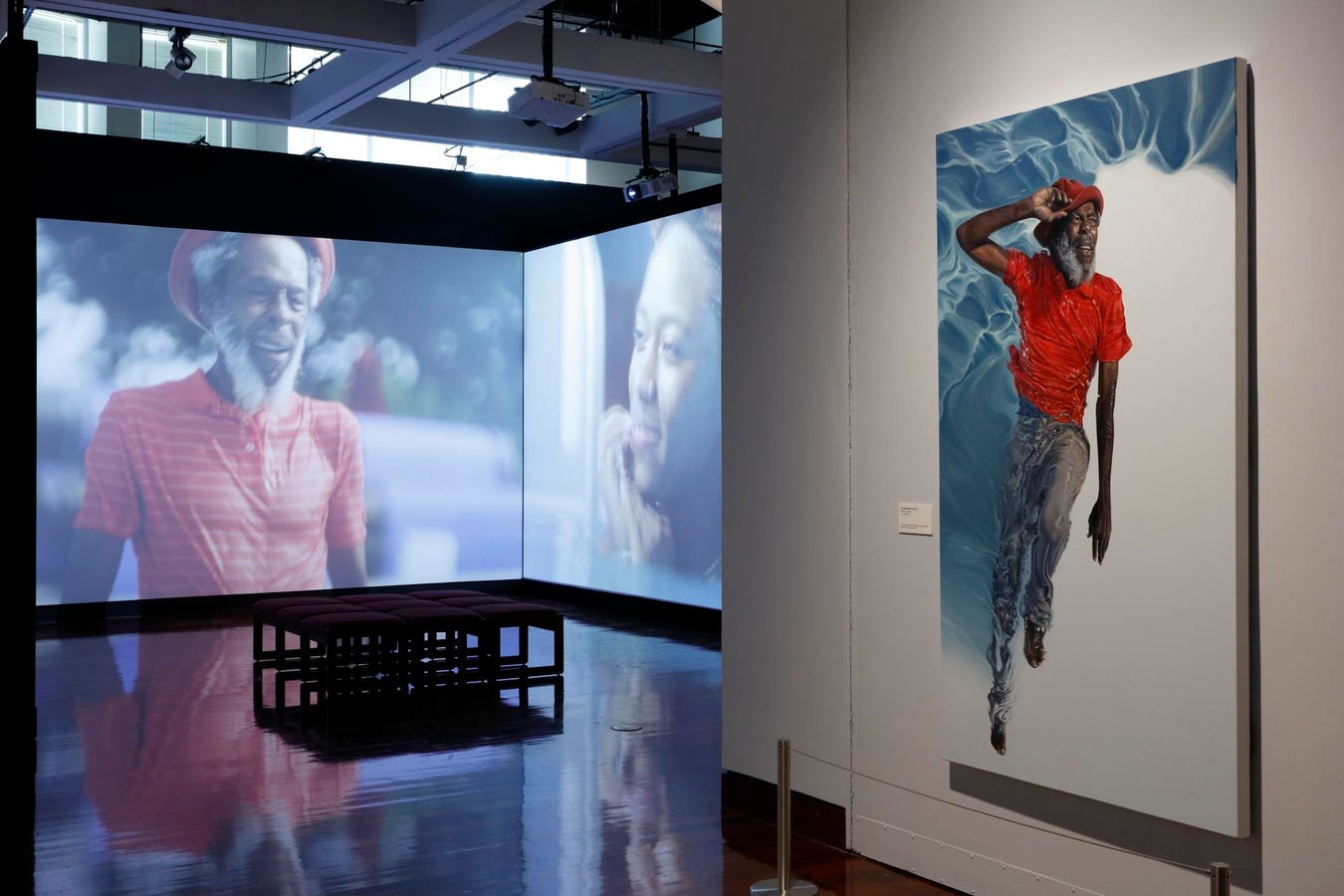
Installation image, “Calida Rawls: Away with the Tides” at Spelman College Museum of Fine Art.
Mike Jensen SCMFA
Cuban sandwiches. Ventanitas. Calle Ocho. Little Havana. Little Haiti. Gloria Estefan. Pitbull.
Miami’s Caribbean and Latin influences are recognized globally and celebrated locally.
Miami is a Black city too.
And Indigenous, for that matter; another story for another day.
Miami’s African American roots have largely been obscured. Purposefully. To find them, you have to know where to look: Hampton House Hotel, Virginia Key Beach, Purvis Young, Arthur McDuffie.
When the Pérez Art Museum Miami invited Calida Rawls (b. 1976) to produce an exhibition aimed at attracting the city’s African American residents, the project began as site-specific.
“Where do Black people live in Miami, and what is the history of Black people in Miami,” Rawls explained to me of her initial inquiry when first undertaking the project in late 2022. “I do not readily think of Black people (when I think of Miami). I think of Cubans. I think of different minority groups, but I did not think of Black people.”
Most don’t.
The more Rawls researched Miami’s Black past, the more she found a state-wide story, a national story, and an international story. For Rawls’ purposes, that story begins in Overtown.
Overtown
Installation image, “Calida Rawls: Away with the Tides” at Spelman College Museum of Fine Art.
Mike Jensen SCMFA
Overtown was long Miami’s thriving Black neighborhood. Some 50,000 residents lived there along with countless Black-owned businesses, churches and schools. Then came Interstate 95 in the 1960s. Property was snatched up by eminent domain. A concrete stake was driving through the heart of the community. The highway bisected Overtown. Straight through it. On purpose. Segregation by design.
Over 12,000 residents were forcibly relocated. Almost all were Black.
Their business and churches and schools likewise went away.
It happened across the country in nearly every major city: urban renewal. Perhaps the most devastating, long-lasting, nationwide, permanent, now nearly invisible example of systemic racism continuing to suppress African American upward mobility in the United States. There was Rawls’ national story with a Miami hook.
“I started thinking of what else do I not know about Miami when I was doing that research and it was a lot about Overtown, and how it was a thriving community, and then when the Federal Highway Act by (President Dwight) Eisenhower was put into place it went from like 50,000 to now 10,000 people –destroyed it,” Rawls explained. “(City officials) always try to say it was blight, but (Overtown) was thriving. It was just a racial excuse. I was thinking about that, and I wanted to give a visual of Black people are in Miami.”
That visual became “Away with the Tides,” an exhibition debuting at PAMM in the summer of 2024. Rawls began with a series of preliminary photoshoots in Virginia Key Beach and the public pool at Theodore Gibson Park Overtown. These informed the subject matter for her lifelike paintings. Ranging from a 10-month-old baby to senior citizens, the portraits provide representation for those who call Overtown home while capturing the generational shift the community has undergone and giving shape to an American experience often overlooked.
With residents as the subjects of her paintings, it became evident that the exhibition would be a transformative experience. For some, their first time at a museum.
“There was one guy, Marquise. He had worked at the kitchen of the museum at one time and he was saying whoever the director was or whoever was boss at the time wouldn’t allow them to go into the gallery spaces,” Rawls remembers of one of her models. “They had to come in through the back. I was like, “Well, now you are on the wall!” He brought his children; it was very emotional.”
What did these Black Miamians think about Overtown going up on the walls at PAMM?
“I don’t think they know about it. I think they live it. A lot of people, when I was telling them what Overtown was, I don’t think a lot of them knew,” Rawls said. “They definitely don’t. So many people from Miami, especially those at Overtown, were so thankful because they were like, “I didn’t even know,” and they were bringing their family members.”
How is this possible?
After erasing the community, Miami went on to erase its history and memory.
That begins in the schools. What is taught and what is not.
“They want to say it’s like this, and you blame whatever’s happening in communities to that community, as if it just happened out of nowhere. It’s just the people rather than a systemic issue,” Rawls said. “It’s easier, and it gets people to not think of why. No one likes to ask why. It’s just this is what it is, and there’s nothing more to that. That’s where it’s dangerous. People won’t think further.”
Rawls found chilling contemporary examples of African American erasure while researching “Away with the Tides.” Here was the Florida story.
“I was thinking of how AP Black History wasn’t going to be taught or accepted (in Florida). What do Black people feel in Miami? I never saw anyone write about that. I never saw the voice when they’re deciding that your history can’t be taught at the school–a whole group–no reporters, or I never saw a national story anyway detailing how the community feels about that.”
In 2023, under the direction of right wing ideologue Florida Governor Ron DeSantis, the state’s education department banned its Advanced Placement course in Black history after determining it lacked “educational value and historical accuracy.” This from the same governor and board of education that would later in 2023 update public school history curriculum statewide to assert that Black people benefitted from slavery in certain aspects.
“It gave me excuse to try to dig up some Black history that would not be taught in the schools, and then also I saw the governor at the time saying he was upset with (President Joe) Biden’s Highway Act,” Rawls remembers. “(DeSantis) was saying of how highways can’t be racist, and I remember thinking, ‘Oh yes, they can.’”
Most of the United States’ first generation urban interstates were racist highways based on where they were routed, who made those decisions, and why.
Florida’s ban on AP Black History was ultimately overturned by a federal judge. A wider attempt at formally entrenching white nationalism, misogyny, and heteronormative sexuality in the state’s colleges attempted by the governor was overturned in federal court earlier this month. Prefiguring what would come under the second Trump regime, Republicans in Florida have taken on erasing Black history as a primary objective.
The Weight Of Water
Installation image, “Calida Rawls: Away with the Tides” at Spelman College Museum of Fine Art.
Mike Jensen SCMFA
Rawls had found her Florida story and national story in Miami, the international story was right there as well. Virginia Key Beach. The Gibson pool. Water.
“Water connects every region of the world. It connects us all. We’re all made of water, and then the Black experience with the Middle Passage, and even the stereotypes that we can’t swim–and what that does–and segregation laws that prevent us to learn how to swim, and access pools. It goes deep on so many levels that I could use with water,” Rawls said. “It’s a great element to keep displaying and using as a part of my visual language because it’s vast, in every culture–all the lands are connected by that one thing. It binds us.”
Rawls’ recent paintings utilize water as a vital, organic, and multifaceted element as well as a historically charged space representing racial exclusion and individual healing.
“Black bodies float in exquisitely rendered submarine landscapes of bubbles, ripples, refracted light and expanses of blue,” as the artist’s website adeptly describes.
“Away with Tides” concludes its national tour at the Spelman College Museum of Fine Art in Atlanta through September 5, 2026. Rawls is a Spelman alumna. Founded in 1881, Spelman College is a leading liberal arts college widely recognized as the global leader in the education of women of African descent.
Spelman’s art museum celebrates its 30th anniversary in 2026 and is the only museum in the nation dedicated to art by and about women of the African diaspora.
More From ForbesForbesA Summer Of Black Excellence On Stage And ScreenBy Chadd ScottForbesLouisville’s E&S Gallery, The Nation’s Oldest And Largest African American Owned Fine Art GalleryBy Chadd ScottForbesTavares Strachan Brings Caribbean Rum Bar & Cafe To Columbus, OHBy Chadd Scott