
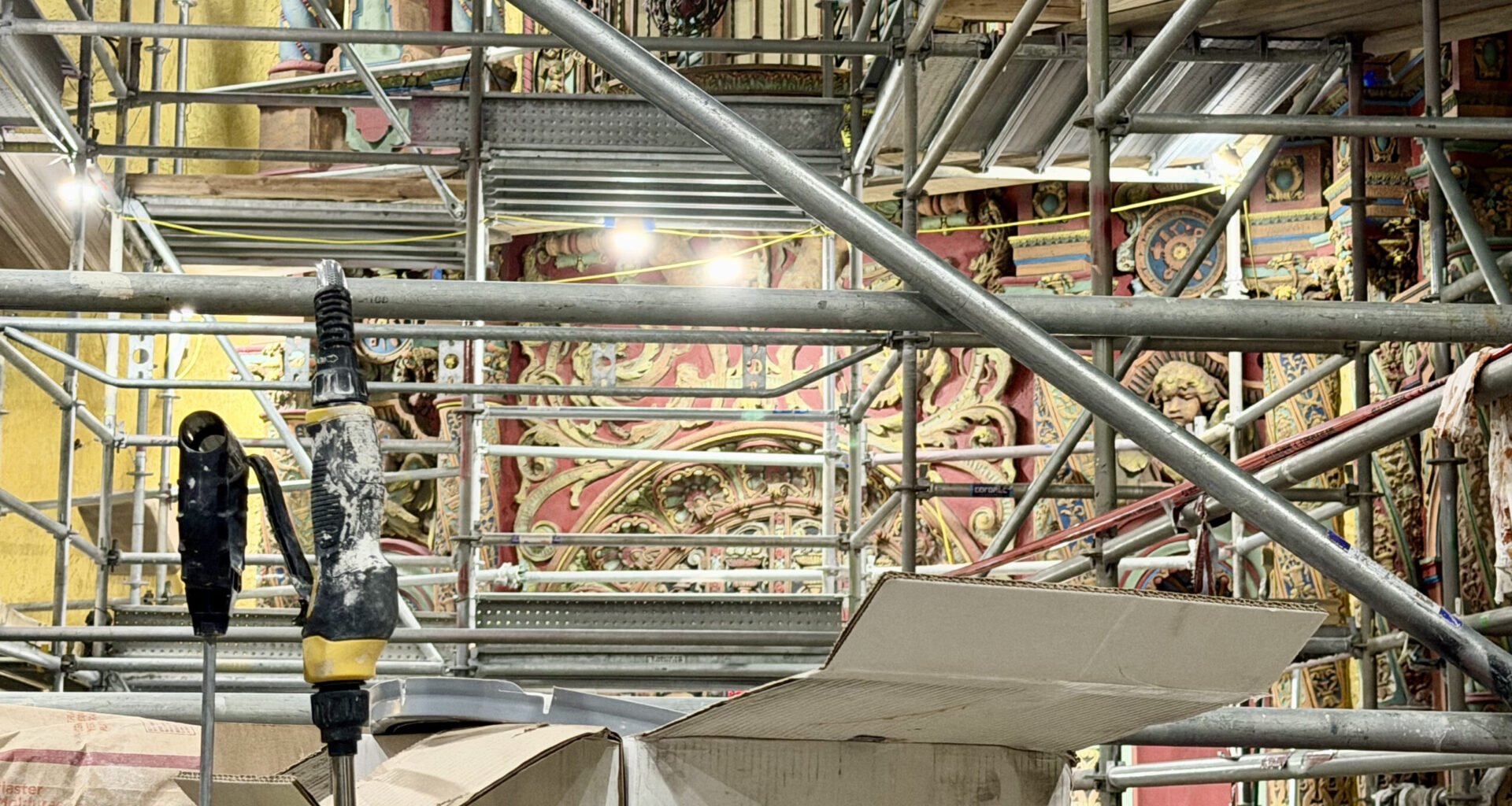
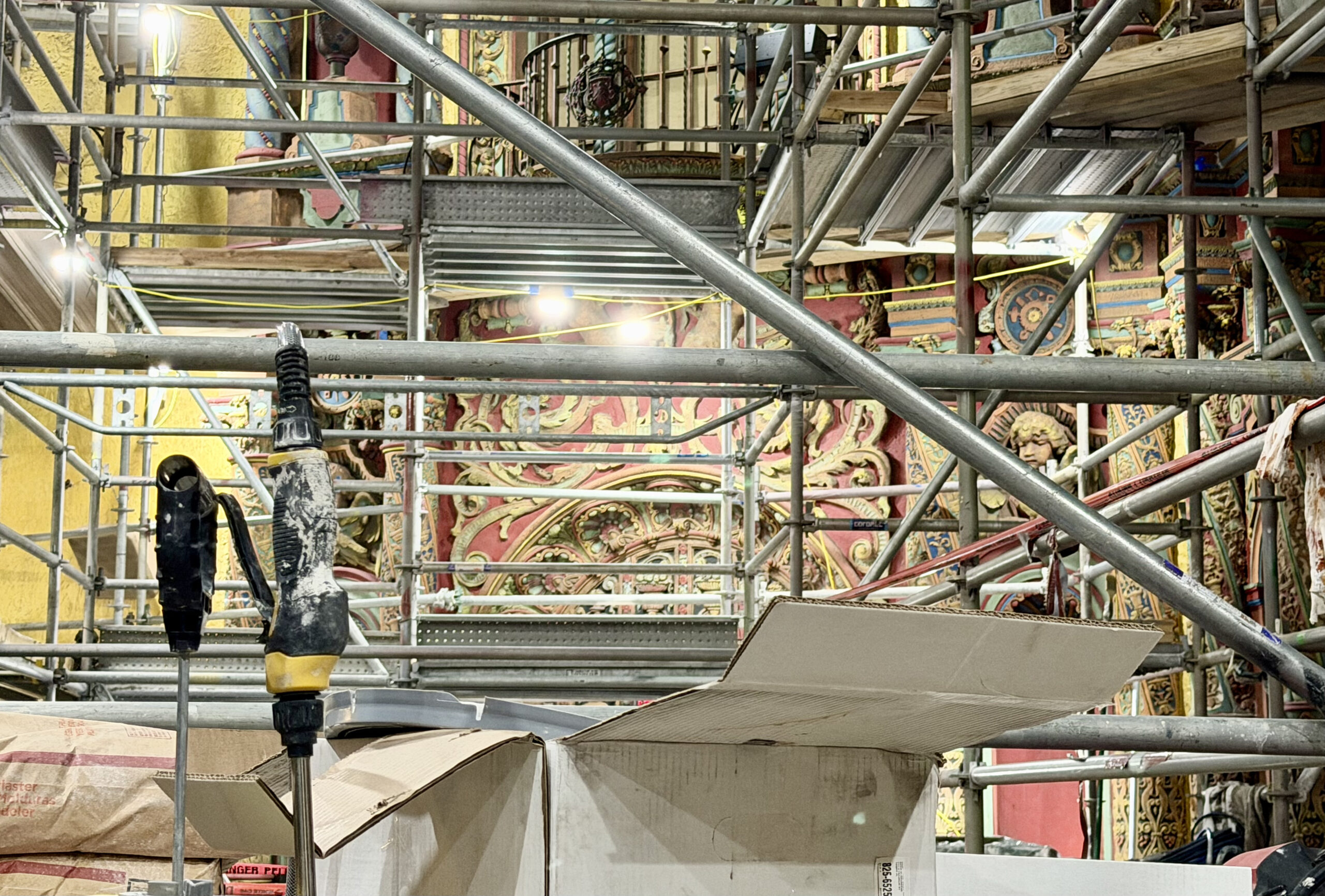
The historic Duncan Auditorium at Tampa Theatre. Photo by Daria Mironova/WMNF News
For nearly 100 years, the sounds inside Tampa Theatre have been those of organ tunes, classic films, and applause echoing under its iconic star-filled ceiling. Today, they have been replaced by the sharp rhythm of a rotary hammer.
Construction crews are carefully restoring the historic Duncan Auditorium, preserving its decorative plaster, original paint colors, and architectural details before Tampa Theatre’s 100th anniversary this October.
The project is the largest restoration in the theatre’s history. It is expected to cost approximately $30 million.
“The rehabilitation and renovation of a building like this is not an event. It’s a process,” Jill Witecki, Vice President and Director of Marketing & Community Relations at Tampa Theatre, said.
A theatre worth fighting for
When Tampa Theatre opened in 1926, it was one of America’s grand silent movie palaces. It was designed by renowned architect John Eberson.
Over the decades, it survived the Great Depression, World War II, changing entertainment trends, the rise of television, and, as Witecki jokingly noted, “all seven Police Academy movies.”
Its greatest challenge, however, happened in the early 1970s, when the aging building was slated for demolition.
“It says a lot about a city what it chooses to save,” Witecki said.
Instead of tearing the theatre down, the City of Tampa purchased the building in 1973, valuing its historical and architectural significance despite the cost of restoration. It reopened in 1976. The theatre became a nonprofit cultural institution, continuing to preserve the landmark through a series of restoration projects, including the current renovation.
 Tampa Theatre’s restoration. Photo by Daria Mironova/WMNF News
Piece by piece
Today, workers are repairing cracked plaster, recreating decorative finishes by hand, and carefully matching century-old paint colors throughout the Duncan Auditorium. Even after the current work is complete, Witecki says the effort to preserve Tampa Theatre will continue.
Helping lead the restoration is Christopher Reeder, a superintendent with EverGreene Architectural Arts.
Although the company is headquartered in Brooklyn, New York, Reeder says they work with local artisans whenever possible.
“We try to hire locals,” he said. “It’s good for the local economy. It’s good PR. Everyone at our company was once a local somewhere.”
For Reeder, Tampa Theatre is one of many historic places he has helped restore. But decorative finishes and Eberson’s signature atmospheric design make this project especially distinctive.
“It’s all the crazy color scheme,” Reeder said. “Obviously, you’ve got the starry night ceiling.”
 Starry sky ceiling restoration. Photo by Daria Mironova/WMNF News
Creating space for future generations
While much of the current project focuses on preserving Tampa Theatre’s past, another major component is designed to shape its future. One of the most significant additions is 3,000 square feet of educational space. It will give the nonprofit organization a permanent home and opportunity to grow its summer camps and cultural programs for kids and adults.
Education has always been part of Tampa Theatre’s mission, but available space limited what it could offer. The expansion reflects its goal not only as a historic movie palace, but also as a community gathering place, where new generations can experience film, history, and the arts.
“We’ve always been limited by the space that we had,” Witecki said. “Now we’re going to be able to give summer camp and so many programs like that a permanent home.”
Why Tampa Theatre still matters
When Tampa Theatre celebrates its centennial in October, the festivities will pay tribute to opening night in 1926.
“You only have one chance to have a 100th birthday party,” Jill Witecki said.
The celebration will recreate elements of the theatre’s debut, including remarks from community leaders, live music, and a silent film accompanied by live music – just as audiences experienced a century ago.
Tampa Theatre remains one of the few theaters in the country where moviegoers can still watch silent films with live musical accompaniment, preserving an experience that has largely disappeared from American cinemas.
“When you walk into Tampa Theatre for the first time, it is jaw-dropping,” Witecki said. “We are the current generation of people responsible for making sure this building sees another hundred years.”
That responsibility extends beyond construction crews and preservation experts.
As a nonprofit organization, Tampa Theatre depends on the support of members, donors, sponsors, and volunteers to continue caring for one of the city’s most recognizable landmarks.
“Nobody works in nonprofit arts to get rich,” Witecki said. “You do it because you’re passionate about it.”
That passion, she says, is about creating unforgettable first impressions. It is their job to make sure every person in Tampa – and especially the kids – has the experience of walking into Tampa Theatre for the first time, feeling its history and importance.
Soon, the sounds of construction will be replaced by the sounds that have defined Tampa Theatre for nearly a century: music, movies, and applause.