
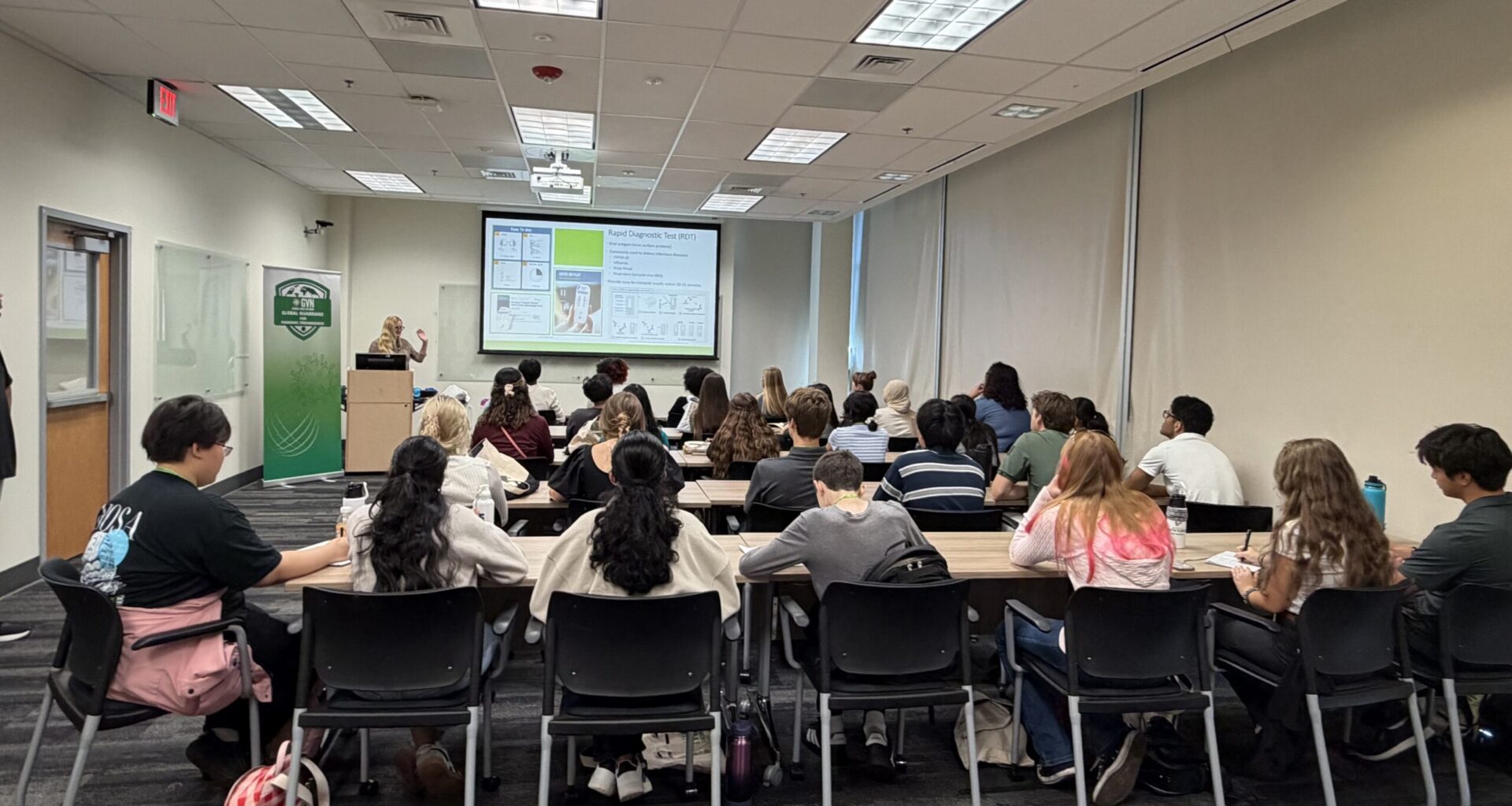
This week, high school students have come together at the University of South Florida Tampa campus to learn about virology, epidemiology and public health.
The 2026 Global Guardians for Pandemic Preparedness program is hosted by the Global Virus Network, which is headquartered at the USF Health Institute for Translational Virology and Innovation (at the USF Research Park in Tampa). A nonprofit coalition, the international organization focuses on advancing research for current and future threats.
Students have been able to participate in interactive lectures, laboratory tours, games, group activities and hands-on demonstrations.
GVN scientific program manager Dr. Elizabeth Traverse was one of the key individuals who designed the curriculum for the initiative. She wanted to make sure that participants engaged with researchers, pharmacists and administrative workers. This could give them access to mentors and show them different areas of the industry.
Students are learning about “the background and behind the scenes of how virology works,” Traverse explained.
“I like to think of the camp as a week-long career fair,” she said. “One of the things that I noticed with younger kids is when they’re thinking ‘oh, what do I want to do when I grow up?’, if they want to go into medicine or science, they only think of doctors and nurses and things like that. They don’t necessarily understand the big wide world of scientific research.”
Traverse added that selecting the young people was a competitive process. Each student had to prepare a personal statement about why they are interested in science, medicine or biology. They also had to discuss their short-term and long-term goals. Additionally, every participant had to have a strong academic record.
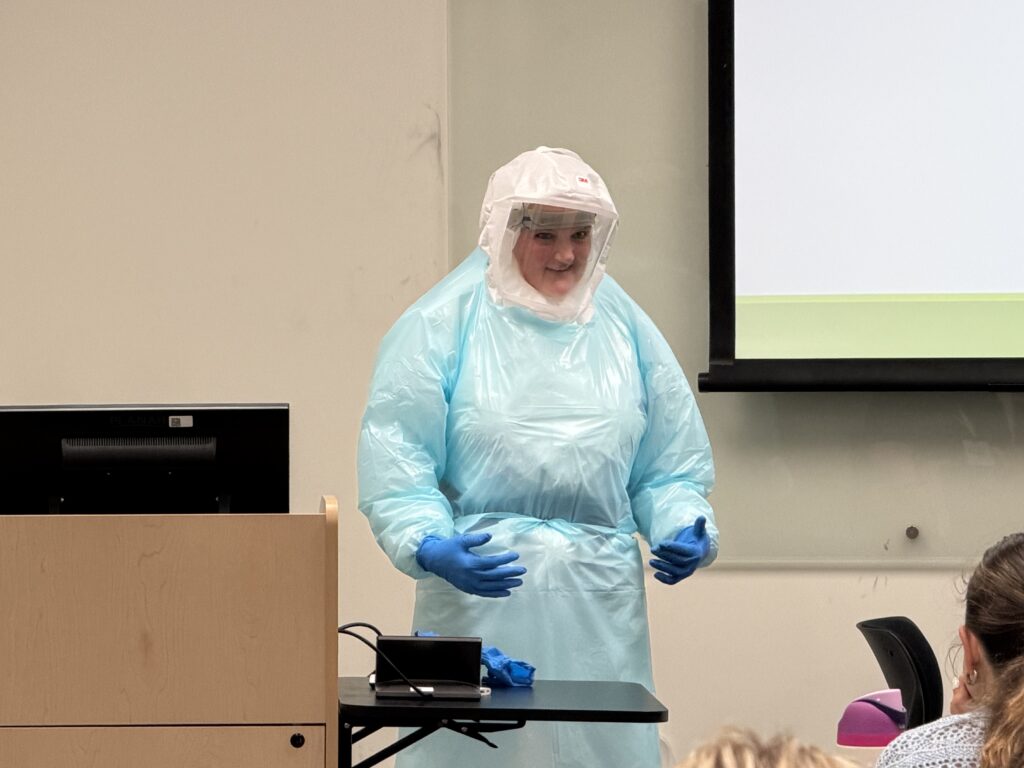
Dr. Kristi Miley, an adjunct professor with the USF College of Public Health Center for Global Health and Interdisciplinary Research, dressed in personal protective equipment to educate students about safety. Photo by Michael Connor.
Traverse and a group of individuals chose the top 30 adolescents across the state for the effort.
“I really enjoy just the differences of all of the students,” she said. “Some of them have an idea of what they want to do but a lot of them don’t. It’s really exciting to see that light bulb moment for them.”
A pilot for the Global Guardians for Pandemic Preparedness program was held in the summer of 2025. Fourteen students from the Tampa Bay region attended.
The GVN was co-founded by Dr. Robert Gallo, who helped discover that HIV (human immunodeficiency virus) is the cause of AIDS (acquired immunodeficiency syndrome) in 1984. He also co-discovered the first human retrovirus.
Gallo, 89, serves as USF’s James P. Cullison Professor of Medicine (Division of Infectious Disease) in the Department of Internal Medicine. He is also the founding director of the USF Health Institute for Translational Virology and Innovation.

Dr. Robert Gallo. Photo: USF
“One of the reasons for the very existence of the Global Virus Network was that we realized that there weren’t enough virologists during the HIV epidemic,” he said. “It became apparent that there were virologists coming in, but they were really clinical people who had to take care of patients.”
Gallo believes that educating people of all backgrounds about the field is essential. This can encourage growth in the industry and foster more research.
“In my reading of history, there is a major pandemic that occurs at least once per generation,” he continued. “But in the years that there is none, there’s a forgetfulness about it.”
Gallo hopes that the students take away “a curiosity about viruses and a basic knowledge” on the topic.
“The GVN is evolving,” he said. “It’s much wider. I thought of it as an urgent response to get enough virologists trained. So, all of this education is important because those people will know something and maybe some will even become virologists. But at least they’re more educated to know where to go.”
Faris Ali is about to start his senior year at Tampa-based Berkeley Preparatory School. He has always had a passion for medicine and wants to pursue a career in the pharmaceutical industry.
“As the world gets bigger, with growing populations and more industrialization, there are going to be a lot more viruses coming about,” Ali believes. “So, it’s really important to have people in this field because it’s not going to be long before there are some new, strange threats.”
Anna Moseley will begin attending Minnesota-based Carleton College in the fall. A graduate of Tampa’s H.B. Plant High School, she is currently interning at the Global Virus Network. Moseley hopes to receive a Ph.D with a focus on biology or infectious diseases. She is also open to pursuing a medical degree.
“I think all the information and the scientists we get to learn from are very intriguing, and just the exposure and the experience this program provides is amazing,” she said. “We all saw how the world reacted to Covid, and now we can plan how to do it better next time. We know that inevitably there’s going to be another virus that happens someday.”
Moseley encouraged other young people to pursue opportunities like the Global Guardians for Pandemic Preparedness if they are curious about medical science and research.
“I think it really makes me have a deeper understanding since I’m interested in those fields,” she said. “Everybody else, as a whole, gets to see the missions that these scientists are working on.”