
FORT PIERCE – After four budget workshops this month, St. Lucie County commissioners voted July 13 to roll back the property tax millage rate instead of adopting the staff-recommended flat rate. The decision will require commissioners to determine which departments will absorb a projected $2.2 million loss in tax revenue.
County Administrator George Landry summarized the lengthy progress begun with a July 8 workshop.
“We’re here with another day of wrap-up,” he said as he flipped through several slides on the overhead screen. “The current budget was put together based on the existing millage rates that you see before you on the screen. Through the process, we broke down that millage by how it gets funded and the allocation of those millage rates. Then we rolled it into our final conversation where you’ll see the scenarios.”
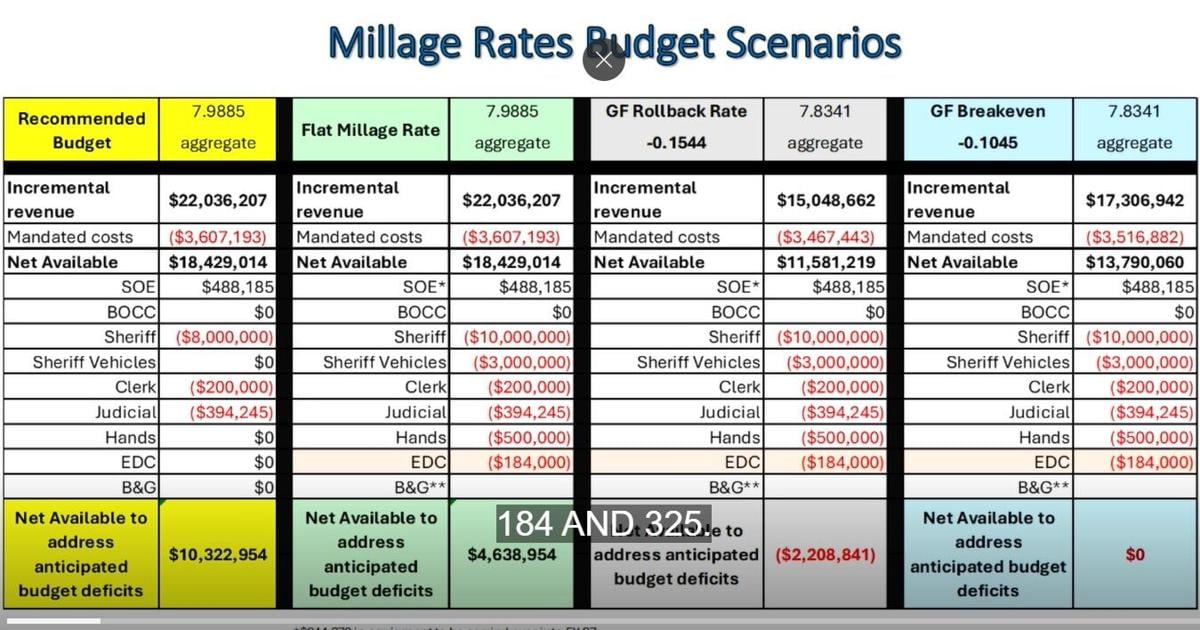
Those color-coded options were the four millage rate choices prepared by staff, which included two that kept the rates flat with slight variations, the rollback rate – the ad valorem amount needed by the county to maintain current funding levels – and a slightly higher break-even rate to avoid cutting any departmental services or staff.
Landry provided further details beginning with the staff-recommended flat rate that did not fully cover the Sheriff’s Office request but achieved a $10.3 million reserve fund towards projected ad valorem losses if this fall’s property tax referendum is approved by Florida voters.
The yellow scenario also eliminated the county’s $325,000 contribution to the Economic Development Council of St. Lucie County, which became a primary focal point that day.
The green flat rate scenario increased the Sheriff’s Office funding and restored $184,000 of EDC funding but reduced the reserve fund cushion to $4.6 million.
“The recommended budget in yellow was presented the three days of last week,” he explained. “Then there was discussion on Friday on funding differences from what was recommended. Under the green scenario, they took the recommended $8 million for the sheriff and moved it to $10 million and a one-time funding of sheriff vehicles at $3 million. There was some discussion on EDC between the $184,000 and $325,000. So, if we used the lower number, it left a balance of $4.6 [million] that could go into a potential reserve account in anticipation of November.”
The final millage scenarios Landry described were the rollback rate and the break-even rate, color-coded in gray and blue, respectively. Neither of those provided a reserve cushion.
“Taking the General Fund back to rollback would drop the incremental revenue from $22 to $15 million,” he said of the gray rate. “That left a deficit of $2.2 million. In order for us to give you a balanced budget, we put together the scenario that’s in blue at the far right of the screen. I believe if you went in about. .0464 plus or minus above the General Fund rollback [rate], it would get you to that balanced budget, leaving the funding the same. That blue scenario would get you to a balanced budget. If the Board wanted to stay with the rollback, then you’ve got to figure out where you want to take $2.2 million from in order to achieve that.”
While District 1 Commissioner James Clasby immediately expressed his preference for the rollback rate, Vice-Chairman Larry Leet questioned the change in the Sheriff’s budget from the yellow and green flat-rate versions.
“I thought we were more in the $8 to $10 million range for the sheriff, plus the $3 million for the cars,” he said. “Was I misunderstanding?”
Management & Budget Office Director Jennifer Hill provided a rather complicated answer to that question, which had to do with a Florida Retirement System accounting error at the Sheriff’s Office.
“What happened Friday was the discussion that it was $8.3 million needed, plus $1.6 million for changes to the Florida Retirement System rates that came in last minute after the sheriff had already submitted his budget requests,” she said. “There was part of the presentation where some numbers from the sheriff were unclear… basically, this year there was a mistake: They were not including their other salaries and overtime in the way they calculated and it was causing a deficit. So that is being corrected for next year.”
Vice-Chairman Leet, however, still wanted to talk about EDC funding.
“The Economic Development Council brings in people like Buc-ee’s and the P-1 Motor Club that create huge revenues in taxes that can replace the homesteaded property taxes,” he said. “So, I am a little bit uncomfortable with decreasing that.”
Hill in response, reaffirmed her recommendation for the yellow scenario that had no EDC funding.
“The recommended budget, which included $10 million set towards dealing with the future deficits from the possibility of Amendment 3 passing, is the most conservative approach,” she said. “When you look forward to where we might be a year from now, the $10 million head start in a $66 million problem is something at least. Anything that sets aside some money to deal with the future issues would be my recommendation.”
Commissioners Erin Lowry and Cathy Townsend both expressed a preference for the rollback rate, however, with the latter insisting “there’s ways to cut this $2 million.” Townsend concurred with Leet, however, on wanting to restore all the EDC funding. Commissioner Clasby opposed that idea.
“I don’t think we have to continue funding them forever,” he said. “There’s multiple groups out there that can perform the same function. We as commissioners could perform the same function going to conferences and other things.”
After much further debate, the majority of commissioners gave their consensus for restoring the full EDC funding, and Chairwoman Jamie Fowler advised her colleagues to sharpen their pencils.
“We’re $2.6 million off from the rollback rate,” she said. “I’m going to ask that we don’t leave that to staff. I think the three of us should come prepared. I’m going to be coming in with suggested cuts.”