
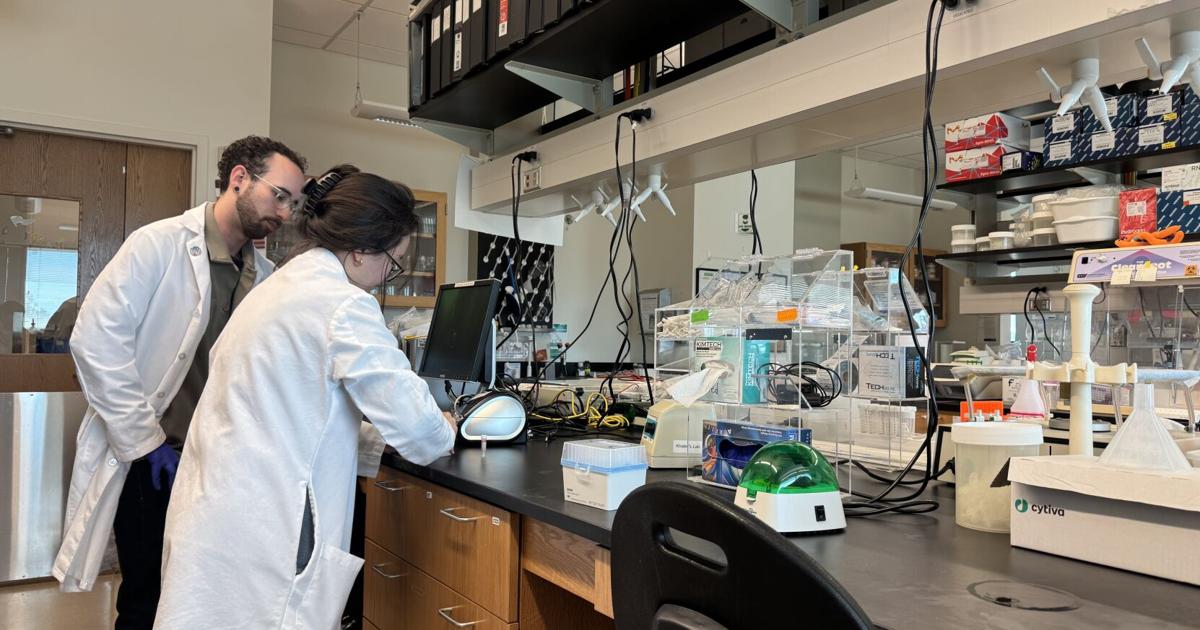

Two researchers, James Velasquez (left) and Carolyn Dang (right), on Dr. Annette Khaled’s team collaborate on Z-TOP peptide work in their lab at UCF Burnett School of Biomedical Sciences in Lake Nona on Oct. 14.
Victoria Pera
A team of researchers at UCF is working with a life-changing peptide and two targeted therapies to tackle breast and testicular cancer.
Dr. Annette Khaled, the head of the UCF College of Medicine’s Cancer Research Division, has recently received more than $2 million in grant funding to expand her work on a peptide called Z-TOP.
Her research team received a $258,000 grant through the Casey DeSantis Cancer Research Program’s Florida Cancer Innovation Fund and nearly $1.8 million in funding through the U.S. Department of Defense, in partnership with the Orlando Veterans Affairs Health Care System.
Khaled said she accidentally discovered this peptide in 2012, and ever since then, her lab has studied what this peptide kills, how it kills and why it kills.
“I was still building my lab, building my research program, and around those early days, we did this experiment and the next morning, we set up our culture the night before,” Khaled said. “The next morning, all the cells were dead and we said, ‘Oh no, failure.’ We killed the cells and as we started to study what happened. We discovered this small peptide actually had inherent killing activity.”
Khaled and her lab discovered that Z-TOP is an effective cancer therapeutic because it kills only cancer cells, not healthy cells. She explained how the peptide kills using an analogy.
“So when proteins are first made, they’re kind of like a bead, like a pearl necklace. You have to have something that’s called a chaperone that comes in and takes that chain of beads and folds them into a three-dimensional shape,” said Khaled. “That three-dimensional shape is what has function and has activity in a cell. That’s what our peptide does, it destroys the chaperone, and when chaperones are eliminated, the proteins stay in a linear form and eventually get destroyed.”
She said that once the proteins of the cancer cell lose their function, the cancer cell doesn’t have the proteins it needs to grow, and it dies. This new funding brings the research to Phase 2, which involves engineering and designing a way for patients to inject the peptide into their bodies.
To achieve this, Khaled asked for help from Lorraine Leon, a materials scientist and peptide research expert at UCF, from the College of Engineering and Computer Science. Khaled said Leon’s background in chemical engineering and materials science will allow her research to advance to the next step of engineering the transportation of this cancer-fighting peptide.
Leon said her lab discovered that Z-TOP’s current problem is that it’s hydrophobic — meaning it hates water. This poses a problem because adult human bodies are made up of about 60% water.
“We’re kind of engineering the packaging of this therapeutic, which is important because things that can’t dissolve in water, you really can’t put in blood, and that’s what our bodies are made of, mainly water,” said Leon. “So, this molecule being really hydrophobic was an issue, but you know, working together, we found a way to solve that.”
Leon said her lab has decided to add a part to the peptide that she described as really hydrophilic and water-loving. So, it could do two things: increase its solubility in water and form self-assembled structures called micelles.
Her lab is exploring the self-assembly properties of these micellar structures to optimize shape for successful drug delivery. With the hopeful intention of making the Z-TOP peptide soluble enough that it can enter patients’ bodies and move where it needs to.
One worker in Khaled’s lab, Carolyn Dang, who has a master’s degree in biotechnology, said she is helping in the research by focusing on liquid biopsies and extracellular vesicles from cancer cells. She added that she feels she is at the forefront of science.
“I think we are at the forefront of science right now because I get to experiment with all this new technology; some of this technology isn’t used right now in clinical to treat patients because it’s so new,” said Dang.
The research team’s goal, Khaled said, is to develop a therapeutic ready for human trials in three years, with the hope that this drug will serve as a treatment to replace chemotherapy, which is known to have significant negative side effects on the human body.
Khaled said she hopes that this research can inspire people to pursue scientific discovery, even in the current economic situation.
“We all love the discovery, not for the sake of glory, not for the sake of, you know, money, or whatever, we do it because we love discovery,” Khaled said. “So if anything, I can say, you know, I hope that the current economic situations and the current funding situation don’t make people go away from science, because discovery is just, it’s addictive.”