
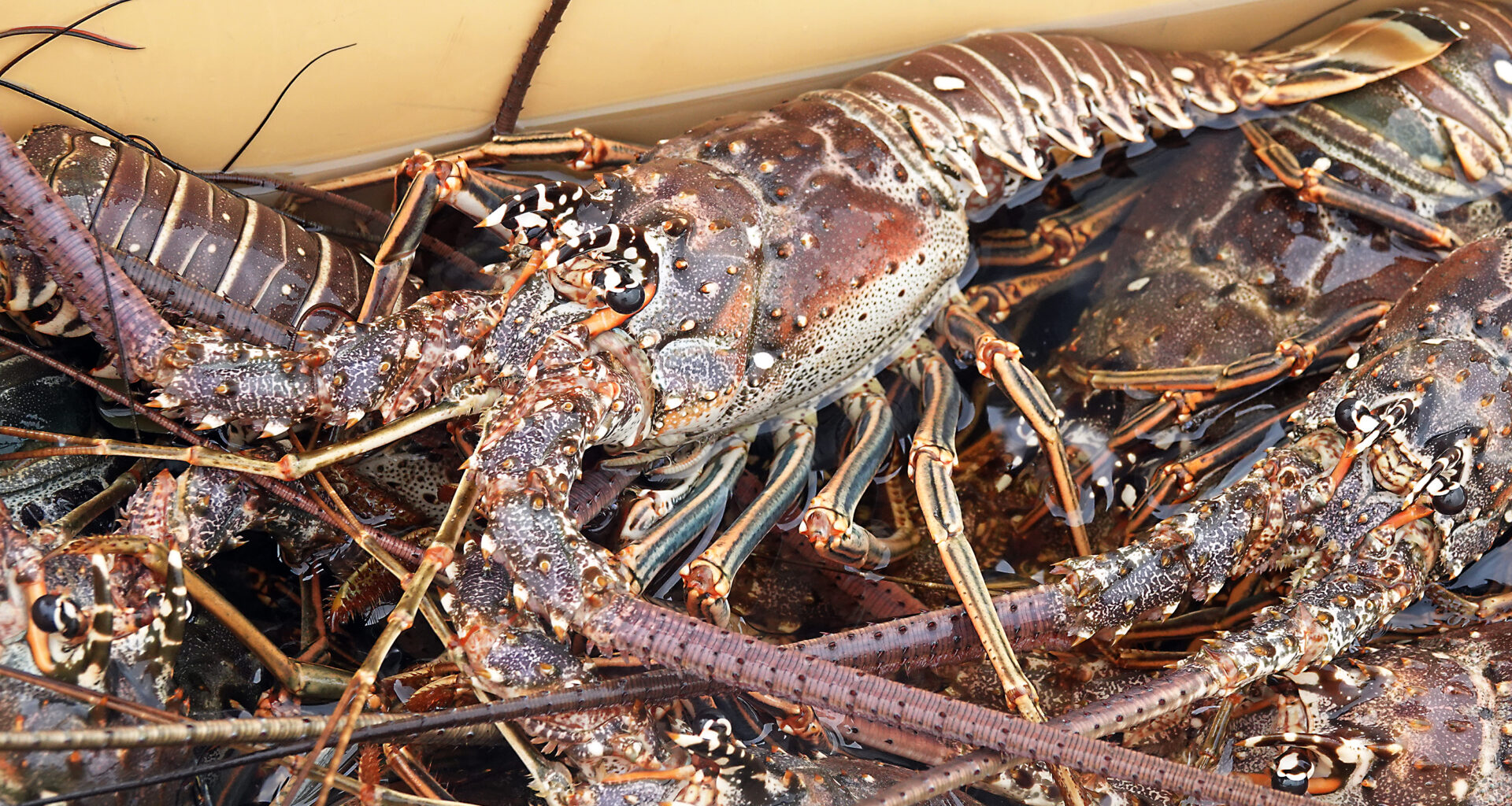
Florida’s two-day spiny lobster mini season will run Wednesday and Thursday, and federal, state and local authorities will be out on the road and water in full force across South Florida.
The mini season is held on the last consecutive Wednesday and Thursday in July annually, beginning and ending at midnight. Here’s what officials want all eager South Florida bug-hunters to know.
Rules
A recreational saltwater fishing license and a lobster permit are mandatory in order to harvest spiny lobster.
There is a daily limit of 12 lobsters per person per day, except in Monroe County and Biscayne National Park, where the limit is six per person per day, according to the Florida Fish and Wildlife Conservation Commission regulations. Limits are enforced both on and off the water.
The carapace must be longer than 3 inches, and the lobsters must be measured while in the water. Divers are required to have and use a measuring device at all times, and lobsters must be taken to land in whole condition, according to FWC’s regulations.
Egg-bearing lobsters cannot be harvested. Using any device that could “puncture, penetrate or crush” the shell or flesh of the lobsters, as well as recreational trapping, are prohibited, FWC’s regulations say.
Check FWC’s regulations for prohibited areas. Night diving is prohibited in Monroe County during the mini season, which is considered to be one hour after sunset and one hour before sunrise.
The Monroe County Sheriff’s Office will have an increased patrol presence at boat ramps, bridges and out on the water. The Sheriff’s Office warned in a statement shared on social media Friday: “Anyone caught with illegal lobster will be charged accordingly. Deputies will be looking for safety and wildlife violations.”
Penalties for possession of each undersized lobster includes up to 60 days in jail, a $500 fine or both, according to the Monroe County State Attorney’s Office.
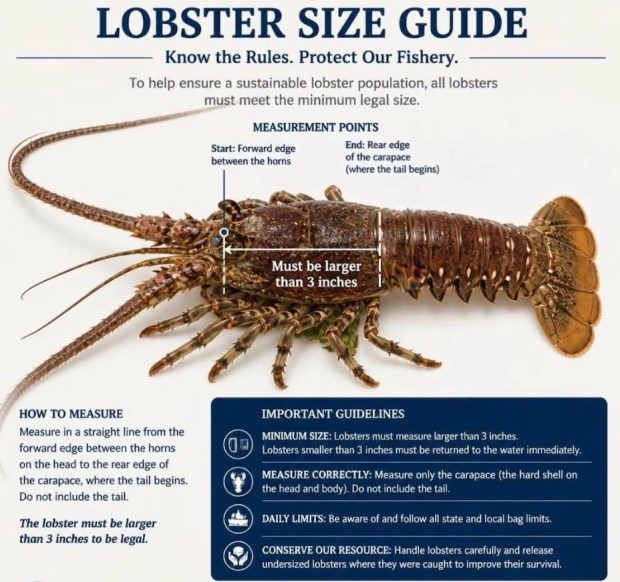 All lobsters harvested during the mini season must be measured in the water, and the carapace must be greater than 3 inches. (U.S. Coast Guard Southeast/Courtesy)
Safety tips
Coast Guard Southeast District Recreational Boating Safety Specialist Scott Szczepaniak emphasized that boat operators need to turn engines completely off when people are diving and swimming in the water.
“Propellers made of aluminum or stainless steel are like knife edges,” he said. “Think about putting your finger in a blender. … The propeller doesn’t care if it’s slicing through the water or slicing through a diver. So that’s the incredible danger because again, a lot of people in the water around the boats.”
Due to the daily bag limit per person each day, “that could be an incentive to overload the boat,” he said. Boaters should follow their vessel’s capacity instructions. And with the season beginning at midnight Wednesday, boaters should check their navigation lights before heading out for any late-night bug diving.
Szczepaniak also urged participants to save their celebratory drinks for when they’re on land, and not to drive.
“We remind folks that one beer on a boat is generally considered to be three beers sitting in your living room because the rocking motion of the boat, the vibration of the boat, that fact that folks are often a little dehydrated when they’re out boating,” Szczepaniak said. “It magnifies the effect of alcohol.”
‘Calm’ weather expected
Boaters and divers should see “relatively calm” waters on the Atlantic side on Wednesday and Thursday, according to National Weather Service Miami meteorologist George Rizzuto.
Wave heights are expected to be between 1 and 3 feet, with areas closer to shore seeing the lower height, Rizzuto said. Winds from the southwest will be about 10 to 15 mph with gusts of 20 mph, so the water may be choppy.
The highest chances of rain are between 2 and 7 p.m., Rizzuto said, and there may be some isolated showers and storms over the water, as is typical for South Florida during the summer.
“We are not going to get a strong system that’ll bring widespread heavy rainfall to the area or anything,” he said.