
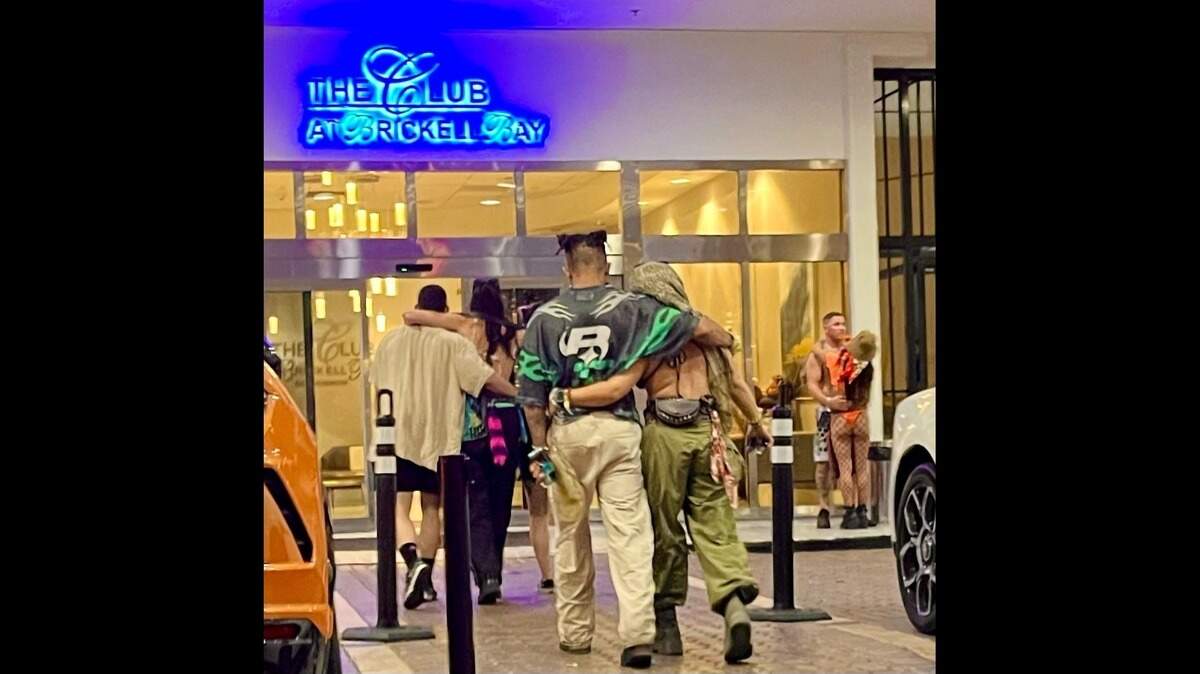
Partygoers stumble back to The Club at Brickell Bay after an evening of reveling. At The Club, 85 percent of the condos are owned by investors who rent their units on vacation booking sites, violating the city’s ban on short-term rentals in multi-family residential condos, a Miami Herald investigation found.
Linda Robertson
lrobertson@miamiherald.com
Chaotic condo
Re: the July 16 Miami Herald story, “‘Save your condo before it’s too late.’ How Miami condo turned into ‘Animal House’.” This happens because Republicans in our state legislature refuse to adequately fund the Florida Department of Business and Professional Regulation (DBPR), under its Division of Florida Condominiums, the state agency responsible for regulating and supporting Florida’s condominium associations.
Surely many owners’ complaints have been ignored and if any of those complaints were made to the DBPR, they were never acknowledged or followed-up. Florida’s elected officials are more interested in servicing their billionaire benefactors and the condo management industry, than individual condo unit owners.
Additionally, Miami and Miami-Dade County’s elected officials are only concerned with creating a playground for the “super-wealthy.” Now, unit owners are in the untenable position of retaining costly legal counsel.
Joanne Tomarchio,
Miami
Sensor saves lives
The Herald’s July 7 editorial, “Another Florida hot-car death of a child: How does this keep happening?” along with the tragic story on July 13 of yet another child dying in a hot car, was deeply personal. The loss of my baby grandson changed my family forever. Every new story reminds me that this is still happening to others.
Neither the story nor the editorial mentioned that a real solution already exists: radar-based occupant detection technology, which can detect tiny movements inside a vehicle and trigger escalating safety measures, such as sounding the horn, lowering the windows, activating the air conditioning, flashing the lights, or contacting parents or emergency responders. This technology can work with today’s car systems.
In 2021, Congress passed the Infrastructure Investment and Jobs Act, directing the U.S. Department of Transportation to establish a federal safety standard to help prevent hot car deaths. Yet the National Highway Traffic Safety Administration (NHTSA) missed the November 2023 congressional deadline to issue the final rule and families are still waiting.
After every tragedy, we hear the same advice, but no loving parent or caregiver believes this could happen to them. Human memory is fallible; technology should be the backup. The auto industry does not have to wait to include effective occupant detection technology and save children’s lives.
Marta Magellan,
Kendall
Polarizing politician
Miami Herald op-ed columnist Mary Anna Mancuso challenged us to keep sight of Lindsey Graham’s humanity. As usual, she is correct. Whatever else Graham was, he was a human being.
Mancuso acknowledges that from 2016 on, the recently deceased South Carolina senator spent the last 30% of his career largely making decisions and taking actions with which she disagreed.
One is left to wonder if she was intentionally channeling former Chinese leader Deng Xiaoping’s declaration that another former Chinese leader, Mao Zedong, was “70% right and 30% wrong” — strongly implying that the last 30% of Mao’s life was China’s national disgrace and disaster — or if that was just an interesting coincidence. After all, Mao was only human.
Philip Cardella,
Miami
Ludlam needs leader
The pathetic disappearance of $42 million, as described in the July 15 Miami Herald editorial, “Ludlam Trail has cost Miami-Dade taxpayers $42M. Where is it?” was meant to design and build the Ludlam Trail.
Put Meg Daly, president and CEO of Friends of the Underline, in charge of the Ludlam project. She’ll get it done and done right.
Don Deresz,
Miami