
OCALA, Fla. (WCJB) – Recent rain has eased drought conditions in some parts of North Central Florida, but groundwater levels in many areas remain stressed — a concern for thousands of homeowners who rely on private wells for drinking water, experts say.
With drought impacts lingering, University of Florida Institute of Food and Agricultural Sciences (UF/IFAS) officials and the Florida Well Owner Network are urging residents to understand how their systems work and how to maintain them to help protect water supply and quality.
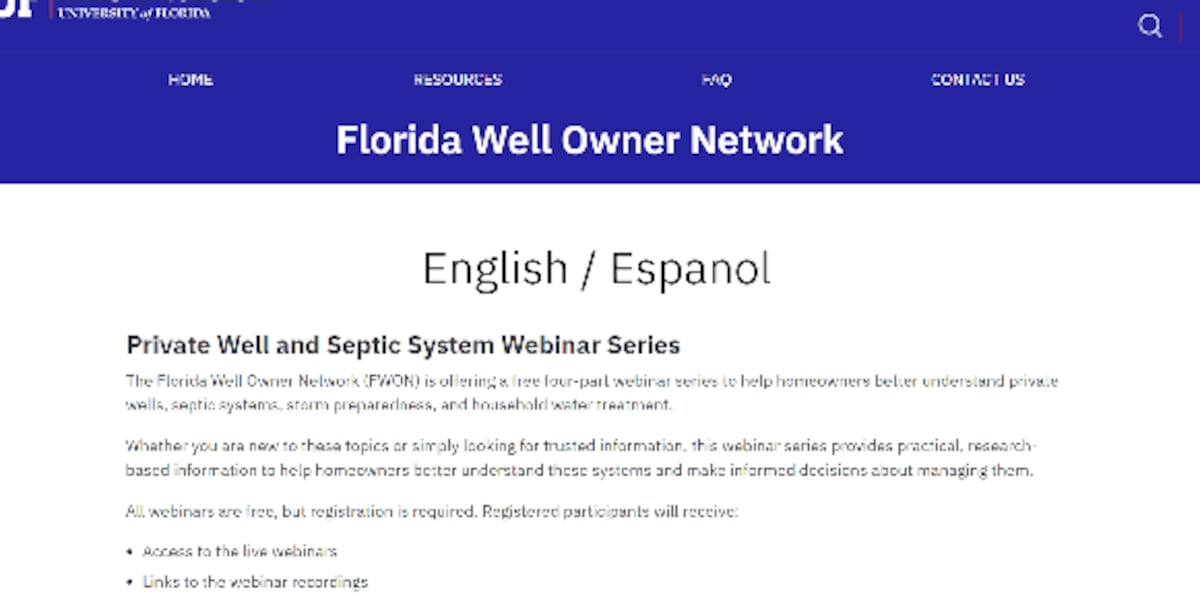
To help homeowners stay informed, UF/IFAS and the Florida Well Owner Network will host a free, four-part educational webinar series on Zoom, offered in both English and Spanish.
Organizers say the sessions will provide practical, research-based guidance for keeping drinking water safe while also protecting Florida’s groundwater resources.
The first session, “Private Well 101: Understanding Your Well and Water Basics,” will cover how private wells operate, common water quality issues, when to test water and where to find trusted resources.
The English session is scheduled for Aug. 25 from 2 to 3 p.m., followed by a Spanish session Aug. 27 from 2 to 3 p.m.
Additional webinars will address septic systems, storm preparedness, and home water treatment options.
The series continues Sept. 1 with “Septic System 101: Understanding Septic Systems and Common Homeowner Practices.”
That session will cover how septic systems work, differences between conventional and nitrogen-reducing systems, routine maintenance, what should and should not go into a system, and steps to extend a system’s lifespan.
On Sept. 8, the focus shifts to storms with “Before and After the Storm: Protecting Household Water Systems During Hurricanes and Flooding.”
Presenters will discuss how hurricanes and flooding can affect private wells and septic systems, what steps homeowners should take before and after severe weather, and where to find reliable recovery resources.
The final session, scheduled for Sept. 15, is “Home Water Treatment Systems: Understanding Filters, Softeners, and Treatment Options.”
Topics will include common household treatment systems — including filters, softeners and reverse osmosis — how they work, and which options may be appropriate for different homes.
Organizers say the goal is to help homeowners keep their systems running safely year-round, particularly as drought and severe weather threaten water supplies across the region.
Click here to subscribe to our newsletter.
Copyright 2026 WCJB. All rights reserved.