
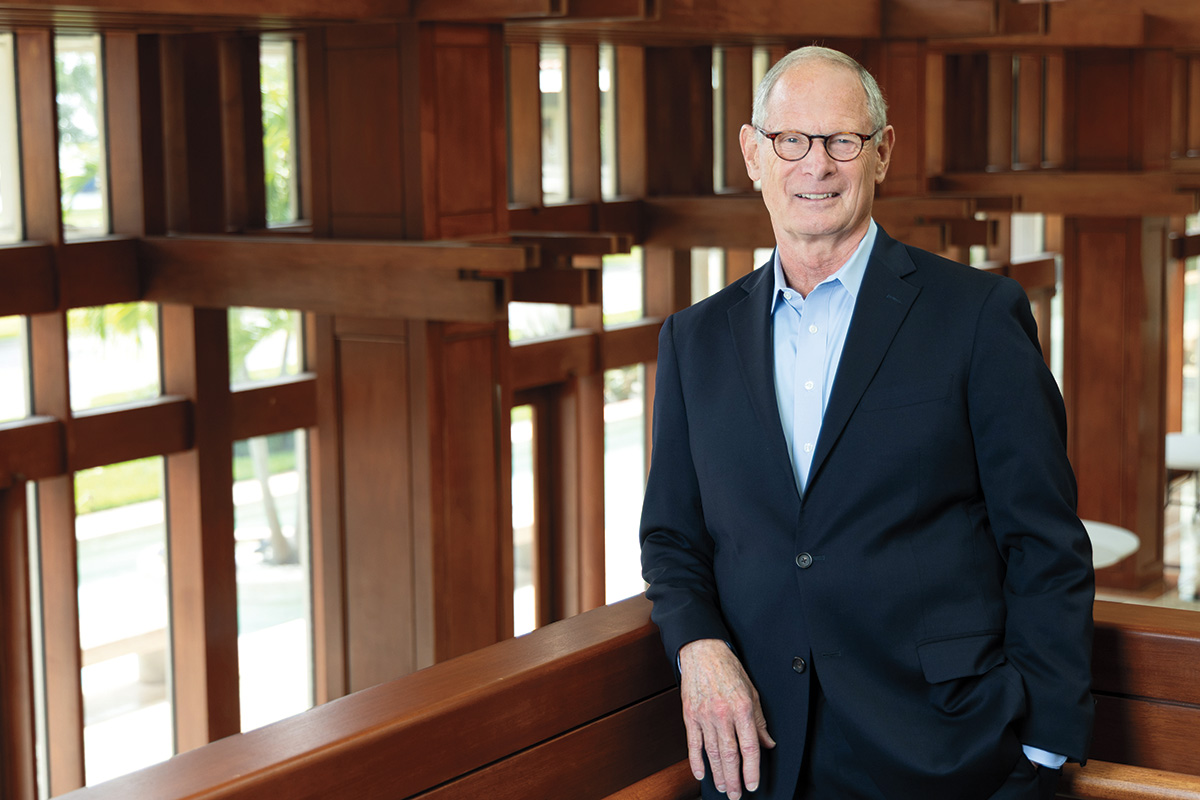
A new thing for me in retirement has been teaching at Duke University. I teach a course called News as a Moral Battleground, and the current climate provides plenty of material. It’s a course about journalism rather than a journalism course. It attracts students from across the university. It’s been a wonderful way to apply some of the experience from my career and turn it forward.
I received the Marshall Scholarship, set up by the British government in appreciation for what the United States did to support Europe during and after World War II. We could study whatever we wanted at any university that had a suitable program. I had done journalism and political science at Indiana University, and I thought, well, law would be an interesting extension of that. So, I got a law degree at the University of Edinburgh, never intending to practice law.
At its best, law school teaches you a way to think that’s similar to journalism. It’s all about trying to discover facts, analyze the important ones and present them in a way that’s coherent and meaningful.
I’ve got four grandchildren and all of them live within 20 miles. I wanted to have a retail relationship with them, rather than a wholesale relationship, by which I mean I wanted us to know each other directly, as people, not just through their parents. I have so many friends who have to get on an airplane to go see their grandkids. I’m very lucky I get to be part of their lives at close range. It’s been a blessing.
Growing up in South Bend, Ind., I had a very typical, I think, Midwestern, middle-class childhood. If you’ve seen the movie A Christmas Story, that’s very resonant.
My parents were both teachers. I was the older of two brothers. I went to public schools. Because we didn’t have a lot of other family around, the four of us were very tight.
My dad taught industrial arts and math, and my mom taught English and business. My mom taught me to type on a typewriter when I was in junior high school, without looking at the keys. I still have the typewriter.
One of the best days of my professional career was one of the worst days of my personal life. My day began with a phone call from Arthur Sulzberger, the publisher of The New York Times, to congratulate me and the St. Petersburg Times on being the only other news organization to win multiple Pulitzer Prizes. … We had two, and they had six or seven.
But what a way to start the day. When I got home, Karyn, my wife, said, ‘Your brother called.’ I called him. I said, ‘How was your day?’ ‘Not so good. I have a brain tumor.’ One of his doctors later described it as ‘the tumor from hell.’ It killed him within months.
I mention that as an example of how great highs and lows, the worst lows, can come right next to each other. The only answer is to let the highs carry you while you keep going through the lows.
Think about what Nelson Poynter did to preserve the independence and local ownership of his beloved St. Petersburg Times. He gave it away. He created [the Poynter Institute] … which could inherit the newspaper and keep it local and independent, rather than sold into a publicly held chain. If Nelson Poynter was prepared to do that, then I had to do whatever I could to keep it … not only going, but vibrant. Because if we failed, there would be almost no chance that something special like this could be created again.
We were absolutely right that the Tampa Bay region was the natural footprint and held the natural audience for the Tampa Bay Times. The expansion throughout the Tampa Bay region and the redefinition of the newspaper, from the St. Petersburg Times to the Tampa Bay Times, was absolutely correct.
But with perfect hindsight, I would have pushed sooner and faster on digital [content]. It’s a tricky balance to navigate, because you also have to be attentive and dedicated to the business you have, simultaneous to creating the business that you’re going to have.
“I got here in 1978, and downtown St. Petersburg had nothing going on. But look at what it’s become. And look at what has happened and what continues to happen in Florida now, almost 50 years later. Florida was a state on the come-up, and it was not all sorted out, which made it a fascinating place to be a journalist.”
We wanted our work to make a difference, and it did. I mean, Lucy Morgan, as the Tallahassee bureau chief, had a bigger impact on state government and politics than, I think, any other reporter in Florida.
The two biggest news days of my career … obviously 9/11. But the other one was the fall of the Sunshine Skyway Bridge.
I view voting as part of my civic participation and responsibility. I’ve been registered with both parties. I’m a Democrat, but for a long time I was a Republican. I wanted to vote in the Democratic primary in the 2000 presidential election, so I switched, and I’ll go back and forth.
One of the things that is contributing to partisan politics is that we have this closed primary system, which, in my view, is causing harm to the possibility for consensus and constructive action across parties. We just elect the people who appeal to the most extreme or most partisan primary voters.
These days, there’s much more suspicion about the press and fake news, and the political rhetoric drives a lot of that. But I think if you try to approach people honestly and openly and with empathy, that can go a long way.