
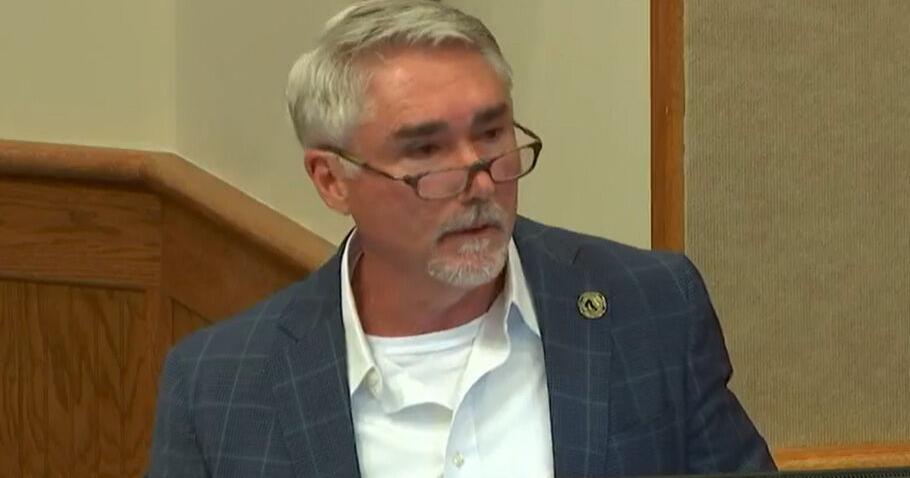

Charlotte County Property Appraiser Paul Polk addresses commissioners during a budget workshop. Polk said continued population growth has increased his office’s workload while staffing has declined over the past decade.
Charlotte County government
Charlotte County Commissioners unanimously approved a tentative millage rate of 6.0394 for fiscal year 2026-27, unchanged from the current year, along with a proposed $1.79 billion county budget and a $153.5 million sheriff’s budget.
The budget will return for public hearings Sept. 14 and 18 at the Charlotte Harbor Event & Conference Center in Punta Gorda, where commissioners may lower — but not increase — the tentative millage rate before adopting a final budget.
Although the millage rate remains unchanged, county officials said inflation and continued population growth are putting increasing pressure on department budgets. Commissioners also spent considerable time discussing the potential impact of Amendment 3, a proposed constitutional amendment on the Nov. 3 ballot that could significantly reduce future property tax revenues if approved by voters.
The financial challenges were echoed by two constitutional officers — Property Appraiser Paul Polk and Sheriff Bill Prummell — who said their offices are struggling to keep pace with the demands of a growing county.

Charlotte County Sheriff Bill Prummell discusses his proposed fiscal 2027 budget with commissioners. Prummell said population growth, rising service calls and higher operating costs continue to drive spending.
Charlotte County government
Polk said he submitted a proposed fiscal year 2026-27 budget of $7,888,624 to the state on June 1, but the Florida Department of Revenue reduced the request to $7,638,548. Polk said the reduction was tied to two long-vacant positions that remained unfilled, but he is negotiating with the department to restore funding for one of them.
He said the additional position is needed because the county’s growing population continues to generate more property valuations while his office has fewer employees than it did a decade ago.
Polk said his office has lost four positions since he took office in 2013, shrinking from 66 employees to 62.
Prummell also cited population growth as a major budget driver. His proposed budget initially faced a $10 million shortfall before commissioners chose a neutral budget option that eliminated the deficit. His tentative budget totals $153.5 million.
As Charlotte County grows, deputies respond to more calls for service, drive more miles and face higher operating costs, Prummell said. The inmate population also continues to rise.
The sheriff’s budget is divided into four categories: courts, detention, dispatch and law enforcement.
This year’s budget discussions also centered on Amendment 3, which asks voters whether to expand Florida’s homestead exemption for nonschool property taxes.
If approved by at least 60% of voters, the measure would increase the homestead exemption for nonschool property taxes to as much as $150,000 in 2027 and $250,000 in 2028 for qualifying residents. Beginning in 2029, the $250,000 exemption would increase annually when inflation is positive. The expanded exemption would not apply to school district property taxes.
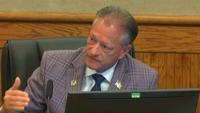
Charlotte County Commission Chair Joe Tiseo listens as Commissioner Bill Truex discusses the county’s fiscal 2027 budget. Commissioners said a proposed expansion of Florida’s homestead exemption could create additional budget challenges in future years.
Charlotte County government
Those who establish Florida residency on or after Jan. 1, 2027, would generally receive an exemption of up to $50,000 for their first four years. Beginning with the fifth year of the exemption, they would become eligible for the larger amount available to established residents.
Commission Chair Joe Tiseo said one area the county should examine for savings is travel, which he said has increased significantly in recent years.
He pointed to Clerk of the Court Roger Eaton’s efforts to reduce costs through technology and asked County Administrator Hector Flores to work with Eaton to identify additional opportunities to trim spending.
Flores said those discussions are already underway.
Commissioner Bill Truex said the proposed homestead exemption could create additional budget challenges in future years.
“If voters approve an additional homestead exemption, we’re going to be behind the 8-ball trying to get that budget covered in future years,” Truex said.