
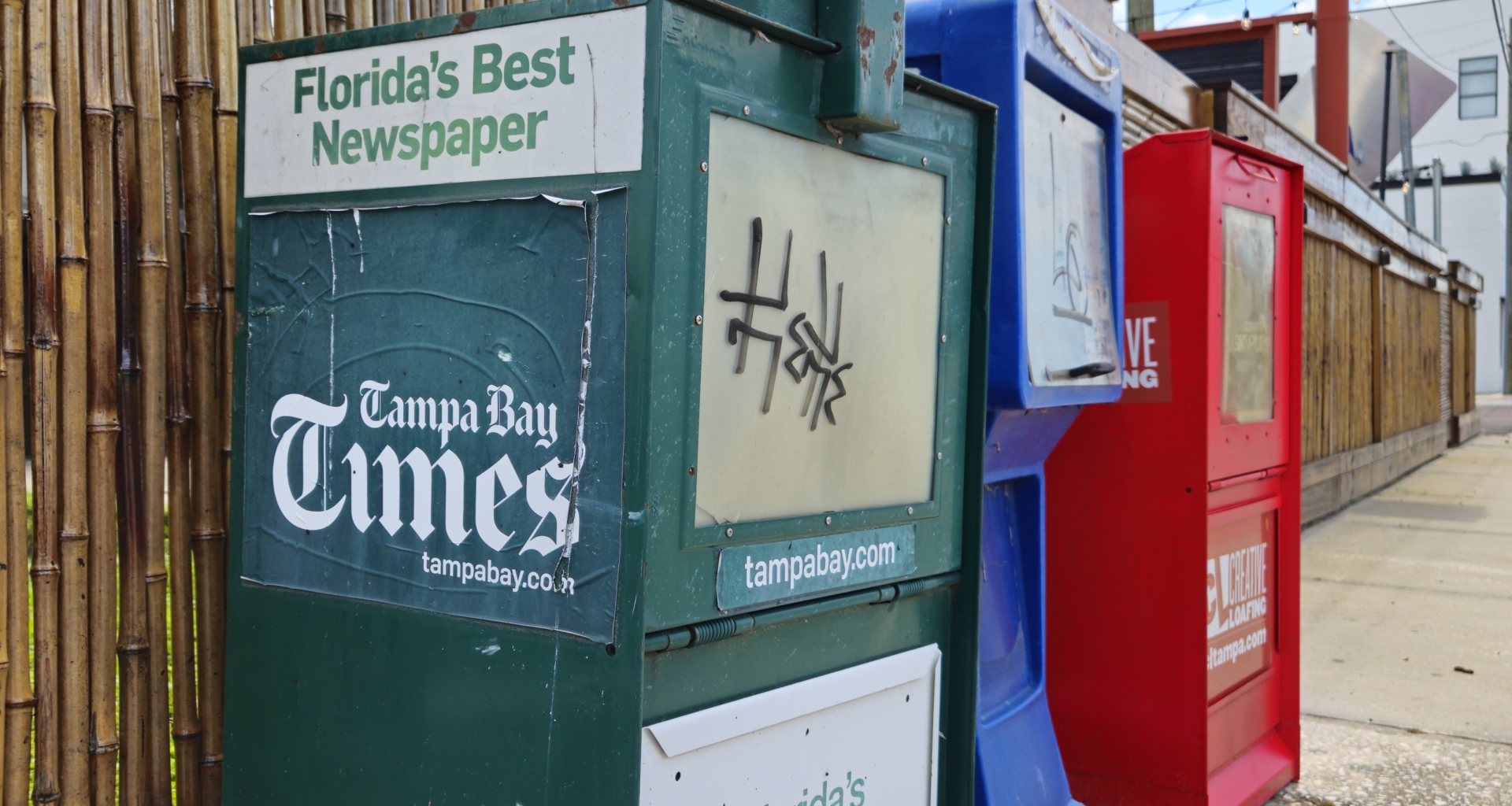
 A Tampa Bay Times box in Tampa, Florida on Aug. 10, 2024. Credit: Ray Roa / Creative Loafing Tampa Bay
In a column published July 16, Tampa Bay Times Chairman and CEO Conan Gallaty announced the paper was “changing the way we make election recommendations.” I’m glad the paper finally came clean about this monumental retreat, coming days after early ballots for the August primary hit our mailboxes. But the column was as misleading as it was self-serving, perfuming a surrender that disserves Times readers and the people of this state.
Gallaty started out fine, arguing that as newspapers struggle with revenues and audiences amid a changing media market, the Times must be smart about focusing its elections coverage. But that’s nothing new; newspapers, like every other business, make decisions every day about how to spend their resources. Having worked for three newspapers in Florida for nearly 40 years, including nearly 30 years at the Times, I’m here to tell you there is plenty of fudge in the bowl to cover whatever political campaigns a newspaper desires. Like everything in life, it boils down to priorities.
But whatever; Gallaty runs the Times and it’s his decision to make. But it’s a shame he chose to rationalize the move by diminishing the work and impact of the Times’ Editorial Board, which for decades weighed in on candidates for federal, state and local offices, along with statewide constitutional and local ballot referendums. That decision is why I retired in April after three decades on the Times Editorial Board.
In his column, Gallaty acknowledged that the editorial boards of American newspapers had a “deep” tradition of recommending candidates. But he maintained the process “created confusion” at the Times, as if the entire staff had backed a candidate. Rather, Gallaty wrote, “it has always been a small group (at the Times) offering its judgment,” leaving the distinction between the newsroom and Editorial Board “not always clear.” Going forward, he announced, undisclosed Times staffers “will be putting our individual names to the recommendations.” Moreover, he wrote: “We will also publish the thoughts of community members backing candidates in their campaigns.”
Confusion? During my years on the Editorial Board, the Times could not have been clearer about the people and process behind our recommendations. The Times held open houses during election season to explain the separate roles the newsroom and Editorial Board played. Editors made clear to the campaigns at multiple points how the news and editorial sides functioned separately. Editorial editors also routinely penned columns explaining to readers how the Times arrived at its recommendations. And all candidate recommendations were published on the editorial pages, flagged separately from the news hole. I’m not sure how Gallaty found this process confusing. Maybe because he wasn’t there.
Dismissing the Editorial Board as a “small group offering its judgment” is another jab intended to legitimize this decision. Over my time, the board included – among others – three Pulitzer Prize winners, three Pulitzer finalists, lawyers, academics, veterans from The New York Times and Washington Post and some of the most experienced and respected journalists in Florida. Gallaty wrote his decision marked “a change in format, not in mission,” but who’s he kidding? Replacing the Times’ Editorial Board recommendations with ghost-written odes from campaign donors and surrogates is not journalism; it’s free advertising. This change isn’t about transparency, but pawning off a civic duty.
The Times has plenty of capable journalists to carry on this important tradition. It’s too late for 2026, but hopefully the newspaper will look back on this election cycle, recognize the void it created and regain its obligation to speak for a better Florida.
John Hill’s entire professional life has been dedicated to readers, be it at Tampa Catholic’s student newspaper, the Oracle at the University of Tampa, The Ledger in Lakeland, Sarasota Herald-Tribune, St. Petersburg Times, and the Tampa Bay Times. He retired from the Times in April 2026.
Creative Loafing Tampa Bay accepts letters to the editors and op-ed pitches. We will not run your letter without permission. Email your submissions to [email protected] for consideration.
This article appears in July 23 – 29, 2026.
Related