
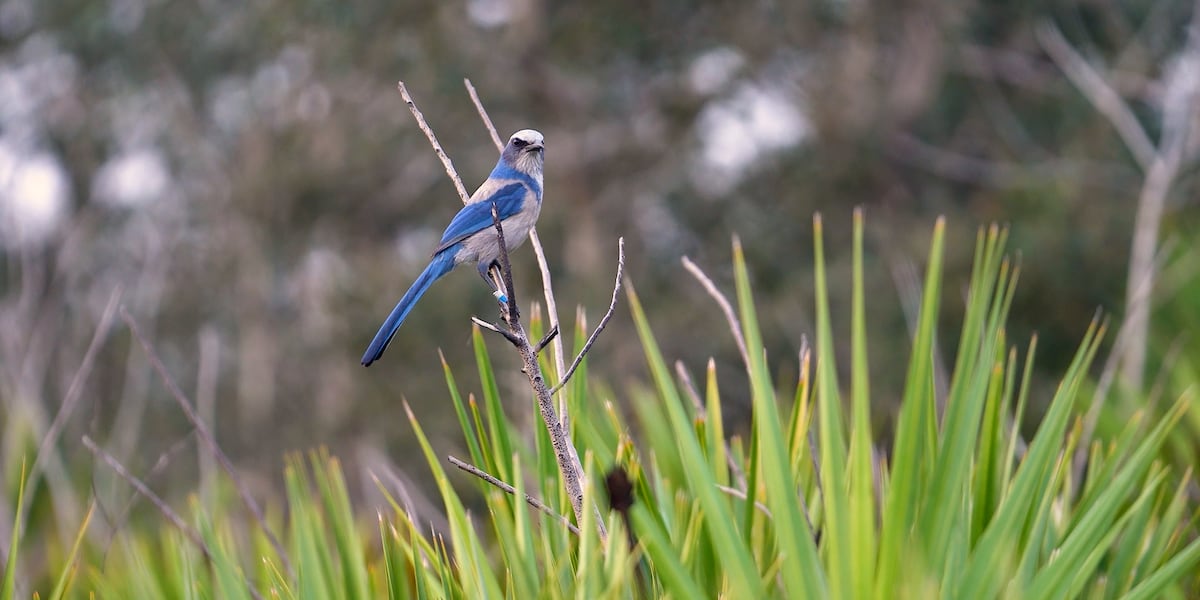
SARASOTA, Fla. (WWSB) – A coalition of state and local interests have successfully relocated 48 Florida scrub-jays to Manatee County in an effort to strengthen the federally protected species.
The project brought together birds from three distinct populations across Florida to a new home in Wingate Creek State Park in Myakka City.
By introducing birds from multiple populations, researchers say they hope to increase genetic diversity and reduce the risks associated with inbreeding in a population that has become increasingly isolated over time.
All 48 birds survived the initial relocation period and monitoring is continuing, researchers said.
Researchers focused on relocating young birds entering their first breeding season, a strategy designed to give the birds the greatest opportunity to establish territories, choose mates, and successfully integrate into the new population.
The project partners include The Mosaic Company, the Archbold Biological Station in Highlands County, the U.S. Fish and Wildlife Service, Verdantas, and the University of Central Florida.
Regional contributions from Manatee County, the Southwest Florida Water Management District, Florida Department of Environmental Protection, Florida Fish and Wildlife Conservation Commission, and regional land managers were also instrumental in preparing and maintaining suitable habitat conditions.
According to the FWC, the Florida scrub-jay is found only in Florida, inhabiting sand pine and xeric oak scrub, and scrubby flatwoods, which occur in some of the highest and driest areas of Florida.
As development and habitat fragmentation continue to reduce and isolate suitable habitat, small populations face elevated risks of decline and local extinction, the Archbold Biological Station said in a news release.
The project brought together young birds from populations in Highlands County, Cape Canaveral Space Force Station, and Duette Preserve.
The Florida scrub-jay is a blue and gray bird about the size of a blue jay. Scrub-jays have blue wings, head, and tail, and gray back and underparts, and a whitish forehead and neck. Unlike blue jays, this species does not have black markings or a crest.
Copyright 2026 WWSB. All rights reserved.