
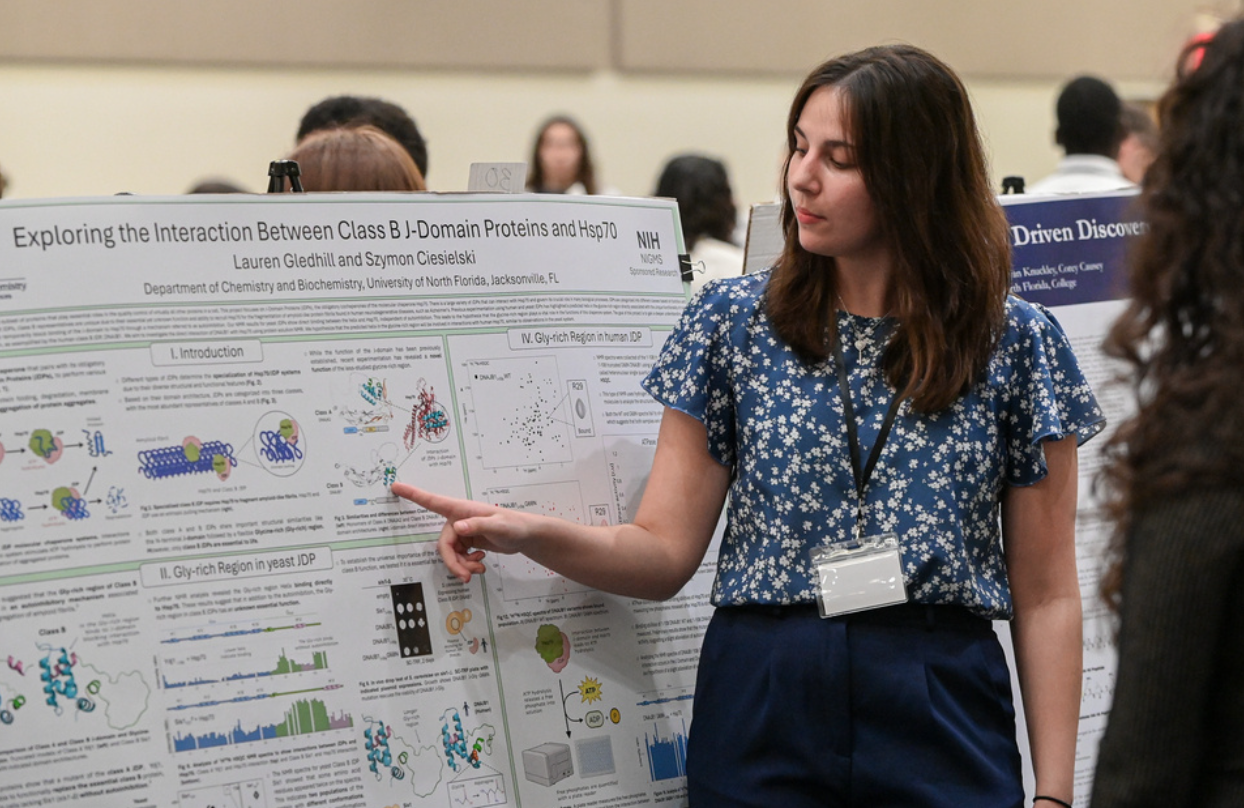
While researchers nationwide have seen billions of dollars in funding cuts and grant terminations, the University of North Florida’s Office of Undergraduate Research is using internal funding to shield its student researchers from the fallout.
Director Judith D. Orchrietor says the office makes it a point to prioritize its student researchers even when funding remains a question.
According to the OUR 2024-25 annual report, the office funded 108 grants and awards totaling $76,164. This landmark figure comes as university researchers nationwide point out perceived inequities in the funding cut process.
Dr. O and the OUR Response
Orchrietor said while federal cuts have affected some UNF labs, OUR uses internal university funding to continue offering research opportunities. This allows the office to shield students from the “trickle-down effect” of federal reductions, she said.
“The students are our top priority. In everything that the office does, we have the students in mind,” Orchrietor said.
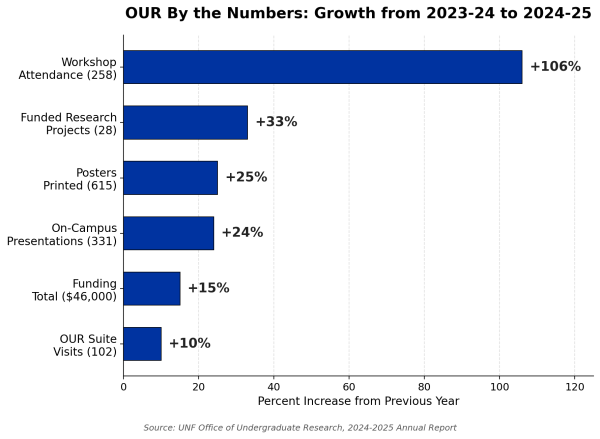 Student engagement across OUR programs grew across the board in 2024-25, with workshop attendance nearly doubling and funded research projects climbing 33% from the year before.
In the 2024-25 academic year, OUR funded 28 research projects for a total of $46,000, according to its annual report.
This follows a national trend of universities self-funding research to fill deficits. Universities are now the second-largest funders of research, according to the Association of American Universities.
Universities invested $30.2 billion of their own funds in campus‑based research in 2024, the HERD Survey found.
Despite talk of funding cuts in recent years, Orchrietor said there has been “an influx of students getting involved.”
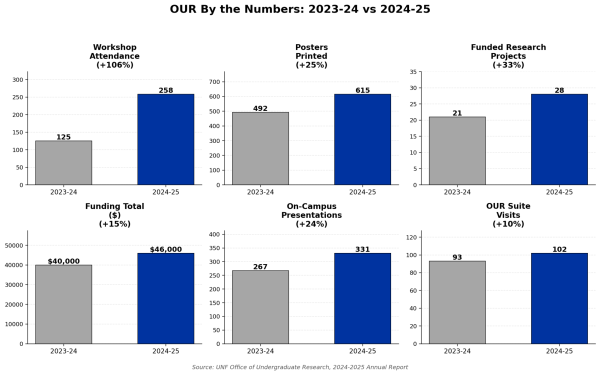 A side-by-side look at OUR’s key numbers from 2023-24 to 2024-25 shows growth in every category, from 125 to 258 students at workshops and $40,000 to $46,000 in research funding.
The OUR 2024-25 report noted a significant increase in attendance at professional development workshops, which help connect students with potential research mentors.
“Students are able to connect with their lab instructor on topics that they care about and specialize in, instead of just working with a grad student,” Orchrietor said.
When are we getting the funds?
U.S. colleges and universities spent $117.7 billion on research and development in 2024, with $64.7 billion coming from federal resources, according to the National Science Foundation’s Higher Education Research and Development Survey.
Between February and August 2025, the National Institutes of Health terminated 2,291 active research grants, rescinding $2.45 billion and disrupting thousands of projects, Science reported.
The NIH ordered its institutes to screen for projects tied to diversity, equity, and inclusion. It terminated dozens of grants studying LGBTQ+ health and gender identity, stating in letters that such programs are “often unscientific,” according to Columbia Law School’s Sabin Center.
In May 2026, a federal judge ruled that the Department of Government Efficiency’s cancellation of more than $100 million in humanities grants was unconstitutional, PBS NewsHour reported. DOGE’s direct role in ordering the cancellations has since been confirmed through sworn depositions by NIH officials, according to Science.
Even amid the cuts, UNF recently landed a five-year NIH grant of nearly $800,000 to launch PRIME-PEDS, a pediatric research training program led by Gui Cesar, an assistant professor of physical therapy.
However, university leaders remain concerned over the slow release of federal research funding, according to the Association of American Universities.
In a Wall Street Journal opinion piece, University of Kansas Chancellor Doug Girod and Johns Hopkins University President Ron Daniels warned that the “federal research engine has sputtered,” threatening America’s scientific primacy.
In the laboratory
Orchrietor noted that new faculty members often provide unique research opportunities for students.
“This means newer equipment, programs, and research avenues,” Orchrietor said.
Aidan Ray Simpson, a senior biochemistry major and president of UNF’s chapter of the American Chemistry Society, is researching PRMTI inhibitors. He works under the guidance of Bryan Knuckley and Corey Causey to study cancer cell treatments.
Knuckley and Causey co-invented a cancer-fighting compound that utilizes PRMTI inhibitors to slow the progression of certain cancers without harming healthy cells, the UNF newsroom reported.
Working with cancer biologist Fatima Rehman, the lab created a compound that “basically only attacks the cancer,” Simpson said.
Simpson said he joined Knuckley’s lab by chance after taking an introductory biochemistry course with him.
“When I came into the chemistry field, I wasn’t sure exactly what I wanted to do,” Simpson said.
He said he decided to join the lab after enjoying the professor’s teaching style.
“Ever since I took organic chemistry, I really liked synthesis and making things,” Simpson said. He noted the experience allowed him to explore his favorite niche of chemistry.
“Who you work with in lab is huge,” Simpson said. “I already had that connection with my professors.”
For the love of the game
Most student research assistants are unpaid and rely on grants or secondary jobs, Simpson said. He works as a resident assistant for UNF’s Housing and Residence Life.
Simpson said he is grateful for the opportunity and works in the lab without pay due to his passion for the research.
“I think you learn more from research than any lab experience in school,” Simpson said. “It’s way more in-depth than a normal 2.5-hour class once a week, when you’re there consistently for three hours every single day.”
He compared the work to what one might do in a graduate program or in the industry.
“Many of our students are doing research for experience,” Orchrietor said, comparing it to an apprenticeship.
Simpson is currently applying to dental school and said his research has strengthened his application.
“I think it shows a curiosity for science and a commitment to learning more about your craft,” Simpson said.
Taking grants for granted
Student participation in OUR programs rose significantly last year, with workshop attendance increasing 106% and student presentations up 24%.
While student involvement is up, Orchrietor said many available grants go without applicants.
“Our Ospreys are amazing, but they let their fear of getting told no stop them from even applying,” Orchrietor said. “These grants can be used for research, traveling to conferences, or as a stipend.”
The OUR offers several funding channels, according to its annual report.
Conference Presentation Travel Awards cover up to $500 for registration, lodging, and meals. Applications are accepted on a rolling basis.
The office also offers training grants that provide up to $1,500 for researchers and $500 for mentors. Applications are due July 15, Oct. 15, and Feb. 15. Last year, 23 of these grants were disbursed.
Other funding includes grants for multidisciplinary research, teaching fellowships, and study abroad. Interested students can find a full list at the OUR office.
Getting the word out: Research Conferences and PANDION
“One big thing that we try to do here at the office is get our research assistants out there,” Orchrietor said.
The OUR hosts a Student Research Symposium each semester. The summer symposium will be held Friday, July 24, in the John A. Delaney Student Union.
Students also have the opportunity to attend the Florida Undergraduate Research Conference, or FURC. Fifty UNF students attended the conference during the 2024-25 academic year, according to the OUR.
Undergraduates can also publish their work in PANDION: The Osprey Journal of Research and Ideas. Last year, 19 students were published in the fifth edition of PANDION, which features lab research, creative literature and art.
Simpson has not yet presented at a symposium, but he said attending one is valuable for students planning for graduate school.
“I feel like getting that opportunity to actually communicate science… is a nice way of doing it,” Simpson said.
___
For more information or news tips, or if you see an error in this story or have any compliments or concerns, contact [email protected].