
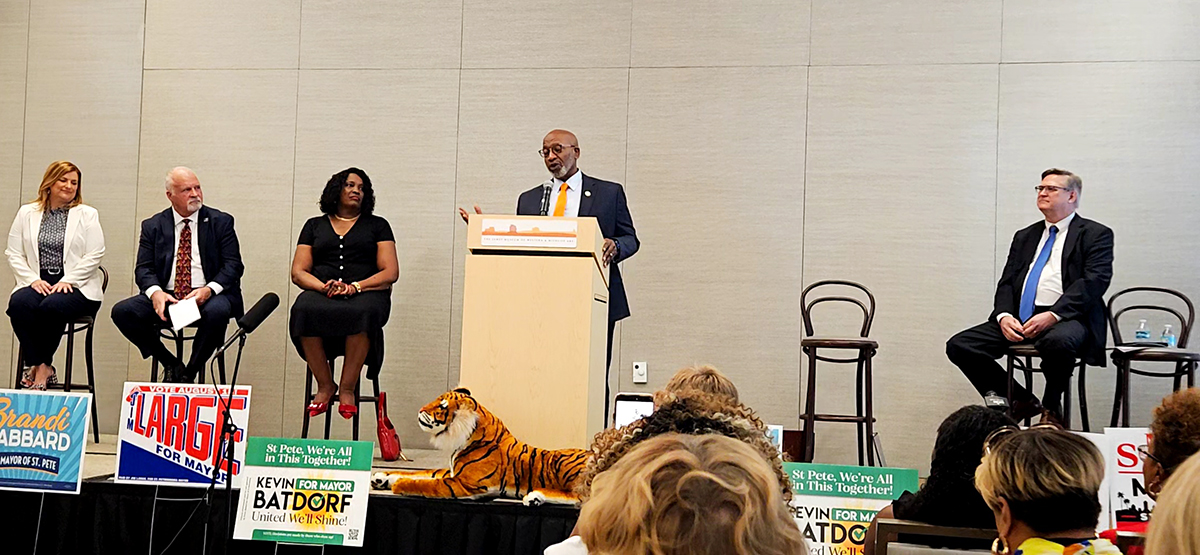
Suncoast Tiger Bay Club organizers saved Charlie Crist a seat at Tuesday night’s St. Petersburg mayoral forum.
It stayed empty.
Crist declined Tiger Bay’s invitation, citing affordability concerns over the $25 admission charge for club members and the $35 charge for nonmembers. His campaign instead hosted a free tele-town hall, and later announced in a news release that more than 7,500 people participated.
“It’s a privilege to be with you today for free,” Crist said during a town hall. “We think that’s very important to make sure that democracy is available to every voter without having to pay an entry fee in order to have a town hall, so that’s why we’re here. We’re honored to have you.”
But competing candidates weren’t moved by the explanation. Businessman Kevin Batdorf eventually used the empty chair reserved for Crist as a makeshift table for his extra water bottles, a visual that came to represent one of the night’s central storylines.

The five candidates who appeared at the sold-out Tiger Bay forum questioned his proposed property-tax cut, hurricane messaging, campaign finances and connection to St. Petersburg.
Crist’s absence became an explicit part of the forum when a Tiger Bay member asked each candidate what they would say to the former Governor if he were sitting in the empty chair.
Tiger Bay organizers, who have close ties to incumbent Mayor Ken Welch, responded to his absence at the outset of the forum by noting that the admission charge covered the meal served at the event and that all six candidates had been invited to attend.
Crist used his tele-town hall to reiterate his proposal to reduce St. Petersburg’s property-tax rate by 0.4 mills, which he estimates would return approximately $15 million annually to property owners. He also criticized City Hall over flooded streets, aging infrastructure, the response to hurricanes Helene and Milton and reports from residents who received unusually high water bills.
Those same criticisms became ammunition for his opponents at Tiger Bay.

With cash on his side, Crist has a target
Welch said Crist has not explained how he would absorb the proposed tax reduction without affecting city services.
“If you’re going to cut $15 million, what will you cut?” Welch asked. “It’ll be the arts. It’ll be neighborhood safety. It’ll be social services. It’ll be homeless programs.”
Welch said the reductions could affect neighborhood safety initiatives, social services, homelessness programs and other expenses funded through discretionary revenue.
He also questioned Crist’s involvement in recent local debates over housing, hurricane recovery and the redevelopment of Tropicana Field and the Historic Gas Plant District.
“Everyone on this stage has had involvement in this community speaking to those issues,” Welch said. “He has not.”
Welch also criticized Crist for failing to respond to a recent social media allegation involving Welch and a city employee.
Welch said Florida Politics Publisher Peter Schorsch, whose wife manages a political committee backing Crist for St. Petersburg Mayor, had posted what Welch described as a false allegation about his conduct. Welch made a response video posted on social media and, at the forum, called the claim “a despicable lie.” He criticized Crist for remaining silent after the post.
“The way that someone runs their campaign is the way they will run the Mayor’s Office,” Welch said.
St. Petersburg City Council Member Brandi Gabbard said she and Welch disagree on many issues but agrees that the race’s increasingly personal tone has crossed a line.
Gabbard focused on Crist’s recent criticism of the city’s hurricane response. Her District includes neighborhoods that experienced widespread flooding and property damage during Helene and Milton.
She said residents continue to carry trauma from the storms and that city employees spent days and weeks working in damaged neighborhoods, sometimes while dealing with losses at their own homes.
“For someone to use their trauma as a political talking point, in my opinion, is despicable,” Gabbard said.
Recently retired Orange County corrections administrator Maria Scruggs questioned when Crist returned to St. Petersburg from Minnesota, where Crist had been temporarily living, according to reports. Scruggs argued the timing of his voter-registration change aligns closely with political deadlines for running for office.
Scruggs also criticized Crist for leaving a previous mayoral forum addressing the arts before it ended and then declining Tiger Bay’s invitation.
Batdorf focused on Crist’s campaign finances.
Batdorf questioned what large donors expect in return for their financial support.
“Why is Seminole Gaming giving you $50,000?” Batdorf asked.
Former St. Petersburg Fire Rescue Chief Jim Large took a less confrontational approach.
Large said he understood how political accusations affect candidates and their families, before joking about a Crist campaign video showing the former Governor canvassing in shorts. He also questioned Crist’s descriptions of his college football career.
Counter-programming
Meanwhile, Crist’s campaign used the tele-town hall to present a different viewpoint, focusing on affordability, public safety and basic municipal services. According to a campaign news release, he also fielded questions about hurricane recovery and the city’s controversial use of Flock cameras.
Crist was briefly joined by two prominent supporters, former Department of Juvenile Justice Secretary and former state Rep. Frank Peterman and state Sen. Darryl Rouson.
The former Governor argued that filling potholes, preventing street flooding and maintaining dependable police and fire services are priorities shared by Republicans, Democrats and independent voters. He also blamed the Welch administration for failing to resolve complaints from residents who have received water bills totaling hundreds or thousands of dollars more than expected.
“The fact that this is still going on tells me one thing: the administration is asleep at the switch,” Crist said about the water bills.
Crist also said the city could play a larger role in education, citing former Mayor Rick Baker’s efforts to engage the community in creating apprenticeships and other opportunities for young people.
“I was just driving around this afternoon, and the streets were flooded in Northeast St. Petersburg. That’s unacceptable. So, just getting the basics done, filling potholes, improving our infrastructure, making sure you’re safe and your family is safe with a good fire department, good police department that has our support and will have the Mayor’s support if I have the honor of winning this race,” Crist said.
“Those are the kind of things that I think are important to all of us, whether you’re a Republican, a Democrat, or an independent; everybody cares about those kinds of things. And I should add, a good education for our children. And ordinarily, you know, municipal offices don’t deal with education that much. But I learned from Mayor Baker that you were able to do it by getting the community involved in helping start apprenticeships for young people, things of that nature. So, it’s an all-across-the-board agenda of doing the right thing.”
Large scandal revisited
The Suncoast Tiger Bay forum’s other most confrontational moment was directed at Large.
A Tiger Bay member asked why Black employees and other minorities should trust Large’s leadership after workplace allegations involving racial discrimination and other inappropriate conduct during his time as Fire Chief.
Large disputed the premise that numerous claims had been made against him. He said the allegation came from a small group of employees responding to an anonymous city survey and that he provided information rebutting the claims during the ensuing review.
Welch himself placed Large on administrative leave in August 2023 before reinstating him later that month, and Welch eventually indicated that no credible evidence was found to indicate Large had violated city policy.
Large pointed to the diversity of employees hired during his nearly two decades leading the department and said he stood on his record as Chief.
“There is no culture of racism,” Large said.
More barbs
Welch defended his administration’s response to a first term marked by the COVID-19 pandemic, five hurricanes, the collapse of the Tampa Bay Rays stadium agreement and growing concern over St. Petersburg’s aging infrastructure.
He pointed to increased housing production, repairs to Tropicana Field and a proposed $600 million general obligation bond meant to fund water, wastewater, stormwater and flood-protection projects if approved by voters.
Gabbard again presented herself as an alternative to both Welch and Crist, arguing that residents have lost trust in City Hall and need an administration that places neighborhood concerns at the center of its decisions.
She said the city cannot simply build its way out of the affordability crisis and must also address utility costs, access to affordable food and transportation connecting residents to jobs.
Scruggs pitched her “people over politics” campaign as a break from developer-driven decision-making. She emphasized her 45 years working in the public sector and proposed transforming recreation centers into neighborhood opportunity zones that would provide services for children, families and seniors.
Large stressed his experience managing city departments and emergency responses, promising to bring accountability, transparency and decisive leadership to City Hall. He even reminisced about his early days working at City Hall, before St. Petersburg adopted a strong-mayor form of government in 1993.
“When we went to a strong Mayor form of government, that’s when we put politics in City Hall, and that’s when I see the problems actually started on a smaller scale,” Large said. “But where we are today is a result of that change.”
The Mahaffey, Trop site and Woodson
Batdorf argued the city should maximize the value of the Tropicana Field property and use the proceeds to address infrastructure needs. He proposed hiring independent consultants without ties to local development to determine the property’s highest and best use.
The candidates also addressed the uncertain future of the Mahaffey Theater, which the city began operating after its agreement with longtime operator Bill Edwards ended.
Gabbard called the waterfront theater a civic jewel but said operating it directly places an unreasonable burden on city staff. She supported eventually returning the theater to an experienced outside operator but said the city must first address deferred maintenance issues.
“I don’t want to set up a future partner for failure because we don’t have a plan for how we’re going to fix that capital asset,” Gabbard said.
Welch said the city attempted to extend its relationship with Edwards, but Edwards chose to end the agreement early.
He said the city has a capital plan addressing the theater’s roof, air-conditioning system and other deferred maintenance. The administration is also finalizing an agreement involving The Florida Orchestra that will eventually go before City Council.
Batdorf proposed finding an organization capable of booking performers at the Mahaffey, the Manhattan Casino and other city venues. He also said The Florida Orchestra should have its offices and programming based at the theater, then turned to Welch to ask that he press for the group to be renamed the “St. Petersburg Orchestra” as part of negotiations.
Scruggs called for collaboration among arts organizations and other stakeholders rather than leaving the Mahaffey’s future solely in City Hall’s hands.
Large said the theater is an important community asset and expressed confidence that the city would preserve it.
The candidates also addressed a question from Terri Lipsey Scott, executive director of the Woodson African American Museum of Florida, who asked how they would preserve and elevate African American history in St. Petersburg.
All five supported a permanent African American museum, though they differed on how it should fit into redevelopment of the Historic Gas Plant District.
Gabbard supported the placement of a world-class museum at the site but questioned whether the city should sell the land beneath it. Maintaining public ownership, she argued, could give the city greater ability to ensure future developers honor their commitments.
Scruggs supported establishing a museum dedicated to telling the stories of the African American residents who contributed to St. Petersburg’s growth. She said the city’s existing cultural institutions could become part of a museum row or arts-focused economic cluster.
Batdorf said an African American museum belongs in St. Petersburg but acknowledged he had not yet formed an opinion about its eventual location or structure.
Large said any redevelopment of the Gas Plant property should recognize the Black community displaced from the area and include the museum alongside the city’s other major cultural institutions.
Welch highlighted his administration’s selection of The Burg Bid redevelopment proposal, which includes at least $10 million for the Woodson museum.
He said his administration renamed the project from the Tropicana Field redevelopment to the Historic Gas Plant District to acknowledge the history of the community displaced from the property.
“The promise to the community wasn’t to sell the land for the highest price,” Welch said. “It was an inclusive opportunity for everyone moving forward.”
Welch closed with an argument that his re-election would allow the city to maintain momentum for The Burg Bid proposal after the Rays terminated their stadium agreement. Starting over with another redevelopment process, he said, could further delay the fulfillment of promises that have gone unfulfilled for decades.
The Aug. 18 Primary is now three weeks away. Mail voting is underway, while early voting begins Aug. 8 and continues through Aug. 15.
___
Ed. note: Michelle Todd Schorsch is the Chair of St. Pete Shines, a political committee backing Crist for St. Petersburg Mayor. Todd Schorsch is married to Peter Schorsch, the publisher of Florida Politics.