
Beth Reynolds walked from her home to the nearby Dollar General to buy a Diet Coke.
She planned to stand in the hot sun Saturday in St. Petersburg, possibly for hours.
The clerk pointed to Reynold’s camera and asked what she intendedto photograph.
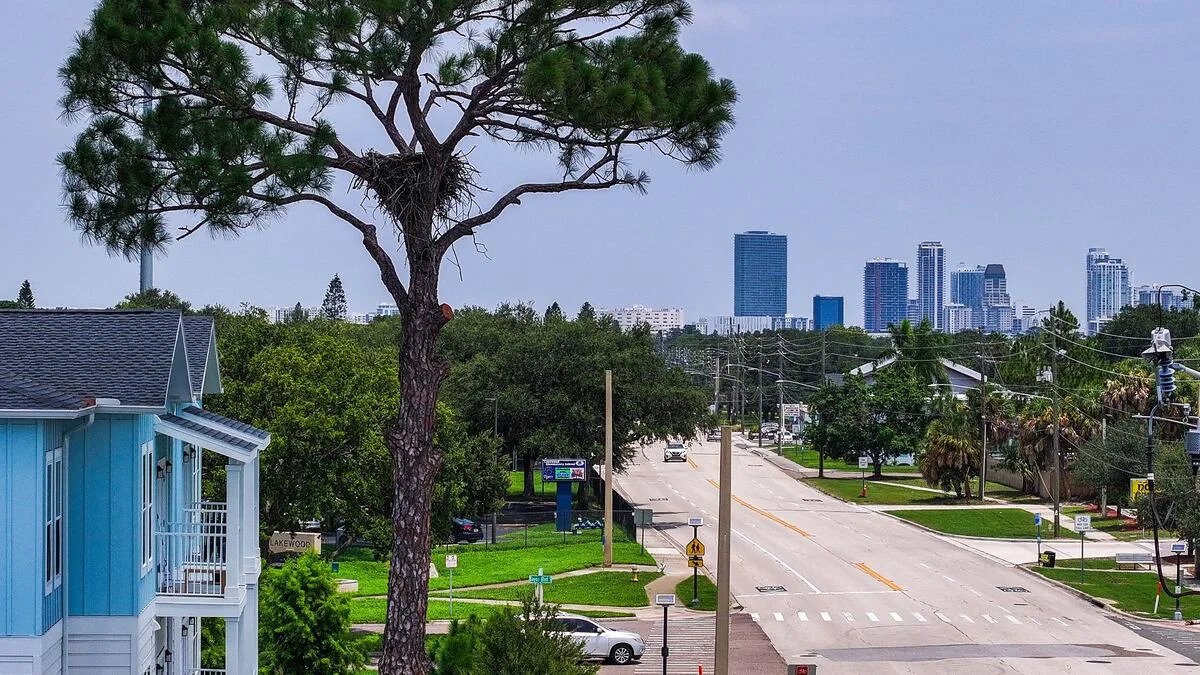
A nearby slash pine, visible from the store’s parking lot, she said. Workers were set to cut itdown that morning. And along with it, an intricately woven American bald eagle’s nest high in the tree’s needly canopy.
Reynolds planned to document it, to bear witness and collect data about the nest.
The clerk “unleashed a few obscenities,” Reynolds said. The clerk adored the tree and the pair of eagles that nested there from fall to spring.

Bayou Court Apartments, an affordable housing complex near Lake Maggiore, had told Reynolds thatthe tree was too unhealthy to remain. At 9 a.m. Saturday, armed with a federal permit and a saw, workers started cutting intothe tree.
“The sound of the chainsaw was just like a knife in your heart,” Reynolds said.
The branches fell away, one by one, until the slash pine resembled a cotton swab.
But soon, the whirring of power tools and snapping of branches stopped. Workers had hit a snag.
The eagles nest was untouched. Reynolds questioned how long it would stay that way.

The apartment complex’s managers appeared steadfast in their decision right up until the tree was set to fall.
“Public safety is our top priority, and the removal of this tree was a necessary and highly regulated response to an imminent hazard,” wroteTyler Herbert, a founding partner of Gravel Road Partners, which oversees Bayou Court Apartments, in an email to the Tampa Bay Times at 10 a.m. Saturday.
The Timesreported about the slash pine’s impending removal on Friday. The story garnered hundreds of comments on social media. Many peoplequestioned the tree’s removal.
Herbert said the company had commissioned two risk assessments from independent arborists that both concluded the slash pine was “severely structurally compromised” after recent hurricanes and an infestation of pine beetles.
Leaving the tree in place “was not an option,” he wrote to the Times.
When Reynolds arrived to watch the tree’s demise, she thought the arborists were ill-prepared. They had a chainsaw to cut through the tree’s thick belly and a bucket truck that was too short to reach the pine’s full height.
Reynolds is an Audubon Eaglewatch volunteer. She has watched mated eagles work to build their nest and raise their young in the tree each nesting season. The eagles have been in the area for at least a decade, and previously nested in a nearby spot.
The eagles left before this summer, but they typically return in the fall.
Three other women, including another Eaglewatch volunteer, stood vigil for hours. They sweat. Guzzled water. Shared turkey and cheese sandwiches. Kept their eyes trained on the tree.

As the afternoon rolled around, the arborists stopped.
“It was a weird feeling, because emotionally, I was prepared for them to take the whole tree down and deal with that whole bit of emotional turmoil about it coming down,” Reynolds said.
“And now, here they stopped.”
By Monday, Gravel Road Partners, which overseesthe apartment had a change of heart.
In an email to Audubon’s eagle advocates, shared with the Times, Herbert told the group that the tree’s removal had been paused.
“We will only take action if and when the risk of the tree falling crosses an unacceptable threshold for the safety and lives of our residents and pedestrians,” he laterconfirmed in an email to the Times. “Until that life-safety line is crossed, the tree and the eagles will remain undisturbed.”

Herbert and his partner’s decision to keep the tree came after an arborist confirmed the canopy was still healthy.
“As a native Floridian, our definitive goal is to preserve this tree and the nest. We adore the wildlife here,” Herbert wrote in an email to the Times.
Before the latest controversy,the birds of prey had been adopted as a symbol of the complex. The apartment’s logo is an eagle, an homage to the couple. Herbert and apartment staff had also named the recent eaglets Pork Chop and Lamb Chop, Herbert said in a phone call with the Times.
The property owners still have the option to cut down the tree if it becomes too dangerous. They have extended their federal permit for a year, Herbert said.
Reynolds is relieved but callsthe reversal “backpedaling.”
“I have to believe that it’s because of the public outcry,” she said. “And that gave me this little sense of justice.”
Herbert said he and his business partner understood the public’s response, which mirrored their own internal battles about the decision.
“It was clear that we weren’t alone in that, and that other people really cared about it,” hesaid.

Across the country, tightened conservation measures in recent decades have helped the population of nesting eagles rebound: In 1973, there were only 88 active nesting pairs in Florida, according to the state’s wildlife agency. A half century later, biologists counted 1,488 nests across the state.
The decision atthe apartment complex is the latest in a series of reversals across Pinellas.
Last month, Safety Harbor relocated its July 4 fireworks show after bird advocates raised concerns over the blasts’ proximity to key nesting islands for protected species.
And in 2023, the Clearwater Threshers canceled a fireworks show that would have likely disrupted baby eagle chicks nesting in a cell tower across the street.

“This is wonderful news,” said Jack Davis, a Pulitzer Prize-winning author and University of Florida professor who in 2022 published a book on the history of America’s bird.
“Nesting bald eagles add to the value of real estate,” Davis wrote to the Times in an email. “Not only do they add a wow factor to the property; people love and admire bald eagles, now our national bird, recognizing that their domestic commitments mirror our own ideals.”
Reynolds is confident the eagles will return to their nest, even if the tree is shaved down. They’ll do what they always do, she said.
Assess the nest, grab some more branches and get to work.
• • •
The Tampa Bay Times launched the Environment Hub in 2025 to focus on some of Florida’s most urgent and enduring challenges. You can contribute through our journalism fund by clicking here