
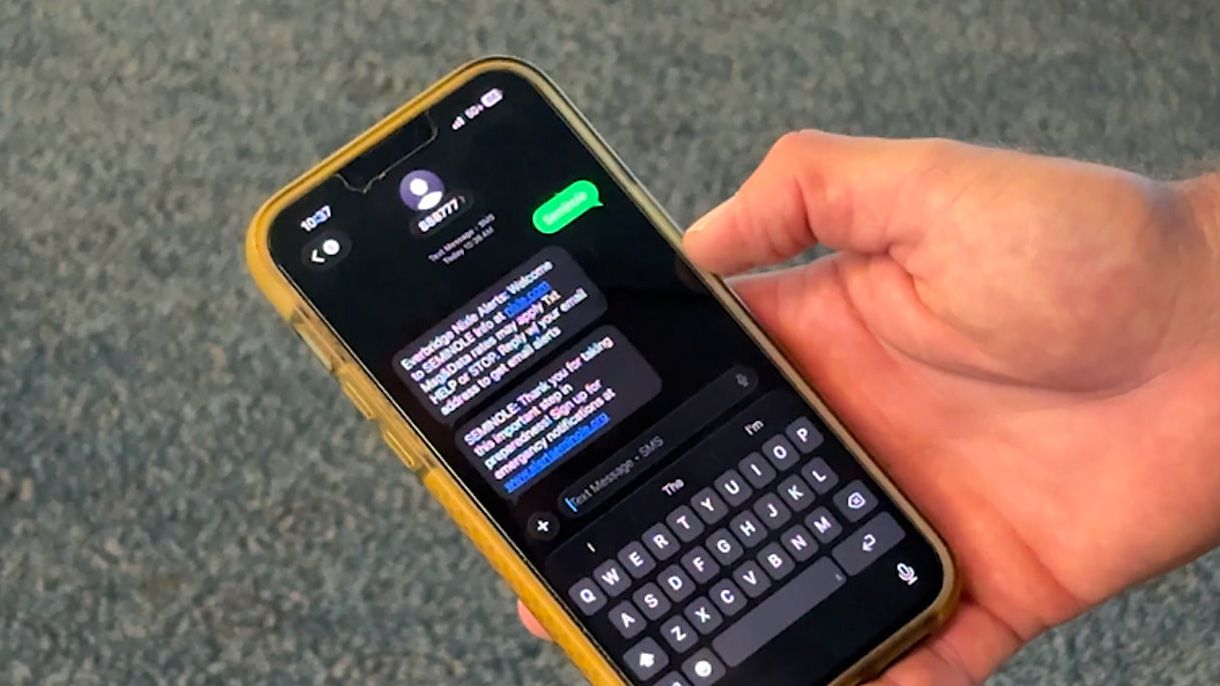
Central Florida counties use opt-in alert systems to send public safety information directly to residents, but registration rates vary widely across Orange, Osceola and Seminole counties.
The county systems are separate from Wireless Emergency Alerts that can appear on cellphones for life-threatening emergencies, such as an Amber Alert. County systems require residents to register before they can receive alerts.
Emergency Alert Systems in Central Florida
In Orange County, 105,000 users are registered for OCFL Alert. Based on the county’s population of about 1.4 million in the 2020 census, about 7% of residents receive those alerts.
Osceola County has just under 20,000 people registered for Alert Osceola, or about 5% of the county.
Seminole County has more than 229,000 people registered for Alert Seminole, which is nearly 48% of county residents.
“This is the only way that government can communicate back with our community directly,” Seminole County Emergency Manager Alan Harris said.
Harris said the alerts can cover public safety concerns like hurricanes, green algae in lakes, hazardous spills and boil-water notices.
“Anything that the public would need to know may be a public safety concern,” Harris said.
The alerts can also be targeted to specific locations rather than sent countywide. Harris said Seminole County draws a map around an affected area and sends alerts only to people within that map.
“These are very geolocated,” Harris said.
Some Central Florida residents said they are already signed up, while others said they had not heard of the system.
“It does make me feel safe, that is for sure,” said Seminole County resident Jorge Moreno.
June Kemp, who lives in Orange County, said she finds the alerts useful.
“I think it is helpful,” Kemp said. “I think any alerts are helpful, if you ask me.”
Others were not registered and did not even know the county offered an alert system.
“This is the first I am hearing about it,” said Seminole County resident Noah Jackson.
Besides the county alerts, Harris said residents should also check their phone settings to make sure Wireless Emergency Alerts are enabled.
“Very important to keep that open, because there is not going to be a lot of them,” Harris said. “When you do get an alert like that, you want to receive that type of alert.”