
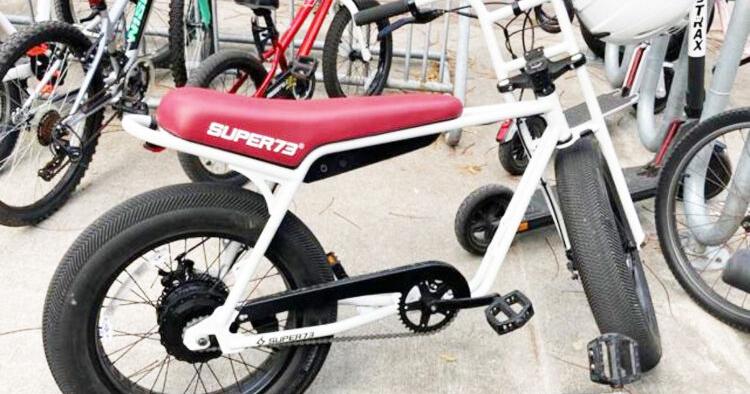
Miami-Dade commissioners have renewed Key Biscayne’s authority to enforce strict e-bike and scooter regulations along Crandon Boulevard through July 31, 2028, preserving rules adopted after two fatal crashes intensified the Village’s concerns about micro-mobility safety.
The Board of County Commissioners unanimously approved a new interlocal agreement during their meeting last week, allowing Key Biscayne police officers to continue issuing citations for violations on the county-owned roadway running through the Village.
“I am pleased to see the ILA passed and renewed,” Key Biscayne Police Chief Frank Sousa told Islander News. “The renewal keeps regulations in place.”
Key Biscayne banned all micro-mobility forms of transportation within the Village boundaries following a tragic accident in February 2024. The interlocal agreement specifies that only Class-1 e-bikes, and/or motorized scooters, are allowed within the bike lane of Crandon Boulevard, which runs through the heart of the Village.
“The ILA does allow (our) officers to issue citations,” Sousa said.

Key Biscayne Police Chief Frank Sousa.
Photo courtesy of VKB
Commissioners also took the e-bike safety measure a step further during last week’s 10-hour Commission meeting, unanimously approving an ordinance to limit electric bikes and motorized scooters to 20 mph, not on sidewalks, specifically on the stretch of the higher-speed Rickenbacker Causeway leading into Key Biscayne.
That measure likely opens the door for other Miami-Dade cities, even the unincorporated areas, to sort of “opt in” to the interlocal agreement the Village has in place.
Lengthy discussion and a valid explanation from Commissioner Raquel Regalado tabled that idea until a different interlocal agreement ordinance that would include public meetings, input, and more dedicated regulations, fines and speeds dedicated to each participating municipality could be written.
“I am happy to draft an ordinance for cities to opt in, but it needs to have a lot of things that are not in this ordinance because this ordinance came after two years of working with Key Biscayne,” Regalado said.
Commissioner Raquel Regalado.
Commissioner Micky Steinberg brought the item for discussion, saying it was only her intent to avoid voting on an interlocal agreement for each of the other 33 incorporated municipalities if they wanted to enforce e-bike regulations on county-owned roads within their boundaries and, instead, use a simplified blanket-type coverage in which they could “opt-in.”
“This is a model for what they should be doing,” Steinberg said of the Village’s agreement, which calls for $250 and $500 fines.
“I appreciate that,” Regalado said. “This ordinance was a lot of work. As many of you know, we were waiting for the state to really regulate it, this was done as a placeholder (for state regulation) … unfortunately, the Governor vetoed (it).
“We had over a dozen meetings in Key Biscayne to make sure everybody understood this. … As many of you know, I’m a big supporter of micro-mobility, but on Feb. 14, 2024, we had Megan Andrews (who) died in Key Biscayne because of an accident. She was 66. She was killed by a 12-year-old on an e-bike. And then Aug. 15, 2025, we had Fabian Moses, 54, killed by a 14-year-old on an e-bike. So this is a big issue for Key Biscayne and not something we went into lightly.”
The late Megan Andrews.
Regalado said she didn’t want to amend the ordinance Steinberg supported because what works for Key Biscayne with a “highway” (how she described the Rickenbacker Causeway), the parameters would not be the same in other locales.
“I would tell you to bring your own items and refer to this, but to have the public meeting so you can inform everyone on the breadth of this,” Regalado said. “We landed on this with collaboration with Key Biscayne and this (ILA) is an extension of what’s already existing, so I don’t want to just add other cities without them going through the work.”
Steinberg said her motion was “just giving the mechanism for another city to enter into an interlocal with the County so they can also avail themselves of the good work that’s been done with this ordinance … nothing to do with changing the ordinance.”
Regalado said she would be happy to work with Steinberg to write a separate ordinance, but the Village’s deal was specific.
Commissioner Micky Steinberg.
(Facebook / Micky Steinberg)
“This is about the Rickenbacker, which is unique as a street, so the speeds on the Rickenbacker are very, very different from other County-owned streets,” she said. “So I would say it would be better to do something separately for other County-owned streets because Rickenbacker is a highway. It’s very particular to what it (ILA) was created for.”
Former State Rep., and now Miami-Dade Commissioner, Vicki Lopez said while she was in Tallahassee, she did pass legislation at the state level that allowed for local governments to regulate micro-mobility devices, “and that is part of statute now,” she said, adding that it was amended into the transportation bill that passed.
“What Commissioner Regalado is saying is true, she and I both worked very hard because the Village of Key Biscayne has banned micro-mobility devices on their roads,” Lopez said. “The one she is referring to is Crandon Boulevard and so this is so specific to Key Biscayne.”
She added that any municipality wanting to expand their own e-bike regulations can do so.
“Commissioner Steinberg and I share Miami Beach and they are looking to expand the state statute in this coming session so, hopefully, that will be something we can work towards,” Lopez said.
Other cities and districts throughout Florida also have been tweaking and tightening their own regulations.
Sunny Isles Beach, for example, recently enacted regulations banning e-bikes and scooters from sidewalks and requiring riders to be at least 16 years old.
On Tuesday (July 28), the Orange County School Board in Orlando is moving forward with a vote that would bar elementary, middle school and high school students without a driver’s license from bringing e-bikes and e-scooters onto school property.
Sousa was asked if he would be in favor of such an option if it presented itself in the Village.
“We work at the will of the Council,” he said. “Our elected officials have made it clear they continue to support the ban.”