
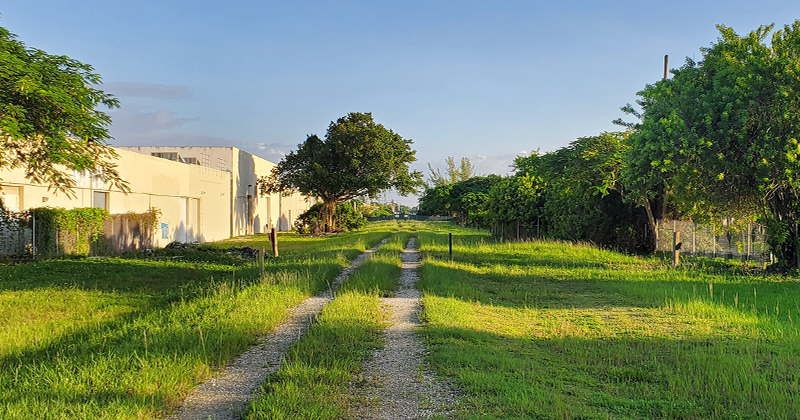
Miami-Dade County is moving the entire 5.6-mile Ludlam Trail into final design, even though funding has not yet been assembled to build the complete pedestrian and bicycle corridor.
The approach could offer a lesson for another ambitious mobility and recreational proposal: the planned Rickenbacker Shoreline connecting Miami with Key Biscayne and Bill Baggs Cape Florida State Park.
Last week, County commissioners approved a professional services agreement with Kimley-Horn and Associates to design the Ludlam Trail from SW 80th Street to approximately NW Seventh Street.
In a video posted on social media after the vote, Mayor Daniella Levine Cava called the approval “a significant milestone” and said the completed trail would transform a former railroad corridor into a public space connecting neighborhoods, parks, schools, businesses and transit.
The contract is valued at up to $9.53 million, including an $843,960 contingency, and has a five-year term, according to the commission item. Plans call for an 18-foot-wide shared-use trail for walking, running and bicycling, with landscaping, shade trees, lighting, seating, directional signs and connections to surrounding communities.
The county has secured nearly $48 million from multiple sources, including a recent $1.25 million state appropriation. Additional money will be needed before the entire corridor can be constructed.
Designing the full trail now will provide the county with construction documents for the complete corridor and strengthen future applications for transportation and infrastructure grants. It also positions individual portions to advance when money for those components becomes available.
That project-delivery strategy could be relevant to the Rickenbacker Shoreline, a proposed network of recreational, transportation and environmental improvements along the causeway leading to Key Biscayne.
Rather than waiting until sufficient money is available for every element of a large project, comprehensive design work can establish a unified vision while allowing construction to proceed in funded segments.
No county or Key Biscayne official has proposed applying the Ludlam Trail strategy to Shoreline. Still, Ludlam provides a nearby example of how a major linear public-space project can advance beyond conceptual planning before its complete construction budget is assembled.
The Ludlam Trail has been discussed for decades. Miami-Dade acquired the abandoned rail corridor in 2018 and subsequently completed environmental studies and developed plans to approximately 30% completion.
Public design meetings are anticipated later this year, giving residents and other stakeholders an opportunity to help refine the final plans. A construction schedule has not been announced.
Similar meetings regarding the Shoreline are also planned, with one “open house” stakeholders meeting held this month at Gramps Getaway and an earlier virtual town hall meeting hosted by District 7 County Commissioner Raquel Regalado.