
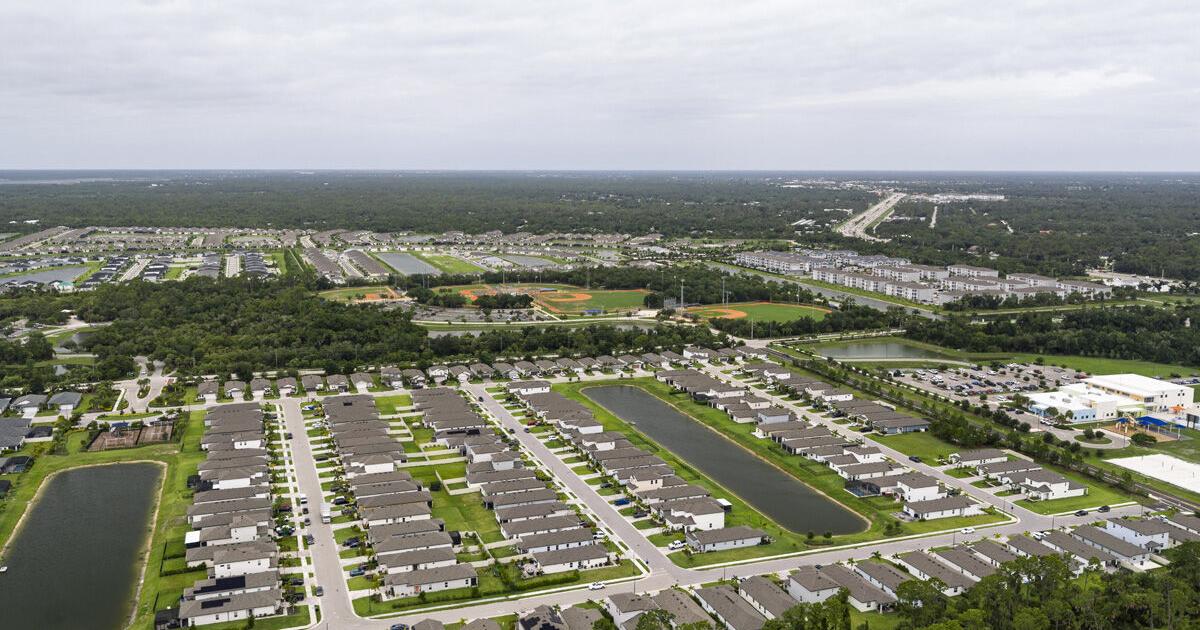

The West Port community in Port Charlotte is among the large residential developments driving Charlotte County’s population growth as officials plan new infrastructure, public services and economic development to meet future demand.
Brian Tietz
Charlotte County should reserve more land for commercial and industrial development to accommodate its growing population, consultant David Farmer told county commissioners during a long-range planning update July 28.
Farmer, CEO and co-founder of Metro Forecasting Models, said the county is projected to add more than 25,000 residents living in about 13,000 new housing units by 2030.
According to Farmer’s projections, Charlotte County has added about 50,000 residents since the 2020 U.S. Census.
“That’s more than a 25% growth rate in five years,” Farmer said.
That level of growth brings increased demand for public services and infrastructure, he said.
“When population increases by 50,000 in five years, the county will need two new parks, three new fire stations and three new neighborhood shopping centers,” he said.
Farmer noted one new fire station already is under construction but said rapid population growth often outpaces public services.
He emphasized the importance of neighborhood shopping centers, saying they provide residents with everyday services while reducing traffic congestion. Residents in some underserved parts of Charlotte County currently travel to Lee County or North Port for shopping and other needs.
“By 2030 we definitely will need three more neighborhood shopping centers, but we’ll also need three more community shopping centers,” Farmer said. He described community shopping centers as developments anchored by a 300,000- to 400,000-square-foot big-box retailer.

David Farmer, CEO and co-founder of Metro Forecasting Models, presented projections showing Charlotte County’s continued population growth and the need for additional commercial and industrial development during a July 28 workshop with county commissioners.
Brian Tietz
However, he said Charlotte County is unlikely to see that type of development within the next five to 10 years because so much available land is being used for residential construction.
As one solution, Farmer suggested the county acquire vacant lots and assemble them into developable 6- to 8-acre parcels. Those projects would improve residents’ quality of life while expanding the county’s tax base, he said.
Locating shopping centers closer to neighborhoods would reduce travel time, greenhouse gas emissions, vehicle miles traveled and road congestion while keeping more tax dollars within Charlotte County and potentially avoiding costly road-widening projects in the future.
Although growth has slowed from its peak of about 5,500 residential permits issued annually, the county still is averaging about 3,300 permits a year.
The study divided Charlotte County into 353 zones and six geographic clusters: Mid, Punta Gorda, Burnt Store Road, Babcock Ranch, East and West.
Growth needs vary by area, Farmer said. He called Babcock Ranch the county’s “poster child” because of its master-planned design, contrasting it with older parts of the county that developed rapidly during the late 1950s and 1960s.
Commission Chair Joe Tiseo noted that early developers sold small lots with financing plans requiring just $10 down and $10 a month. While much of Charlotte County was not master planned, he said, more recent developments have been better designed.
The Willow Community off Tucker’s Grade is among the residential developments reshaping Charlotte County as rapid population growth drives demand for new housing, infrastructure, public services and economic development.
Brian Tietz
Farmer said the Mid cluster is the county’s fastest-growing area and still has significant room for development.
“It has a large appetite for services and a lot of vacant lots,” he said. “This area is not even close to buildout.”
The Mid cluster alone will need four additional neighborhood shopping centers, comparable to Publix-anchored developments, beyond those already operating there, Farmer said.
Maps and projections presented during the meeting show where the county expects most growth through 2030. About 42% of new residents are projected to live in Babcock Ranch, followed by 21% in the West Port area of the Mid cluster, 14% in the Rotonda area of the West cluster and 9% along the Burnt Store Road corridor.
Punta Gorda is expected to grow more slowly because of its smaller size, but the study found it already has a strong supply of shopping opportunities.
Farmer also said Charlotte County needs more industrial development to create jobs and strengthen the local economy, in addition to expanding commercial development where demand is increasing.
He also noted the proposed 20-year extension of Charlotte County’s 1% local-option sales tax, which voters will consider in the Nov. 3 general election. The tax helps fund capital improvement projects throughout the county, and the referendum’s outcome could affect future infrastructure investments.