

Oliver Larkin supports tuition-free college, abolishing ICE, Medicare for All, and ending U.S. aid to Israel. He’s a democratic socialist inspired to get involved in politics by progressive icon U.S. Sen. Bernie Sanders.
And he’s running for Congress in South Florida — where the term “socialist” is toxic to many voters — in territory that President Donald Trump won in 2024.
Larkin’s Democratic primary challenge to U.S. Rep. Jared Moskowitz, who is seeking a third term, is seen by many as a long shot, as even some supporters acknowledge.
But Larkin has generated an enthusiastic following, both online and in real life, from people who want big changes. Some have been energized enough to hit the streets campaigning on his behalf.
And they’ve been buoyed by recent high-profile primary victories in other states by candidates who, like Larkin, have been endorsed by Democratic Socialists of America and gone on to defeat more establishment-oriented, centrist Democrats — like Moskowitz.
“Jared has the money, but I would say Oliver has the many,” said Paul Smailis, one of about 75 people who attended a recent Larkin town hall in Dania Beach.
He first learned about Larkin online. Smailis has gone out canvassing, which is knocking on doors of registered Democrats to pitch his candidate, and expects to do more plus phone banking in the lead-up to the Aug. 18 primary.
A lifelong Floridian, Smailis, 37, considers himself “very tapped in politically” but hasn’t ever canvassed for a candidate before. “It feels good to actually put yourself out there and fight for something you actually believe in,” he said, explaining he wants to change Florida. “It’s been kind of just overwhelmingly red and Republican, so this is the movement I can get myself behind.”
And, like other Larkin supporters, he’s turned off by what he’s heard about the congressman. “I’m not a big fan of Moskowitz,” Smailis said. “He’s a little too close to (Republican Gov. Ron) DeSantis for me. He’s a little too conservative.”
Who is Larkin?
In news interviews, town hall appearances and candidate forums, Larkin sells himself as a candidate who can change the status quo.
Winning, he said, “could change the course of American politics” and show “you can stand on both progressive values and win in any district in the country. It will send shock waves across the United States of America.”
Larkin, 34, who in June changed his registration to vote from Broward to Palm Beach County, has lived in South Florida for essentially his entire life. He said his family moved to Fort Lauderdale when he was 4.
His upbringing doesn’t immediately conjure up the image of “democratic socialist.” Larkin attended the exclusive Pine Crest School in Fort Lauderdale through ninth grade and finished high school at the elite Phillips Exeter Academy in New Hampshire. Larkin has a bachelor’s degree from Sewanee: The University of the South, where he majored in English, minored in history, and received a certificate in creative writing.
After graduating from college with student loan debt in 2015, he said he was working at a minimum-wage job as a restaurant line cook when he felt inspired by Sanders, the independent senator from Vermont who was seeking the Democratic Party’s presidential nomination.
Larkin quit his job, drove to New Hampshire to volunteer for the Sanders campaign, and said he became a paid staffer in six states. “He got me to see the possibility in a participatory democracy.”
Since then, Larkin has been a political organizer and a communication and marketing strategist. At one job, he organized a union.
In July 2025, he announced he was challenging Moskowitz in a different congressional district, before Republicans who control state government radically changed the contours of most districts in South Florida. After the boundaries changed, Moskowitz and Larkin both switched to the new 25th Congressional District, which includes about half the territory the incumbent congressman has been representing.
On the issues
Larkin described some of his positions as “morality-based policies that I think most people regardless of political party agree with.” Much of his platform includes policies progressives love, centrist Democrats are wary of, and Republicans reject.
Example: He favors a universal health care system covered by the government, which goes by the name Medicare for All. He wants Medicare expanded to vision, hearing, dental, mental health and reproductive health care “with no premiums, deductibles or copays. Other countries are able to do it. We can do it here in the United States.”
At public appearances, news interviews and in answers to a questionnaire, Larkin has outlined his views on a range of issues.
Beyond healthcare, Larkin supports paid family and medical leave, free tuition at public universities, and implementing 18-year term limits for Supreme Court justices and expanding the court to 13 justices.
He also wants a moratorium on construction of new AI data centers due to concerns over water usage and utility rates, and supports abolishing ICE, the immigration agency that has become hugely controversial for its enforcement tactics under Trump.
Larkin supports an end to fossil fuel extraction and production, said he is “rather skeptical of nuclear energy,” wants more solar energy, and favors “more public ownership of utilities.”
The candidate supports efforts to promote diversity, equity and inclusion, and wants to pass federal laws banning discrimination against LGBTQ+ people and expanding healthcare coverage for transgender individuals. “When I think of DEI, I just think of common respect and decency for everyone in our society, that’s all.”
If he is elected and Democrats take control of the House, Larkin said he would vote to impeach Trump.
On Moskowitz
The campaign isn’t just about motivating volunteers and prospective voters with progressive policy ideas. It also offers a heavy dose of Moskowitz criticism.
In a TV and streaming ad Larkin released Monday, he used some of its 30 seconds to tell viewers that “politicians like Jared Moskowitz sold us out just to cash a campaign check” from a political action committee. It also shows a video clip of Moskowitz saying “I’m a twice-appointed Ron DeSantis Democrat.”
His central critique is that the congressman votes too often with Republicans, and is too aligned with corporate interests and too accommodating to Israel’s foreign policy interests.
Larkin has repeatedly criticized Moskowitz for voting for the Laken Riley Act. He was the only Florida Democrat, and one of 46 in the House, who voted with the Republican majority in favor of the first bill signed into law by Trump during his second term. It was named after a Georgia nursing student who was murdered by an undocumented immigrant last year while she was jogging. The law requires detention of undocumented immigrants charged with crimes, including nonviolent burglary, theft or shoplifting.
Larkin repeatedly chides Moskowitz for what he says is an inadequate presence in the district.
“Where’s he at? Where’s our congressman?” he asked Monday at an event held by the Black Democratic caucuses of Broward and Miami-Dade counties. “I went on Fox News last week thinking I might find him there because he seems more comfortable on Fox News than he is in the 25th District.”
Moskowitz won’t share a venue with Larkin — even though it gives the challenger a talking-point to accuse Moskowitz of ducking debates. The Moskowitz camp asserts it would be wrong to give a platform to someone who has some prominent antisemitic supporters. Larkin said he doesn’t tolerate antisemitism in his campaign.
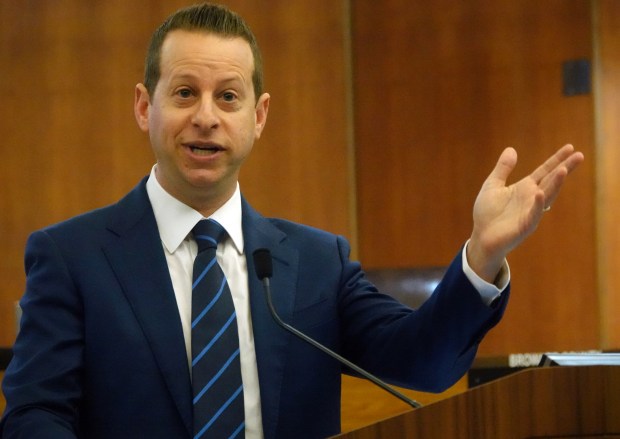 U.S. Rep. Jared Moskowitz is seeking a third term in the South Florida 25th Congressional District. (Joe Cavaretta/South Florida Sun Sentinel)
Moskowitz campaign
Moskowitz is treating Larkin as more of an annoyance than a significant threat, but isn’t completely ignoring him. Though Moskowitz is holding onto most of his campaign money for an expected bruising fall campaign — national Republicans and Democrats have targeted the district — he is advertising.
In one of the spots, he highlights his votes against Trump’s most controversial policies and depicts himself as an effective fighter who will “hit back.” In another, the narrator explains, “Moskowitz isn’t just a Democrat who fights, he’s a Democrat who wins.”
“South Florida sent me to Washington to fight for them and get things done,” he said in a written statement Wednesday. “From making schools safer after Parkland to standing up to a corrupt administration in Washington, I’ve always believed this job is about delivering results for the people you represent. I’m going to keep fighting for South Florida every single day.”
Larkin’s central criticism, a willingness to work with Republicans, has been a Moskowitz selling point, and allowed him to score some legislative achievements during his political career. “I have never hesitated to work with anyone across the aisle if I think it’ll improve the lives of my constituents,” he said when announcing he’d run for reelection.
Before he was elected to Congress in 2022, Moskowitz was a state representative and a Parkland city commissioner. He was DeSantis’ first state emergency management director and the governor later appointed him to fill a vacancy on the Broward County Commission.
 Congressional candidate Oliver Larkin, a democratic socialist running against U.S. Rep. Jared Moskowitz for the 2026 Democratic nomination in South Florida’s 25th Congressional meeting, holds a town hall meeting at MAD Arts in Dania Beach on July 23, 2026. (Anthony Man/South Florida Sun Sentinel)
Will it sell in Florida?
Democratic socialists have had some headline-grabbing recent primary victories in New York and Colorado, and Democratic Socialists of America posted on social media that the Larkin-Moskowitz contest was next on their agenda. “The movement moves from New York to Colorado to FLORIDA!”
A nationwide CNN poll, conducted by SSRS and released Thursday, shows 34% of Democrats and Democratic-leaning adults identify as democratic socialists. They are much more likely to be younger than 45 and say they’re much more motivated to vote this year.
“I think the energy that we’re seeing with DSA candidates all across the country, and certainly with our campaign, is really bringing young people and people who feel politically disenchanted into the process,” Larkin said.
Others are skeptical that can produce a primary win. The 25th Congressional District, which runs along the Atlantic coast from Delray Beach to Miami Beach, is far different from the districts that have seen democratic socialist victories. Its voters tend to be older than the younger voters who have embraced democratic socialism.
“I don’t think that the democratic socialist message is breaking through in Florida like it is elsewhere in the country,” said Sean Foreman, a Barry University political scientist.
One reason, Foreman said, is that Florida’s economy, though uneven, has been booming in recent years. “I think that deters some of the criticism from democratic socialists.”
Another, he said, is that Florida has been heading in a more rightward direction in recent years. “Florida was a purple state that’s becoming more red on a variety of issues, and so those messages just don’t have a wide audience here.”
Foreman and Alfredo Olvera, president of the Dolphin Democrats, a large LGBTQ+ political club in Broward, said the very name socialist is a tough sell, especially among Hispanic voters. “We have so many immigrants from countries where there were failed socialist experiments. That personal experience matters,” Foreman said.
Larkin said his brand of democratic socialism is something different. “What being a democratic socialist means to me is having a government that is democratically operated.”
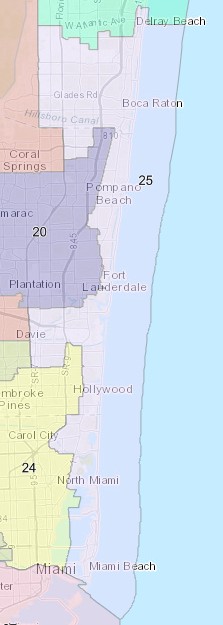 The 25th Congressional District, created in the 2026 Florida special redistricting, takes in parts of coastal Broward, Palm Beach and Miami-Dade counties. It stretches from Delray Beach south to Miami Beach. (Florida Senate/courtesy)
Supporters
Pamela Hanrahan, of Hollywood, said she saw Larkin for the first time at the Dania Beach town hall.
“It was great,” she said. “I think he shares a lot of important beliefs that we should all have. … You can tell just by the way he thoughtfully answers everything that he really is motivated about fulfilling what he says.”
The July 23 town hall attracted about 75 people, including campaign staffers, in a range of ages. Two days later, a similar number of people gathered in Fort Lauderdale for a rally and a day of canvassing.
Foreman said he wasn’t discounting the people who show up. “If you’re going to get people to show up for an alternative message, they must be searching for something other than the status quo,” he said, “but you don’t have a wide group of people.”
“I can see him getting 70, 80 very committed people there. But I don’t know that they’re going to be able to convert thousands of voters to this message,” Foreman said. “I don’t think they’re enough to flip any seats in Florida.”
Olvera said he’s seen a lot of pro-Larkin activity on social media. “I see people posting, I see a lot of friends of mine who have liked the posts. I don’t know how that translates into actual voters. There is what social media is telling you, and what the voters are actually thinking.”
 Supporters of congressional candidate Oliver Larkin, a democratic socialist running in 2026 Democratic nomination in South Florida’s 25th Congressional meeting, created digital graffiti showing support for the candidate at a town hall meeting at MAD Arts in Dania Beach on July 23, 2026. (Anthony Man/South Florida Sun Sentinel)
Familiar look
For anyone who follows politics — especially progressives and people with an interest in New York — something seems familiar about Larkin.
He reminds some people of Zohran Mamdani, the democratic socialist who rocked the political establishment when he won the Democratic primary for mayor of New York in June 2025 and the general election in November despite opposition from establishment Democratic Party leaders and the city’s business and financial interests.
Larkin said he’s heard the comparison before, “and I take it as a compliment.” But, he added via email, “I’m running my own campaign for South Florida. I arrived at my politics over a decade ago, informed by a lifetime growing up in our community. The issues here are unique, and my job is to represent the people of this district.”
The comparison goes beyond the democratic socialists’ policy positions. Larkin and Mamdani are both 34. Both have dark hair and sport closely cropped beards. And both (Mamdani always; Larkin often) wear the same thing: a dark suit, white shirt and dark tie.
Melissa Mills said she has been “frustrated with Florida Democrats” for years, but likes Larkin after seeing and hearing him.
“I’m impressed with him, very much so,” Mills said, adding Larkin came across as “genuine, authentic.”
She’d never seen him before the Dania Beach town hall, but was so impressed by what she heard that she took to social media to post that she’d “found a progressive congressional candidate to support,” adding, “And yeah, he’s DSA.”
Larkin, Mills said, is “like the Miami Mamdani.”
Political writer Anthony Man can be reached at aman@sunsentinel.com and can be found @browardpolitics on Bluesky, Threads, Facebook and Mastodon.